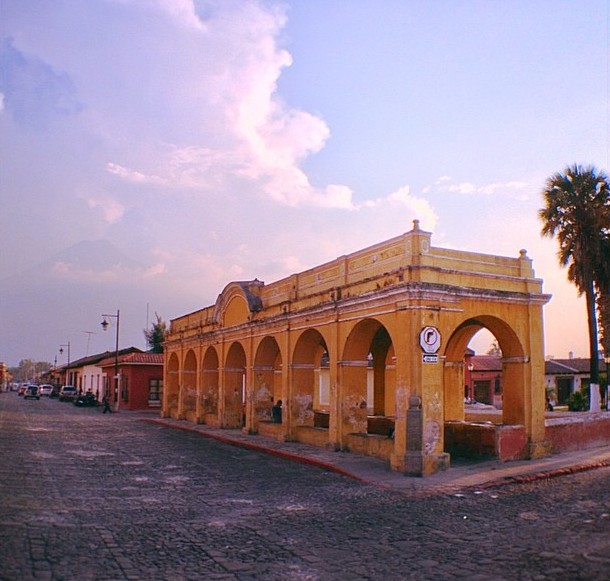
 Photo Wikimedia Commons
Contents
History & cultureBY TELLBY7 sections · numbered as on the map01 Orientation
Located in the southwestern reaches of the serene Panchoy Valley in Antigua Guatemala, San Bartolomé Becerra serves as a vital sanctuary of Catholic pilgrimage traditions and sacred art that have endured uninterrupted since the Spanish colonial era. Representing an essential component of the Antigua Guatemala historical district designated as a UNESCO World Heritage site in nineteen seventy nine, this historic community embodies deep religious symbolism and civic resilience that have successfully weathered centuries of catastrophic earthquakes and urban relocations. When Spanish conquistadors and religious orders established the new capital in the Panchoy Valley during the mid sixteenth century, surrounding indigenous villages and settlement areas were systematically integrated into a unified administrative and spiritual network. Among these peripheral communities, San Bartolomé Becerra attained an outstanding reputation specifically for its solemn Lenten processions and remarkable devotional craftsmanship.
This location shares its historical trajectory with the broader Panchoy Valley, which was selected as the third capital site following the catastrophic volcanic mudslide from the Volcán de Agua that obliterated the previous settlement in the Almolonga Valley in fifteen forty one. Ever since the formal establishment of Santiago de los Caballeros in fifteen forty three, the capital functioned as the administrative seat for the Captaincy General of Guatemala for two hundred and thirty years. Within this flourishing imperial framework, San Bartolomé Becerra developed its own distinct spiritual identity. Franciscan and Dominican friars worked diligently to introduce Catholic doctrines and establish lay confraternities, anchoring deep spiritual roots among the local population while supporting the daily administration and religious festivities of the regional center.
Standing at the center of the village, visitors can admire the commanding presence of the Volcán de Agua rising to three thousand seven hundred and sixty six meters to the south, alongside the perpetually active Volcán de Fuego toward the west. Even after the catastrophic Santa Marta earthquake of seventeen seventy three prompted colonial authorities to transfer the capital to the Valley of the Shrine in seventeen seventy six, the steadfast inhabitants of San Bartolomé Becerra chose to remain, preserving their sacred heritage across generations. Most notably, on the fifth Sunday of Lent, thousands of pilgrims and visitors gather in this village. The sacred procession lasting from seven in the morning until ten at night winds through streets adorned with vibrant carpets crafted from dyed sawdust, fresh flowers, and aromatic pine needles. Today's walking tour guides you through five key locations, starting from the entrance approach, moving past the front façade and main altar, to the venerated passion sculpture and the floral carpet plaza.
02 Section 1
This entrance approach is not merely a humble rural pathway, but an extraordinarily evocative historical site imbued with the emergency refuge, survival, and enduring hope of those who sought a new sanctuary immediately following the catastrophic volcanic mudslide that obliterated the former capital. As you step onto this sacred path traversed by countless pilgrims over the centuries, please look closely at the rustic stone wall standing along the right side. …
03 Section 2
This magnificent front façade is a miraculous survivor of Guatemalan earthquake-resistant Baroque architecture, having stood firm without collapsing against the violent shockwaves of successive major earthquakes over centuries. Standing at the center of the church courtyard and looking upward, your eyes are immediately drawn to the three dimensional decorations carved against the backdrop of solid, thick masonry walls. …
04 Section 3
Beyond being a simple space for prayer and worship, this main altar represents a splendid concentration of faith created through the dynamic synthesis of spiritual salvation and financial patronage by Catholic lay confraternities officially approved by the Spanish Crown and the Papacy. Standing right in the middle of the central nave and gazing deep toward the sanctuary, the main altar glowing with brilliant gold leaf and rich polychrome colors immediately captures your complete attention. …
05 Section 4
This sacred sculpture of Jesus carrying the cross is a supreme masterpiece of Guatemalan religious art that has captured the tears, prayers, and devotion of Catholic pilgrims through centuries of catastrophic earthquakes and historical upheavals. Standing directly in front of the sculpture and gazing attentively into the compassionate eyes and sorrowful face of Christ, the divine expression enduring the crushing weight of the cross touches the deepest recesses of the heart. …
06 Section 5
This expansive plaza transforms every Lenten season into the world's most breathtaking temporary open-air art gallery, born from the overnight labor and profound devotion of local families crafting vibrant carpets from dyed sawdust and fresh flowers. Walking across the broad plaza pavement and looking along the pathway connecting the entrance to the main church doors, one can marvel at how this ordinary stone courtyard undergoes such an astonishing transformation during Lent. …
07 Closing
San Bartolomé Becerra, which we have explored together today, represents far more than a simple Catholic church or a picturesque sanctuary. It stands as a monumental heritage of community resilience and spiritual devotion that blossomed despite destructive earthquakes and volcanic disasters. Established as a peripheral village during the Spanish colonial era by colonial authorities and religious orders, this small community has safeguarded the essence of Lenten pilgrimage traditions and sacred…