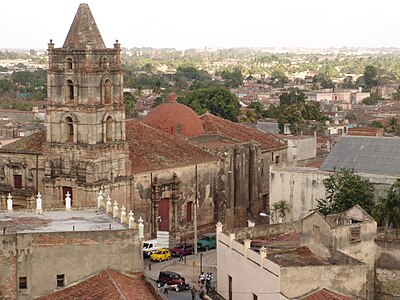
 Photo Wikimedia Commons
Contents
History & cultureBY TELLBY7 sections · numbered as on the map01 Orientation
Welcome to the Historic Centre of Camagüey, one of the most distinctive and captivating cultural treasures in the entire Caribbean region. Designated as a UNESCO World Heritage Site in two thousand eight, this extraordinary historic district encompasses fifty-four hectares of remarkably preserved urban heritage, making it the largest protected historic area in all of Cuba. As you begin your journey today, you are stepping into a living city whose very physical structure tells a dramatic tale of human survival, geographical adaptation, and architectural mastery. Originally established in fifteen fifteen under the official title of Santa Maria del Puerto del Principe as one of the seven foundational Spanish colonial settlements on the island, the town was forced to relocate twice due to severe coastal flooding and devastating pirate incursions. In fifteen twenty-eight, the settlers permanently reestablished the city in its current inland position nestled securely between the Tinima River and the Hatibonico River.
In this fertile interior territory, Camagüey flourished as an important agricultural center deeply dedicated to cattle breeding and the sugar industry. Geographically isolated from major maritime trading routes, the city developed an organic and highly eccentric urban morphology unlike any other Spanish colonial town in Latin America. Rather than implementing the rigid grid pattern mandated by traditional Spanish imperial laws, the early builders constructed an intricate labyrinth of serpentine streets, asymmetrical alleys, sudden dead ends, and irregular open plazas specifically designed to disorient invading pirates and protect the local population. Standing here today, you can observe how this ingenious defensive urban planning produced a uniquely cohesive architectural environment featuring fifty-four individually protected landmark structures and twenty-five vibrant public squares.
Throughout this historic core, domestic residences showcase deep Andalusian architectural influences, characterized by truncated pilasters framing residential doorways, sloping terracotta roof tiles, and vibrant pastel wall finishes. Perhaps the most celebrated cultural emblem you will encounter during your walk is the tinajon, a massive earthenware water jar originally imported from Spain and later manufactured locally using rich regional red clay. Built to collect and store precious rainwater across this dry interior plain, these colossal clay vessels remain anchored in central courtyards, public gardens, and shaded plazas throughout the town. As you navigate these winding historic pathways, you will discover a living community where centuries of artistic heritage, architectural innovation, and local pride continue to flourish in complete harmony.
02 Plaza San Juan de Dios and Hospital
Standing here in Plaza San Juan de Dios, you are experiencing what is widely recognized as the most completely and authentically preserved eighteenth-century urban square in the entire Caribbean basin.
Take a moment to slowly cross the smooth river cobblestones that form the floor of the plaza, guiding your gaze toward the pristine white plaster walls and low-slung terracotta tiled roofs of the historic hospital structure standing directly in front of you. …
03 Church of Nuestra Señora de la Merced
Emerging abruptly from the tightly enclosed, winding residential alleys into the open space before the Church of Nuestra Señora de la Merced, you are confronted with one of the most stunning architectural visual surprises in all of Camagüey.
Raise your eyes to admire the soaring belfry and the grand baroque facade that commands the skyline above you, serving as an indispensable visual anchor for the entire historic center. …
04 Plaza del Carmen and Carmen Hospital
Arriving at Plaza del Carmen, you enter what is universally recognized as the most charming and culturally authentic public space in Camagüey, renowned for showcasing the highest concentration of historic tinajones in the entire city.
Cast your eyes around the perimeter of the cobblestone plaza to admire the low-rise colonial residences painted in warm pastel hues of ochre, terracotta, turquoise, and soft yellow, taking special note of the massive clay jars positioned proudly in residential…
05 Our Lady of Candelaria Cathedral and Agramonte Park
Reaching Agramonte Park and the Cathedral of Our Lady of Candelaria, you stand at the absolute historic heart of Camagüey, where civic authority, religious faith, and patriotic pride have intersected since the founding of the city.
Direct your eyes toward the center of the leafy park to take in the heroic bronze equestrian monument of Major General Ignacio Agramonte, and then look beyond it toward the majestic facade and reddish bell tower of the Cathedral rising into the sky. …
06 Iglesia de Nuestra Señora de la Soledad and Cisneros Street
Standing at the animated intersection where Cisneros Street meets the Iglesia de Nuestra Señora de la Soledad, you are positioned at one of the most vital nexus points within Camagüey's intricate urban maze.
Look down the bustling corridor of Cisneros Street to view the cream-colored bell tower of Soledad Church as it rises above the continuous low-rise streetscape, creating a dramatic visual framing effect. …
07 Closing
As our walking tour through the Historic Centre of Camagüey comes to its conclusion, we extend our heartfelt gratitude to you for exploring this extraordinary Caribbean treasure with us today. From its original establishment in fifteen fifteen and its strategic inland relocation in fifteen twenty-eight between the Tinima and Hatibonico rivers to avoid relentless pirate raids, to its landmark inscription as a UNESCO World Heritage Site in two thousand eight, Camagüey stands as an unequaled…