Contents
History & cultureBY TELLBY7 sections · numbered as on the map01 Orientation
Welcome to the historic San Lázaro Tower, where Havana's monumental coastal defenses meet the vast expanse of the turquoise ocean. This iconic location forms an essential component of the UNESCO World Heritage site known as Old Havana and its Fortification System, beautifully showcasing the unique historic value of a city that was both a flourishing maritime trade hub and an impregnable fortress. Without relying on complex official designation criteria or formal UNESCO terminology, one can easily understand that this area represents the genuine essence of Havana's legacy, where human ingenuity and defensive architecture merged to protect a society that prospered from the sea while continuously defending against its inherent dangers.
From its earliest founding days, the city of Havana maintained a deeply complex and dual relationship with the surrounding ocean. The powerful Gulf Stream, originating in the Gulf of Mexico and sweeping northwestward across the Atlantic, served as the mandatory navigation highway for all European and Spanish vessels returning from the New World. Thanks to this strategic maritime current, Havana rapidly evolved into the most celebrated port of the Americas. Its bustling waterfront came alive with shipyards, docks, and an extraordinarily diverse population of merchants, sailors, and traders who transformed the city into a thriving center of global commerce.
However, the immense wealth and prosperity brought by the sea also brought severe, life-threatening vulnerabilities. The immense riches concentrated within Havana made it an irresistible target for ruthless corsairs and pirates who frequently raided, burned, and looted Caribbean settlements. To safeguard their home from these persistent maritime threats, the citizens and military authorities engineered a remarkably clever defense system combining the natural environment with heavy stonework. The dense, impenetrable thickets of coastal vegetation surrounding the urban edge were designated as protected zones where cutting down trees was strictly forbidden by law. The locals appropriately referred to this dense protective woodland as el vedado, meaning the forbidden forest.
Behind this natural green barrier, military engineers constructed massive stone fortresses, thick perimeter walls, and isolated watchtowers along the exposed coastline. Among these defensive structures, the solitary watchtowers played a crucial role in monitoring the open ocean for approaching enemy fleets. The San Lázaro district we are exploring today offers a fascinating glimpse into how these stern military spaces gradually evolved over centuries into vibrant promenades dedicated to leisure, contemplation, and community life. As you feel the fresh ocean breeze, let us begin our journey through the remarkable history and timeless coastal heritage of Havana.
02 The Solitary Watchtower of San Lázaro
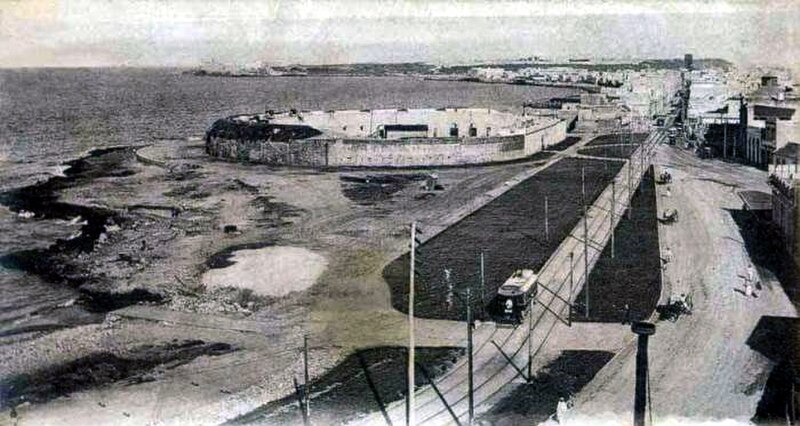
Standing proudly before your eyes, the San Lázaro Tower holds a uniquely solitary and pivotal place within Havana's historic coastal defense network. In an era when the dense urban core and vital residential sectors of Havana were secretly concealed and safely protected behind dense, impenetrable thickets of forbidden natural forests, this modest stone watchtower stood utterly exposed along the raw oceanfront. …
03 From Wild Thickets to the Promenade of La Punta and San Lázaro
The refreshing oceanfront promenade where we now walk while gazing across the open blue waters was once an absolutely impenetrable natural barrier where human access was strictly forbidden. In early colonial times, this entire coastal boundary was covered by dense, wild thickets where cutting down even a single tree was punishable by law. …
04 The 19th-Century Sea Bathing Tradition of San Lázaro
As the nineteenth century dawned, the relationship between habaneros and the surrounding ocean underwent a revolutionary transformation, shifting from passive coastal strolls to active immersion in the crashing waves through the popular tradition of sea bathing. The notion that local citizens erected wooden bathing huts directly on the rocky shoreline where Atlantic waves crashed against the stone, eagerly diving into the ocean water, marks a profound departure from the older era when the sea…
05 Francisco de Albear's Visionary 1863 Vaulted Malecón
The world-famous waterfront promenade that we admire today almost took on a vastly different and incomparably grand architectural form. During the colonial era, the San Lázaro shoreline was envisioned not as a simple flat roadway, but as a monumental double-decker structure elevated atop a vast gallery of stone vaults. …
06 The Realization of the Modern Malecón Wall
The iconic, low stone seawall that defines modern Havana today was realized only after city leaders rejected an extraordinary and impractical engineering proposal that claimed it could divert the Gulf Stream to sanitize the urban environment. During the late nineteenth century, several extravagant proposals were put forward to dramatically alter the coastal landscape. …
07 Closing
Today, our journey from the solitary San Lázaro Watchtower to the resilient stone wall of the modern Malecón has taken us through an inspiring historical transformation. This coastline was once an impenetrable forbidden wilderness where cutting down trees was strictly prohibited and a lonely stone tower kept constant watch against pirate invasions. …