Contents
History & cultureBY TELLBY7 sections · numbered as on the map01 Orientation
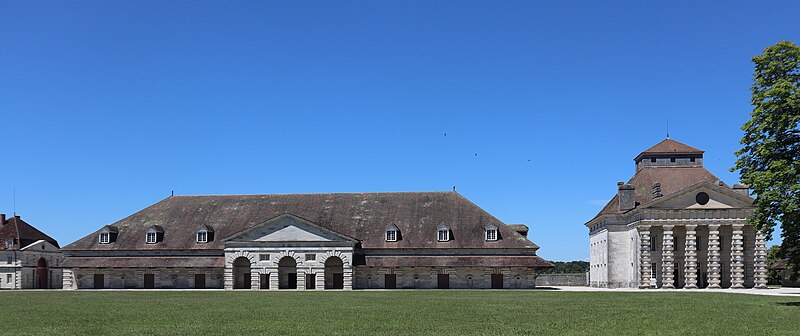
Welcome to the Royal Saltworks at Arc-et-Senans. Standing before this remarkable site, you are witnessing a rare masterpiece of eighteenth-century industrial architecture that beautifully captures the ideals of the Enlightenment. The history of this place is deeply tied to the ancient human quest for salt. Since the Middle Ages, people in the region extracted salt by evaporating brine drawn from natural springs in Salins. By the middle of the eighteenth century, rapid demographic growth created an overwhelming demand for salt, which was essential for preserving meat, manufacturing cheese, and supporting craft activities like tanneries. Furthermore, the Kingdom of France was bound by international treaties to supply salt to neighboring Swiss cantons, while relying heavily on tax revenues gathered through the compulsory salt tax known as the Gabelle, collected by the private tax agency known as the Ferme Générale.
However, the original saltworks in Salins faced severe operational obstacles. Boiling brine required immense quantities of firewood, which led to the rapid deforestation of the surrounding hills, making fuel increasingly scarce and expensive. Restricted by the narrow geography of the Salins valley, expanding the factory was physically impossible. In response, the Royal Council decided to construct a brand new, highly efficient salt factory in an ideal location between the villages of Arc and Senans. This new site sat right next to the vast Chaux forest, offering a virtually endless supply of timber fuel, and provided a spacious flat terrain for ambitious industrial construction.
To solve the problem of distance, the Royal Architect Claude Nicolas Ledoux devised an ambitious engineering plan. The brine was transported over a distance of twenty-one kilometers from Salins through a double pipeline made of hollowed spruce trunks buried one meter underground. Between seventeen seventy-five and seventeen seventy-nine, eleven magnificent buildings were erected in a perfect semicircular arrangement. Ledoux did not treat this factory as a purely utilitarian facility. Instead, he envisioned a grand theater of industry where work, human life, and royal administration existed in complete harmony.
Although Ledoux never traveled to Italy himself, he mastered the classical architectural language of Greco-Roman antiquity and Italian Renaissance masters such as Palladio and Serlio through published architectural prints and descriptions. He adorned the industrial complex with bold bossages, imposing Doric columns, elegant pediments, and dramatic roofs. As daylight shifts across the seasons, the changing light brings the stone surfaces to life in an ever-shifting spectacle of color and shadow. In recognition of its unprecedented architectural quality and utopian vision, UNESCO designated the Royal Saltworks as a World Heritage Site in nineteen eighty-two. As you begin your journey through this historic circle, prepare to explore how architectural beauty transformed a humble salt factory into a timeless symbol of human progress.
02 The Guards Building: Gateway of Control
Did you know that behind the monumental entrance of this building, flanked by majestic columns fit for a royal palace or a holy cathedral, there once existed both a cold detention prison and a fiery blacksmith forge? You are currently standing directly in front of the Guards Building, the monumental entrance and central control gateway of the Royal Saltworks at Arc-et-Senans. As you look up at the main facade, observe the imposing columns and the sculpted portico towering above the entrance. …
03 Workers' Houses and Workshops
Did you know that long before modern labor laws existed, this eighteenth-century industrial complex provided its workers with comfortable living quarters and private vegetable gardens in a groundbreaking model of worker welfare? You are currently standing before the Saltworkers' Houses and Workshops, which sweep gracefully along the outer semicircular curve of the Royal Saltworks. …
04 The Pan Houses: The Heart of Salt Production
Did you know that in order to boil down millions of liters of salt water in giant evaporation pans day and night, virtually entire sections of the nearby Chaux forest were cut down to fuel the fires? You are now standing in front of the Pan Houses, the two massive crystallization factories that served as the beating heart of salt production at the Royal Saltworks. Gaze up at the imposing stone facade of these twin buildings, which span the straight diameter line of the semicircular layout. …
05 The Director's House: Center of Power and Vision
Did you know that the manager's house at the heart of this industrial factory was constructed to resemble a sacred Greek temple or a grand royal palace, complete with monumental Doric columns? You are currently standing directly before the Director's House, the undisputed visual, administrative, and symbolic centerpiece of the Royal Saltworks at Arc-et-Senans. Stand at the center of the entrance approach and look up at the soaring facade. …
06 The Ledoux Museum: Architect's Utopian Vision
Did you know that you are standing inside the only museum in all of Europe dedicated exclusively to the life and work of a single architect? Welcome to the Ledoux Museum and Modern Exhibition, housed within the historic walls of the Director's House. As you look around these exhibition galleries, observe the collection of approximately sixty finely crafted architectural models, the high-resolution digital touch tables, and the historic prints adorning the walls. …
07 Closing
Standing here in the expansive central courtyard surrounded by vibrant themed gardens, take a moment to reflect upon the tumultuous history and triumphant rebirth of the Royal Saltworks at Arc-et-Senans. Following the shutdown of salt production in eighteen ninety-five, this architectural masterpiece endured decades of neglect and existential threat. …