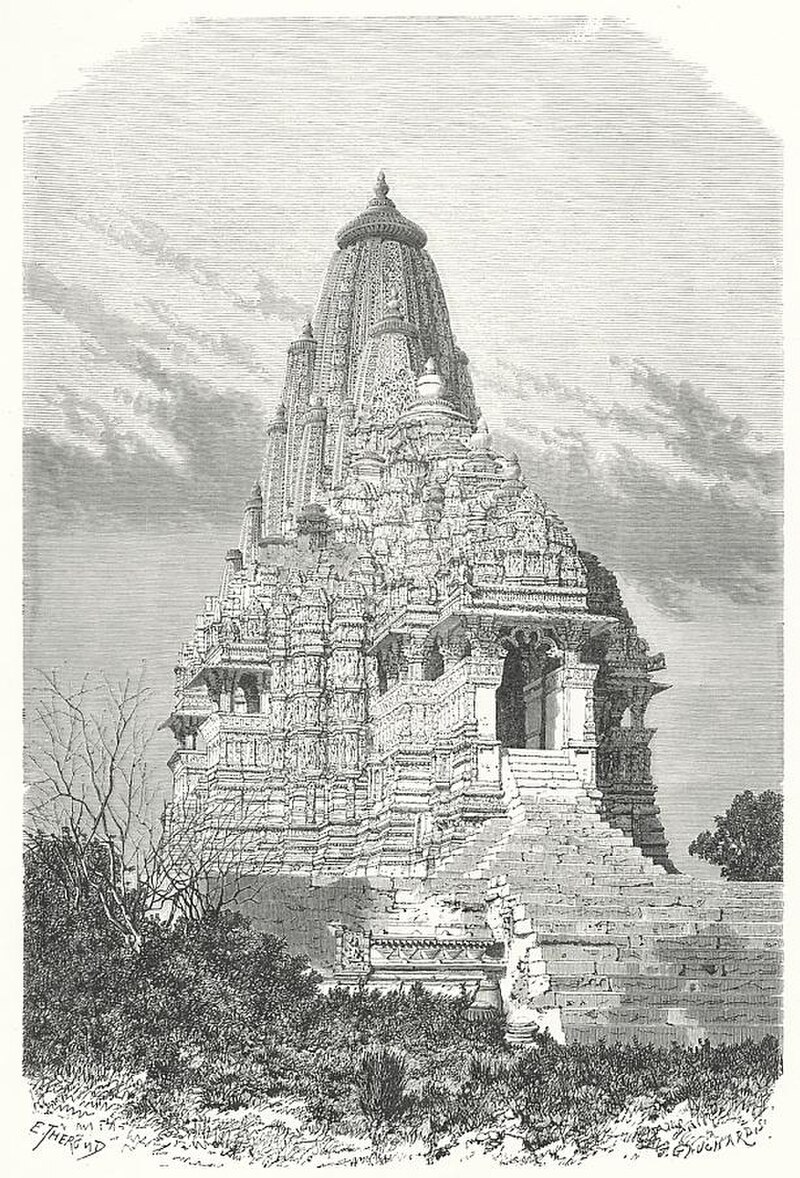
 Photo Wikimedia Commons
Contents
History & cultureBY TELLBY8 sections · numbered as on the map01 Orientation
Welcome to the Kandariya Mahadeva Temple, the most majestic and brilliantly preserved jewel among the western group of monuments in Khajuraho, located in the Chhatarpur district of Madhya Pradesh, Central India. As you stand before this towering sanctuary, let us first reflect on the profound meaning embedded within its name. The word Kandariya translates to cave, while Mahadeva signifies the Great God Shiva. Thus, the title Kandariya Mahadeva honors Shiva as the Great God of the Cave, inviting every visitor to embark on a sacred journey from the illuminated outer world into a quiet, cave-like interior. This magnificent temple was constructed between 1025 and 1050 CE during the golden reign of King Vidyadhara, the most formidable ruler of the Chandela dynasty. Inscriptions discovered on a pilaster within the temple assembly hall mention the builder under the name Virimda, which scholars recognize as a cherished pseudonym for King Vidyadhara himself. According to cherished historical tradition, King Vidyadhara successfully resisted the invasions led by Mahmud of Ghazni during the offensives of 1019 and 1022, culminating in the defense of the strategic Kalinjar fort. While popular belief holds that the King commissioned this extraordinary stone temple as a grand act of thanksgiving to Lord Shiva for preserving his realm, modern historians often view this victory story as an enduring cultural tradition rather than an absolute political certainty. Fascinatingly, this monument forms a sacred cosmic hexagon or yantra cosmogram alongside the adjacent Matangeshwara and Vishvanatha temples, together embodying three fundamental manifestations of Shiva. The temple is meticulously aligned along an East-West cardinal axis following a classic Latin cross plan, intentionally oriented toward the East so that the morning sun greets the main entrance. In 1986, UNESCO inscribed the Khajuraho Group of Monuments onto the World Heritage List under Criteria III and V, recognizing this temple as a masterpiece of human creative genius and an exceptional testimony to the medieval Chandela civilization. As we begin our exploration today, prepare to move step by step through a carefully ordered spatial hierarchy, ascending high stone terraces, traversing illuminated assembly halls, and ultimately reaching the dark, peaceful sanctum at the very heart of the temple.
02 The Plinth and High Entrance Steps
Please stand at the base of the grand temple structure and gaze upward at the massive stone foundation platform rising before you. Known in classical Indian temple architecture as the Jagati, this towering plinth elevates the entire sacred monument four meters, or thirteen feet, above the surrounding ground level. …
03 Makara Torana Garland Arch and Entrance Porch
As you reach the top of the grand staircase and approach the main doorway of the temple, your eyes are immediately drawn to a breathtaking architectural marvel known as the Makara Torana. This spectacular decorative arch, suspended gracefully above the entrance, is carved from a single monolithic block of sandstone, designed to resemble an ornate, flowing garland of sacred blossoms. …
04 Pillared Assembly Halls and Balconied Windows
Leaving the entrance porch behind, advance deeper into the interior of the temple, where you enter two magnificent sequential pillared halls known as the Mandapa and the expansive Maha-mandapa. The Mandapa serves as the primary assembly hall, while the adjacent Maha-mandapa is the grand hall, forming the spacious heart of the temple complex. …
05 The Vestibule and Dark Sacred Sanctum
Moving forward from the grand assembly hall, step across a narrow transitional doorway into the Antarala, or vestibule. This intermediate chamber acts as a sacred bridge linking the broad, illuminated public spaces of the temple to its most holy and restricted inner core, the Garbha-griha. As you cross the threshold of the Antarala and gaze into the Garbha-griha, you immediately experience a profound and dramatic shift in spatial atmosphere. …
06 Inner Circumambulation Path and Celestial Figures
Positioned at the right side of the sanctum doorway, step forward into the enclosed circumambulatory pathway known as the Pradakshina, which circles the outer wall of the central shrine. In Hindu ritual tradition, walking around a sacred space or deity in a clockwise direction is an essential act of active prayer and meditation. …
07 Exterior Sculpture Registers and the 84-Spired Shikhara
Step outside now into the open courtyard to behold the breathtaking exterior walls and the soaring central tower of the temple. The entire monument rests upon an expansive base plan measuring thirty-one meters in length and twenty meters in width. The outer surface of the structure is adorned with three distinct horizontal bands, or triple vertical registers, packed with over eight hundred and seventy meticulously carved figures. …
08 Closing
From our initial footsteps at the base of the towering four-meter plinth, through the luminous, sculpture-filled assembly halls, and finally into the quiet, cave-like darkness of the central womb chamber, we have completed a profound journey through the cosmic landscape of the Kandariya Mahadeva Temple. …