Contents
History & cultureBY TELLBY7 sections · numbered as on the map01 Orientation
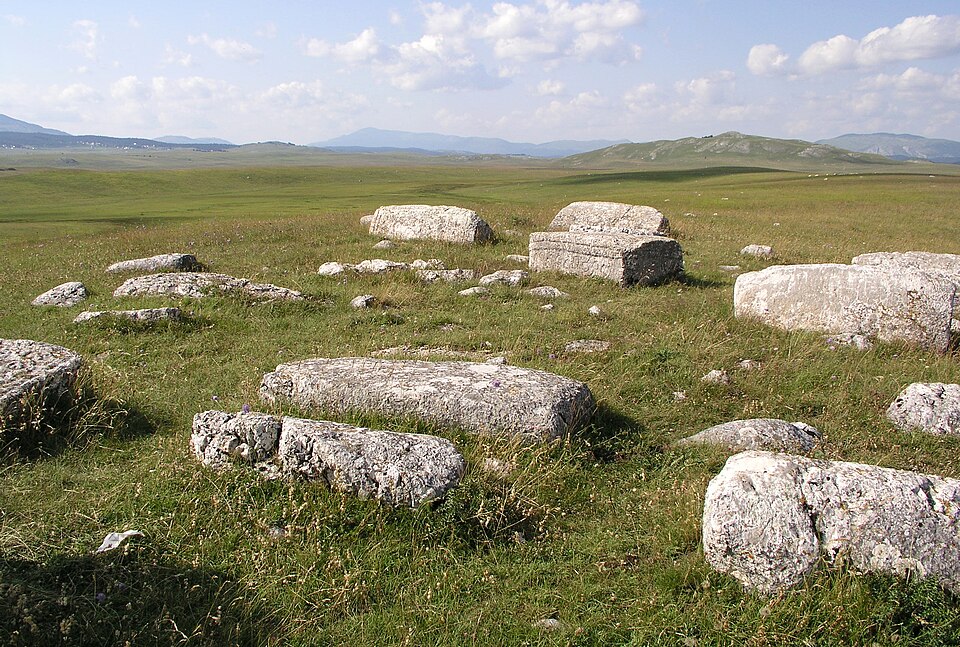
Welcome to Grcko Groblje, a truly remarkable medieval tombstone graveyard nestled within the breathtaking mountain landscapes of northern Montenegro near Zabljak. You are currently standing at the peaceful entrance path right beside the scenic Riblje Lake, where deep history and tranquil natural beauty seamlessly meet. Before you lies a gently elevated hill adorned with ancient stone monuments that have silently endured through many centuries of changing weather, harsh mountain winters, and human history.
This extraordinary cultural site is inscribed on the UNESCO World Heritage List because it serves as an exceptional testimony to the unique cultural and religious fusion of the medieval Balkans. Created primarily between the twelfth and sixteenth centuries, these monolithic stone tombstones known individually as stecak and collectively as stecci represent a shared funerary tradition that transcended regional boundaries. They were used for burials by Catholic, Orthodox, and Bosnian Church communities alike, alongside nomadic Vlach pastoral groups, demonstrating an extraordinary level of interconfessional harmony. Rather than belonging exclusively to one single religious group, these carved limestone blocks unify diverse spiritual beliefs, chivalric culture, and ancient regional traditions into a singular, highly expressive form of sepulchral art that spans across several countries in southeastern Europe.
Our comprehensive audio tour will guide you step by step from this entrance path through the central highlights scattered across this historic ellipsoidal graveyard site. The recommended walking route takes you through flat limestone slabs lying close to the earth, elevated chest tombstones with impressive three dimensional forms, house like gabled roof stones with pointed tops, and finally to the scenic ridge overlooking the tranquil blue waters of Riblje Lake and nearby Vrazje Lake. At each designated stop along the route, simply play the corresponding audio narrative to uncover the intricate carved reliefs, the feudal nobility buried beneath these heavy stones, and the fascinating historical mysteries behind this sacred cultural landscape.
As you walk among these ancient stone markers, please help us preserve this fragile cultural heritage for future generations by refraining from stepping on the limestone slabs or touching their delicate carved surfaces. Take a moment to enjoy the crisp mountain air and listen to the gentle wind rustling through the grass as we step back into the vibrant world of the medieval Balkans. Now, let us begin our journey of discovery by moving forward along the entrance path toward our first official stop, where we will uncover the surprising secret behind the unique name of this ancient cemetery.
02 The Entrance Path and the Meaning of Greek Cemetery
Although this sacred burial site is known by the specific local name of Grcko Groblje, which translates directly into English as the Greek Cemetery, it holds the surprising secret of having no actual historical connection to the Greek people whatsoever.
Standing here at the entrance path, direct your eyes toward the gently elevated hill resting just fifty meters from the road, where a collection of ancient stone tombstones is spread across an ellipsoidal area of approximately five hundred…
03 Flat Slabs and the Medieval Feudal Nobility
Out of the total forty nine tombstones preserved here at Grcko Groblje, it is a fascinating fact that ten of these monuments consist of flat slabs that lie completely flat against the earth, forming the foundational structural layer of this medieval graveyard.
Look down carefully near your feet as you stand in this section of the site. You can clearly see flat, rectangular limestone slabs resting low against the grassy ground like massive stone grave covers. …
04 Chest Stećci and Twisted Band Reliefs
When exploring Grcko Groblje, it is a truly remarkable fact that box shaped chest tombstones represent the largest overall category of monuments here, counting twenty seven individual structures out of forty nine, twelve of which feature exceptionally intricate relief carvings.
Direct your attention now to the vertical side surfaces of these substantial, three dimensional chest tombstones rising prominently from the grassy mound. …
05 Gabled Roof Stećci and Hunting Scenes
Among the various tombstone styles preserved at Grcko Groblje, the twelve gabled roof tombstones represent an extraordinary architectural achievement, designed to resemble miniature house like dwellings or sacred shrines for the eternal resting of the soul.
Look up at the highest part of these impressive gabled stecci, where the stone narrows into a sharply pointed triangular roof structure known as a gable. …
06 View of Riblje Lake and the End of Stećci Tradition
Standing here overlooking the water, it is a truly dramatic historical fact that the centuries old tradition of creating these magnificent stecci tombstones came to a sudden halt in the sixteenth century, leading to the complete abandonment of these sacred sites.
Cast your eyes beyond the ancient stone markers to appreciate the breathtaking view of Riblje Lake, whose calm blue waters stretch peacefully across the surrounding rural landscape near Vrazje Lake. …
07 Closing
This concludes our audio guide tour of the Grcko Groblje Medieval Tombstone Graveyard, a precious UNESCO World Heritage site situated near Zabljak in northern Montenegro. As you prepare to leave this serene hill beside Riblje Lake, we hope that exploring these forty nine limestone monuments has offered you a meaningful connection to the art, history, and spiritual depth of the medieval Balkans. …