 Photo Wikimedia Commons
Contents
History & cultureBY TELLBY8 sections · numbered as on the map01 Orientation
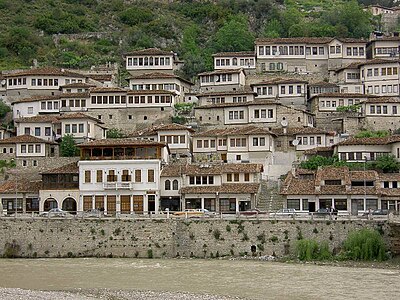
Welcome to the Historic Centre of Berat, an extraordinarily well-preserved living monument to more than two millennia of Balkan urban history, cultural synthesis, and architectural evolution. Nestled along the dramatic limestone gorge carved out by the Osum River between the towering peaks of Mount Tomorri to the east and the expansive Myzeqe plain to the west, Berat presents an inspiring convergence of natural beauty and human craftsmanship. In 2008, this remarkable historic ensemble was inscribed as a UNESCO World Heritage Site, recognizing its outstanding universal value as a vibrant community where Christian and Islamic traditions have peacefully coexisted for over two thousand years within a spectacular natural landscape. Standing here today, you are gazing upon an urban landscape shaped by successive civilizations including Illyrian, Roman, Byzantine, Bulgarian, Medieval European, and Ottoman cultures. Historically, Berat occupied a vital position along strategic trade routes connecting ancient regional ports like Apollonia, Durres, and Vlora with inland trading hubs such as Elbasan, Korca, and Ohrid, extending all the way toward Thessaloniki and Constantinople. The spatial organization of historic Berat comprises three distinct primary quarters that together create a magnificent three-dimensional visual ensemble. Perched high upon a rugged rocky promontory on the north bank of the river stands Kala, the ancient citadel quarter, which has been continuously inhabited since antiquity. Cascading down the steep slopes below the fortress walls toward the riverbank is the Mangalem quarter, famous for its densely stacked white vernacular houses and sweeping views. Directly across the Osum River on the southern bank lies the Gorica quarter, nestled quietly against the opposite hillside and connected to Mangalem by a historic stone bridge. Your recommended journey begins at the main gate of the formidable citadel hilltop. Passing through its massive stone archway, you will enter a labyrinth of narrow cobbled alleys leading to medieval Byzantine treasures such as the Church of the Holy Trinity and the Cathedral of St. Mary, home to the world-renowned Onufri Museum. You will then explore the ruins of the 15th-century Red Mosque inside the fortress before descending the winding stone pathways into the terraces of Mangalem. Finally, you will cross the gentle waters of the Osum River over the historic arches of Gorica Bridge to take in the iconic panoramic view of the entire hillside. Today, as you step through these historic streets, you are experiencing the enduring rhythm of a city where history is not merely preserved behind glass, but actively lived every day.
02 Main Gate and Ramparts of Berat Castle
Originally established during the Illyrian period in the fourth century BC, this castle is one of the very few surviving ancient fortresses in the entire world that remains continuously inhabited by local residents today, two thousand four hundred years after its initial foundation. Now, take a moment to stand near the main entry portal and look directly ahead at the imposing stone archway and the massive vertical ramparts rising dramatically against the sky. …
03 Church of the Holy Trinity inside the Citadel
Perched dramatically right on the edge of a sheer cliff overlooking the Osum River valley, this compact yet exquisitely proportioned church has maintained its complete original structural form for over seven hundred years despite enduring severe earthquakes and violent medieval wars. Now, raise your eyes to admire the harmonious composition of its exterior facade, featuring a beautifully balanced red tile dome, decorative red brickwork, and intricate patterns of reddish ceramic tiles set in the…
04 Cathedral of St. Mary and the Onufri Museum
Created by the legendary sixteenth-century Albanian master painter Onufri, the secret chemical formula behind his signature intense crimson pigment, known worldwide as Onufri Red, has never been fully deciphered even by modern scientific laboratory analysis. Step inside the Cathedral of St. Mary, built in seventeen ninety-seven upon the foundations of an earlier medieval church, and direct your gaze straight ahead toward the magnificent, elaborately gilded wooden iconostasis that dominates the…
05 Ruins of the Red Mosque in the Castle
Constructed in the fifteenth century shortly after the Ottoman conquest of Berat, this historical site represents the very first mosque built inside the castle walls, erected directly in the midst of the long-established Christian residential quarter. Direct your eyes now toward the center of the open courtyard space, where the solitary lower section of the minaret still stands, crafted from alternating courses of rich red brick and pale white limestone. …
06 Traditional Vernacular Houses of Mangalem Quarter
Built seamlessly along the extremely steep limestone cliffs below the castle, these extraordinary vernacular houses feature an ingenious terraced design where the roof of a lower residence frequently serves as the sunny courtyard or access pathway for the house directly above it, specifically engineered so that no home obstructs the natural sunlight or river view of its neighbors. …
07 Gorica Bridge Spanning the Osum River
Erected in its stone form during the eighteenth century, this iconic bridge showcases the pinnacle of Ottoman civil engineering, featuring special hydraulic discharge windows carved between its primary arches to release water pressure and protect the structure during violent seasonal river floods. Now, look down at the rushing waters of the Osum River flowing beneath your feet and admire the sweeping curve of the nine elegant stone arches that gracefully support the entire roadway spanning the…
08 Closing
As our journey through the Historic Centre of Berat comes to a close, take a quiet moment here at this valley viewpoint to look back upon the sweeping panorama before you. Above stands the ancient Citadel of Kala, where Illyrian stones and Byzantine churches have watched over the valley for more than two thousand four hundred years. …