Contents
History & cultureBY TELLBY7 sections · numbered as on the map01 Orientation
Welcome to Adur Gushnasp at Takht-e Soleyman in Shiz, Adurbadagan. This ancient site is one of the most solemn and magnificent sanctuaries of pre-Islamic Iran, housing a Zoroastrian sacred fire of the highest grade known as Atash Behram. Among the three great sacred fires of the era, Adur Gushnasp held a position of singular spiritual and political prominence. This remarkable place is recognized as a World Heritage site because it is the only highest-grade Sasanian fire temple for which archaeological discovery, sigillographical seal evidence, and historical textual references all align perfectly. As you begin your walking tour across this historic landscape, please follow a few essential safety and navigation instructions. Wear comfortable footwear and remain on the designated walking paths at all times, paying careful attention to loose gravel and uneven stone surfaces underfoot. The ancient masonry walls, structural bases, and delicate archaeological remains throughout the site are fragile historical treasures, so please refrain from touching, climbing, or sitting upon any stone structures. Follow all posted guidelines and instructions from site stewards to help preserve this irreplaceable heritage for future generations. This audio guide is arranged sequentially into seven distinct sections that will lead you through the sanctuary. We begin here at the site entrance and fortification wall, proceed into the administrative quarters of the high priest, advance to the central sanctuary where the sacred fire burned, explore the reconstructed areas following historical conflicts, examine the hilltop Islamic palace ruins, and finish at a panoramic final outlook. As you walk along the paths once trodden by Sasanian monarchs and priests, immerse yourself in the quiet dignity and enduring legacy of this sacred mountain shrine. Take a moment to absorb the expansive atmosphere surrounding you. High upon this mountain plateau, the combination of natural topography and monumental architecture reflects the profound religious vision of the ancient Sasanian world. Every stone step under your feet connects you to centuries of continuous human reverence, royal devotion, and spiritual ritual. Prepare your mind and senses as we step forward together into the fascinating history and enduring majesty of this sacred sanctuary.
02 The Main Gateway and Fortification Wall
As you stand before the grand entrance and outer fortification wall, you are gazing upon a monument steeped in the strategic and spiritual history of the Sasanian Empire. Archaeological research indicates that the sacred fire of Adur Gushnasp was not originally established at this precise location in high antiquity; rather, it was relocated to this mountain site at Shiz in Adurbadagan during the late fourth or early fifth century. …
03 The High Priest's Quarter and Bulla Discovery Spot
You are now standing in the High Priest Quarter, a location of momentous significance in the annals of Near Eastern archaeology. For generations, scholars debated the exact historical identity of these majestic mountain ruins until a dramatic archaeological breakthrough occurred right at this spot. Excavators uncovered a remarkably preserved Sasanian clay seal impression, known technically as a bulla, bearing an official Middle Persian inscription that read: High Priest of the House of the Fire…
04 The Sanctuary of the Sacred Fire
You have reached the inner sanctum of Adur Gushnasp, the holy heart of the entire mountain complex. While kings built these soaring stone arches, the devotional practices recorded at this altar reveal a profoundly human dimension of ancient Zoroastrian faith. According to the Middle Persian religious text known as the Saddar Bundahesh, common pilgrims suffering from failing sight prayed to the holy fire, swearing sacred oaths that if their vision were restored, they would fashion a crafted eye…
05 Ruins of the Byzantine Sack and Reconstruction
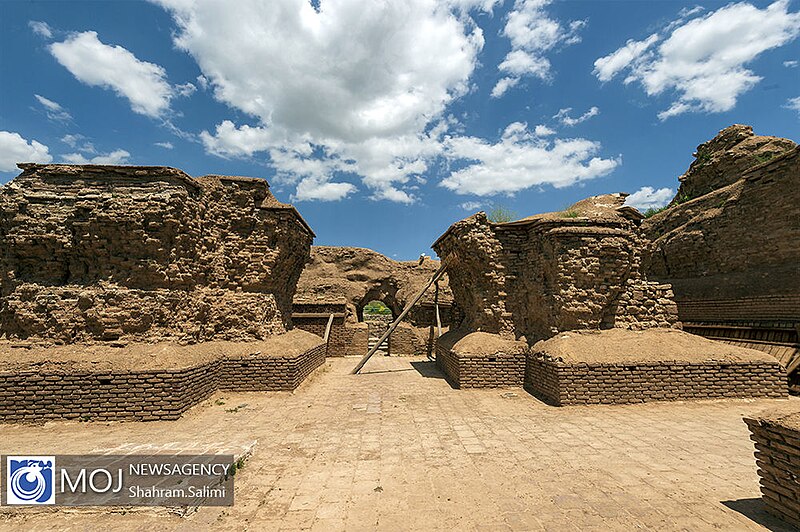
Standing before these historic ruins, you are witnessing the scar tissue of one of the most apocalyptic military conflicts of Late Antiquity. During the catastrophic Byzantine-Sasanian War of six hundred two to six hundred twenty-eight, the Roman Emperor Heraclius launched a deep counter-offensive into the Iranian heartland. …
06 The Hilltop Islamic Palace Ruins
As you reach the highest elevation of the site, you enter a space that encapsulates the transformation of this ancient sacred landscape into a medieval secular seat. Despite the Arab conquest of Iran and the gradual spread of Islam, the holy fire of Adur Gushnasp continued to burn on this mountain plateau for centuries into the Islamic era. However, as social pressures and religious persecution mounted, the sacred flame was finally quenched in the late tenth or early eleventh century. …
07 Closing
As you stand at this final high vantage point, take a moment to look out across the panoramic expanse of Takht-e Soleyman. The ancient sanctuary of Adur Gushnasp holds a singular place in the history of archaeology and world heritage as the only highest-grade Sasanian fire temple positively identified through the complete alignment of excavation findings, textual records, and clay seal impressions. …