Contents
History & cultureBY TELLBY7 sections · numbered as on the map01 Orientation
Welcome to Tiwanaku, the spiritual and political heartland of ancient Andean civilization, situated at an altitude of nearly 3,900 meters on the vast Bolivian Altiplano, roughly 70 kilometers by road from La Paz. Long before the rise and dominance of the Incas, this extraordinary site flourished as a sophisticated regional center, renowned for its monumental stone architecture, advanced high-altitude agriculture, and complex cosmic worldview. To its ancient inhabitants, the site was known in the Aymara language as Taypiqala, meaning stone in the center, expressing the deep cosmological belief that this sacred sanctuary lay at the very midpoint of the universe. Linguists also suggest that the Puquina language was originally spoken by its early builders. In recognition of its exceptional cultural value and architectural achievement, UNESCO designated Tiwanaku as a World Heritage site in 2000.
Spanning an area of four square kilometers, Tiwanaku was founded around AD 110 and grew steadily over the centuries, reaching its urban zenith between the 7th and 10th centuries with an estimated population of 10,000 to 20,000 residents in its central core. Located just 21 kilometers from Lake Titicaca, the city relied on the lake as a natural thermal regulator. The massive water volume of Lake Titicaca absorbed solar heat during the day and radiated warmth during freezing altiplano nights. Capitalizing on this unique microclimate, Tiwanaku engineers developed an ingenious system of raised fields known as suka kollus or camellones. Water-filled channels surrounding elevated planting beds protected staple crops such as potatoes and tubers from severe frosts, generating massive agricultural surpluses that sustained a thriving population.
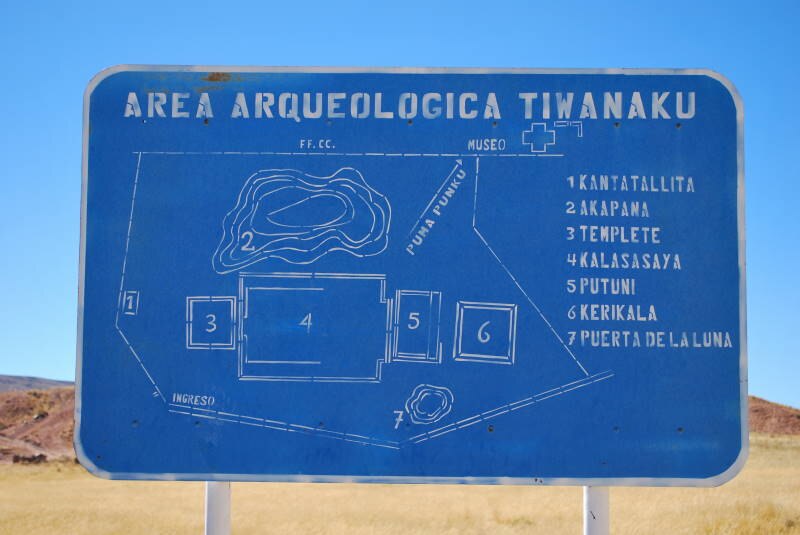
Visiting this high-altitude sanctuary requires physical care due to the thin air, strong winds, and intense solar radiation. Visitors are advised to walk at a slow, measured pace, breathe deeply, stay hydrated by drinking water, and wear a brimmed hat, sunglasses, sunscreen, and a light windproof jacket. Today's guided route covers a flat three-kilometer walking circuit through the core ceremonial monuments. You will begin at the Semi-Subterranean Temple with its wall-embedded stone heads, ascend to the elevated Kalasasaya platform and the Ponce Monolith, view the iconic Gateway of the Sun, explore the elite residential palace of Putuni with its stone sliding doors, and conclude among the megaliths of Puma Punku. Visiting the site's Lithic and Ceramic Museums first is recommended to view the giant Bennett Monolith.
02 Templete Semisubterráneo: The Sunken Courtyard of Stone Heads
As you step to the edge of the Semi-Subterranean Temple, the most astonishing fact that immediately captures your attention is the incredible variety and individuality of the carved stone faces projecting from the interior walls. Protruding outward from the masonry are more than 175 uniquely sculpted stone heads, and remarkably, no two faces are identical. …
03 Kalasasaya: Temple of Standing Stones
Ascending the grand stone steps from the subterranean courtyard brings you onto the elevated platform of Kalasasaya, a magnificent rectangular terrace covering approximately two hectares. In the Aymara language, Kalasasaya translates to Temple of Standing Stones. The most surprising revelation about this monumental courtyard is that its massive outer walls served as a highly accurate solar calendar capable of tracking the 365-day solar year, equinoxes, and solstices down to the precise day. …
04 Puerta del Sol: Gateway of the Sun
Reaching the northwestern corner of the Kalasasaya platform brings you face to face with the Gate of the Sun, or Puerta del Sol, the iconic masterpiece of pre-Columbian stone sculpture. Standing three meters high and four meters wide, with a thickness of 23 centimeters and a total weight of approximately ten metric tons, the most astonishing fact about this monumental gateway is that it was carved entirely out of a single solid block of hard grey volcanic andesite stone. …
05 Putuni: Palace of the Elite
Walking west from Kalasasaya brings you to the Putuni enclosure, known as the Palace of the Elite or the Palace of the Sarcophagi. In the Aymara language, Putuni translates to place where there are holes, referring to the subterranean stone burial chambers discovered within its walls. Featuring a rectangular platform raised 1.2 meters above the ground, this elevated structure served as the exclusive residential complex for Tiwanaku's royal rulers and high priests. …
06 Pumapunku: The Megalithic Wonder
Walking southwest from the main ceremonial core brings you to Puma Punku, or Pumapunku, which translates to Gate of the Puma in the Aymara language. This standalone ceremonial complex contains some of the most extraordinary megalithic engineering in the pre-Columbian Americas. Built on a T-shaped terraced earthen platform faced with megalithic blocks, Puma Punku measures 167.36 meters along its north-south axis, 116.7 meters along its east-west axis, and stands five meters tall, featuring…
07 Closing
Thank you for exploring the sacred archaeological ruins of Tiwanaku, the ancestral cradle and spiritual heartland of Andean civilization. Today, you have journeyed through Taypiqala, the stone in the center of the world. You have explored the subterranean courtyard with its enigmatic stone heads, marvelled at the solar calendar walls and carved monoliths of Kalasasaya, examined the iconic Gate of the Sun and Gate of the Moon, walked through the elite royal palace of Putuni, and witnessed the…