 Photo Wikimedia Commons
Contents
History & cultureBY TELLBY8 sections · numbered as on the map01 Orientation
Welcome to the Jama Masjid of Fatehpur Sikri, a magnificent masterpiece of Mughal architecture where imperial grandeur and profound spiritual devotion converge in perfect harmony. You are standing at the threshold of one of the most remarkable sacred monuments created under the visionary patronage of Emperor Akbar, who ruled the Mughal Empire from fifteen fifty six until sixteen o five. The historical origin of this monumental congregational mosque is deeply intertwined with the emperor's intense reverence for the Muslim Sufi saint Shaikh Salim Chishti, who lived between fourteen seventy eight and fifteen seventy two. Desperately seeking a male heir to secure the future of his dynasty, Emperor Akbar made a humble pilgrimage to the rocky ridge of Sikri, where the ascetic saint resided in a simple natural cavern. When the holy saint foretold the birth of a royal son, who would later ascend the throne as Emperor Jahangir, Akbar experienced boundless gratitude. To honor the saint and express his unyielding devotion, the emperor resolved to construct a majestic imperial capital upon the very hilltop where the saint dwelt. Commenced in fifteen sixty nine and completed in fifteen seventy four, this meticulously planned walled city was bestowed with the triumphant name Fatehpur Sikri, meaning the City of Victory. From fifteen seventy one until fifteen eighty five, Fatehpur Sikri flourished as the vibrant capital of the Mughal Empire, serving as the seat of imperial authority, artistic flourishing, and spiritual enlightenment. At the absolute heart of this glorious city stood the monumental Jama Masjid, acting as the ultimate religious sanctuary for the court and the citizenry alike. As you prepare to walk into this vast sacred precinct, observe how the architecture beautifully integrates indigenous red sandstone with sophisticated white marble inlay, featuring broad low arches and graceful bulbous domes that became defining signatures of Mughal architectural identity. The atmosphere of quiet nobility that envelopes the complex reflects Akbar's ambitious philosophical goal of achieving social, political, and religious integration throughout his diverse realm. As you step across the threshold into the expansive courtyard, allow yourself to absorb the sacred stillness and historical resonance that permeates every carved stone. This audio guide will accompany your steps, illuminating the rich history, master craftsmanship, and architectural synthesis of this immortal site.
02 Buland Darwaza - The Victory Gate
Standing before you at the southern entrance of the mosque complex is the breathtaking Buland Darwaza, famously known as the Victory Gate or the Gate of Magnificence. This colossal portal was commissioned by Emperor Akbar in fifteen seventy six to commemorate his legendary military triumphs over the rich provinces of Gujarat and the Deccan regions. …
03 The Grand Courtyard
As you emerge from the shadow of Buland Darwaza into the open air, you are instantly greeted by the astounding expansiveness of the main courtyard of the Jama Masjid. This magnificent open quadrangle serves as the spiritual heart of the entire mosque complex, presenting an extraordinary demonstration of spatial harmony, geometric precision, and aesthetic balance. …
04 Tomb of Shaikh Salim Chishti
Located in the northeast quadrant of the vast courtyard, glowing with luminous elegance, is the exquisite Tomb of Shaikh Salim Chishti. Constructed in its final white marble form between fifteen eighty and fifteen eighty one, the sacred site traces its initial structural establishment back to fifteen seventy one within the corner of the mosque compound. Shaikh Salim Chishti was an immensely revered Muslim Sufi saint and a direct descendant of the celebrated Khwaja Moinuddin Chishti of Ajmer. …
05 The Main Prayer Hall
Dominating the entire western perimeter of the vast courtyard rises the imposing structure of the main prayer hall, serving as the central sanctuary where thousands of worshippers assemble for congregational prayer. This grand sanctuary represents the primary religious anchor of the Jama Masjid complex, built in strict adherence to sacred Islamic architectural principles. …
06 Synthesis of Indo-Islamic Architecture
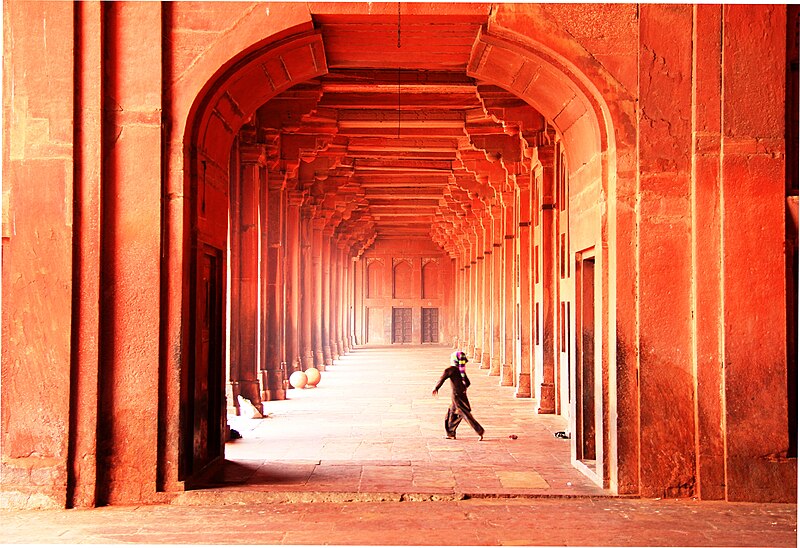
Standing before the cloisters and pillared arcades of the Jama Masjid, you are positioned at the precise spot to appreciate the brilliant architectural synthesis of Indo-Islamic and Persian styles that defines Akbar's reign. The architecture of Fatehpur Sikri is world-renowned for its harmonious fusion of Islamic and Persian structural concepts with traditional Indian, specifically Rajasthani and Rajput, construction techniques and ornamental motifs. …
07 Historical Legacy & Cloisters
As you walk along the continuous red sandstone cloisters that encircle the outer boundaries of the Jama Masjid, take a quiet moment to reflect upon the dramatic history and legend of this short-lived imperial capital. The rocky site where you now stand was originally a remote, quiet ridge where the Sufi saint Shaikh Salim Chishti lived in a humble stone cavern. …
08 Closing
Thank you for joining us on this audio guide exploration of the Jama Masjid of Fatehpur Sikri, one of the most magnificent treasures of Mughal history and Indian architecture. Commissioned by Emperor Akbar to honor the revered Sufi saint Shaikh Salim Chishti and celebrate imperial triumphs, this sacred complex continues to stand after five centuries as a breathtaking testament to human artistic genius and spiritual devotion. …