 Photo Wikimedia Commons
Contents
History & cultureBY TELLBY7 sections · numbered as on the map01 Orientation
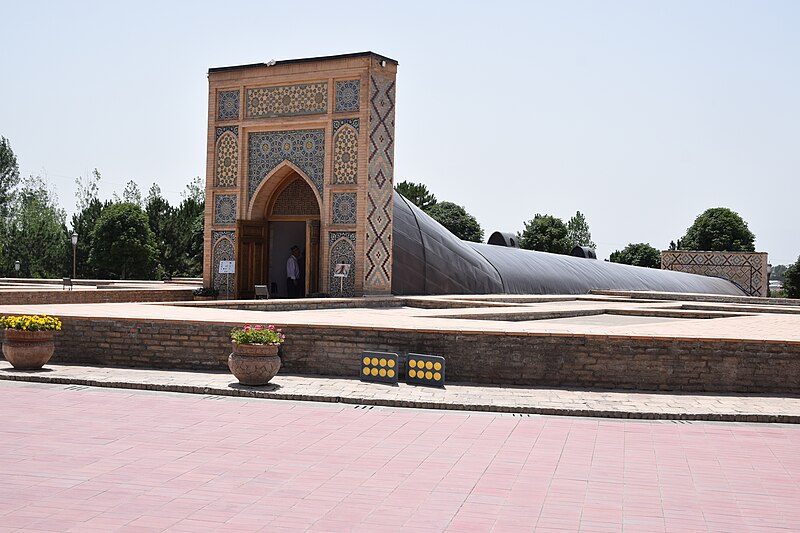
Welcome to the Ulugh Beg Observatory, an extraordinary monument of global scientific heritage located on the north-east outskirts of Samarkand at the foot of Chupan-ata mountain, which was known during medieval times as Kukhak. In December two thousand one, the historic town of Samarkand was inscribed on the UNESCO World Heritage List under the title Samarkand Crossroads of Cultures. This ancient city has long been celebrated as a major crossroad and melting pot of world cultures, religions, and arts across several millennia. Situated in a vast oasis in the fertile valley of the Zerafshan river and surrounded by high mountains, this abundant land with rich fauna and water has sustained human settlements since as early as fifteen hundred BC. Founded in the seventh century BC as ancient Afrasiab, Samarkand reached its most brilliant architectural and cultural development during the Timurid period in the fourteenth and fifteenth centuries. The World Heritage designation recognizes Samarkand because its magnificent architecture and townscape represent masterworks of Islamic cultural creativity, having played a seminal role in the development of town planning, building arts, and regional culture throughout Central Asia. As a prominent capital of ancient states, Samarkand concentrated diverse religious traditions including Zoroastrianism, Buddhism, Christianity, and Islam, leaving behind material remains that testify to remarkable civilizations. It was during the reign of Ulugh Beg, the famous fifteenth century Timurid ruler and outstanding scientist, that this hilltop scientific complex was constructed. Ulugh Beg chose this natural elevated location outside the main urban settlement to secure clear visual horizons away from atmospheric disturbances and city dust. Although the grand circular three-story building decorated with glazed tiles, majolica, and mosaics was destroyed over time, the subterranean trench cut eleven meters deep into the bedrock preserving the lower part of the major astronomical instrument remains preserved today. In nineteen eighty-two, the site was officially incorporated into the state historical architectural reserve to safeguard its unique cultural value. Following the independence of the Republic of Uzbekistan, comprehensive national conservation programs were established to strengthen structural foundations and preserve site fragments. This audio guide leads you through the subterranean trench, the calibrated marble arcs, the circular building footprint, the site museum, and the surrounding mountain landscape. Please step forward toward the first stop at the edge of the deep subterranean trench.
02 The Deep Trench and Great Sextant
The fact that a massive astronomical instrument was partially buried eleven meters deep inside solid foothill bedrock to achieve unprecedented observational stability remains one of the most remarkable engineering breakthroughs of the medieval world. Look down at the exposed subterranean curved trench cut directly into the hill rock before you. …
03 The Calibrated Marble Arc
The fact that degree marks carved into marble blocks six centuries ago provided some of the world's most accurate astronomical measurements before the invention of the optical telescope is a remarkable testament to medieval scientific craftsmanship. Observe the surviving twin arcs of polished marble lining the sides of the subterranean instrument structure directly before you. …
04 Foundation of the Circular Three-Story Building
The fact that a magnificent three-story circular tower decorated with glazed tiles, majolica, and intricate mosaics once stood directly over this exact spot before it was destroyed represents one of the most breathtaking architectural loss stories of the medieval world. Look down at the round footprint on the ground demarcating where the massive outer walls once stood. …
05 Observatory Museum and Timurid Artifacts
This dedicated site museum holds rare preserved astronomical data, mathematical records, and irreplaceable scientific relics from the golden age of Timurid scholarship, offering a tangible connection to medieval intellectual achievements. Point your visual attention toward the display cases lining the main exhibition hall, which showcase medieval astronomical diagrams, star charts, and instrument fragments discovered during archaeological digs. …
06 View Toward Mount Kukhak and Chupan-ata
Mount Kukhak, known today as Chupan-ata, provided both the essential natural elevation and the dark, unobstructed horizon necessary for Timurid astronomers to observe celestial movements with absolute precision. Raise your eyes now toward the gentle rising slope of Chupan-ata mountain visible just beyond the observatory grounds. This historic hill ridge stretching across the horizon formed the natural environmental backdrop for all cosmological research conducted in Samarkand six centuries ago. …
07 Closing
This concludes our audio tour of the Ulugh Beg Observatory. The subterranean trench, the calibrated marble arcs, the circular foundation outline, and the rare museum artifacts you have explored today are far more than historical ruins. They represent a monumental milestone in the history of global observational science. As both a sovereign ruler and an extraordinary astronomer, Ulugh Beg chose the pursuit of empirical truth over courtly luxury. …