 Photo Wikimedia Commons
Contents
History & cultureBY TELLBY7 sections · numbered as on the map01 Orientation
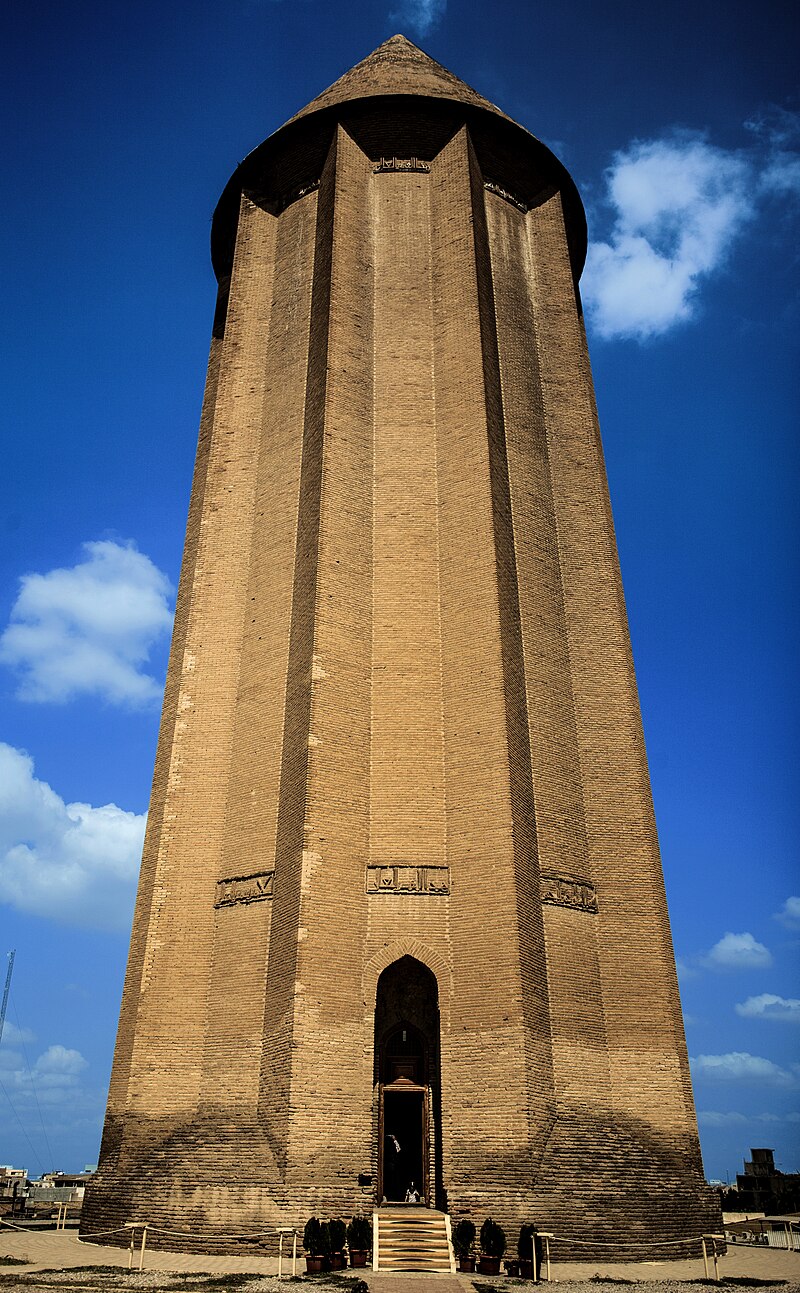
Welcome to the grand site of Gonbad-e Qabus, an unprecedented architectural wonder that has towered over the sweeping Gorgan plain for more than a thousand years. As you enter the open grounds of Qabus Park and cast your vision toward the elevated knoll ahead, you are looking at the tallest ancient monument on Earth constructed entirely from unglazed red fired bricks. Standing atop an artificial hill that rises nearly ten meters above the surrounding terrain, this soaring beacon represents the ultimate pinnacle of early Islamic geometric architecture and brick engineering. The builders achieved a monumental aesthetic without applying a single piece of colorful glazed tile or ornate surface marble, relying solely on the rhythmic arrangement and physical shadow play of simple baked clay. The design harmonizes a circular inner chamber with a ten-pointed star exterior, establishing a structural balance that has withstood severe weather cycles and seismic tremors across ten centuries. Historical records indicate that this territory served as the royal heartland of the Ziyarid dynasty, where master craftsmen perfected calculating vertical loads and structural wind resistance. As you slowly walk up the paved pedestrian path ascending the hill, observe how the warm reddish tones of the brick masonry shift beneath the light of the open sky. Each brick embodies the sophisticated technical knowledge of medieval Iranian masons who transformed raw earth into an enduring symbol of dynastic authority. This audio guide will accompany your steps around the base foundation, the vaulted eastern portal, the star-shaped exterior flanges, the calligraphic inscription bands, and the high conical dome. Beyond its historic construction, our journey will uncover the microscopic biological organisms that continuously interact with this ancient brick fabric. Modern conservators and scientists are working tirelessly to decode how bacteria, lichens, fungi, and microalgae alter these historical surfaces. Let us now step closer to the lower brick foundation of the tower to commence our scholarly examination.
02 Foundation & Lower Bricks
Please step close to the edge of the lower brick foundation and look down directly at the masonry floor joints near your feet. Here at the base of this ancient monument lies a profoundly paradoxical discovery revealed by modern conservation science. While the original bricks laid down in the year 1006 have successfully endured over ten centuries of environmental exposure, the replacement bricks introduced during a conservation project just 13 years ago have suffered far more rapid biological…
03 Eastern Entrance & Early Muqarnas
As you step before the impressive eastern portal of the tower, pause and direct your gaze upward at the delicate vaulted arch spanning directly above the threshold. This arched recess contains one of the most historically significant structural breakthroughs in world architecture: the earliest known three-dimensional prototype of honeycomb vaulting, known in Islamic design as Muqarnas. …
04 Ten-Pointed Star Exterior & Flanges
Tilt your head far upward along the sharply angled brick buttresses that extend outward like folded geometric wings along the exterior wall. While the interior chamber of the tower forms a smooth unbroken circle, the outer perimeter is engineered as a ten-pointed star formed by ten projecting triangular flanges spaced with absolute mathematical precision. …
05 Kufic Inscription Bands
Direct your gaze toward the horizontal rectangular panels running symmetrically across both the upper and lower sections of the main tower shaft. Encased within these recessed frames are geometric letterforms carved into the brickwork using early Kufic script. What makes these calligraphic bands truly extraordinary is that the medieval builders used no colored glazes, tile mosaics, or painted pigments. …
06 Conical Brick Dome & Tower Crown
Look all the way up to the very top of the tower, where the red brick cone meets the open sky. Reaching a height of over 18 meters, this smooth conical dome rests atop the main cylindrical body without any internal timber frames, iron rods, or central supporting pillars. Its complete stability over a thousand years relies entirely on precise mathematical calculations of dead weight distribution and the inward inclination of each brick course. …
07 Closing
As we finish our walking path around the base of Gonbad-e Qabus and begin our descent down the gentle slopes of Qabus Park, let us reflect on the profound historical and scientific journey we have experienced. This UNESCO World Heritage monument is far more than an ancient architectural relic from a distant golden age; it is a dynamic biological ecosystem where medieval engineering, structural physics, microbial ecology, and climate forces continuously interact. …