Contents
History & cultureBY TELLBY7 sections · numbered as on the map01 Orientation
Welcome to the entrance of the Murambi Genocide Memorial. This sacred ground forms an integral component of the serial property officially inscribed on the UNESCO World Heritage List in twenty twenty-three, comprising four principal memorial sites across Rwanda, including Nyamata, Murambi, Gisozi, and Bisesero. Together, these four sanctuaries stand as indelible material evidence of the nineteen ninety-four Genocide against the Tutsi, during which more than one million innocent human beings were systematically exterminated in a brief period of one hundred days. This memorial complex was recognized as a UNESCO World Heritage property because it serves as an essential global sanctuary for historical memory, national reconciliation, and peace education. Rather than merely preserving the tragic traces of past destruction, this physical space is dedicated to cultivating a durable culture of peace, promoting human rights, and encouraging constructive dialogue among nations, reminding future generations of the vital necessity of early warning systems, human empathy, and the international prevention of mass atrocities across the globe. In the indigenous language of Kinyarwanda, the concept of heritage is expressed through the term indangamurage, derived from roots meaning to make known and a past made present. Following the genocide, the Rwandan authorities conceptualized these preserved sites and physical evidence as indangamurage z'itsembabwoko n'itsembatsemba, representing the heritage of ethnic extermination and massacres preserved to ensure that historical truth could never be erased or denied. As you stand here at the main entrance and memorial plaza, you are invited to assume a deeply respectful and reflective posture. The serene, rolling green hills of Southern Rwanda surrounding this plaza stand in stark emotional contrast to the unimaginable human suffering that transpired on this exact hilltop during three tragic months in nineteen ninety-four. Tens of thousands of Tutsi families sought refuge on these grounds in the hope of receiving international protection, only to fall victim to calculated and systematic state-sponsored violence. This entrance plaza serves as an orientation zone, meticulously designed to prepare your heart and mind to confront the weight of history preserved within these physical structures. Visiting this memorial is not merely an act of viewing historical artifacts, but an active ethical commitment to remember the victims, honor their human dignity, and champion global peace. Please take a quiet moment here on the plaza, collect your thoughts, and slowly walk toward the first technical school classroom block directly ahead.
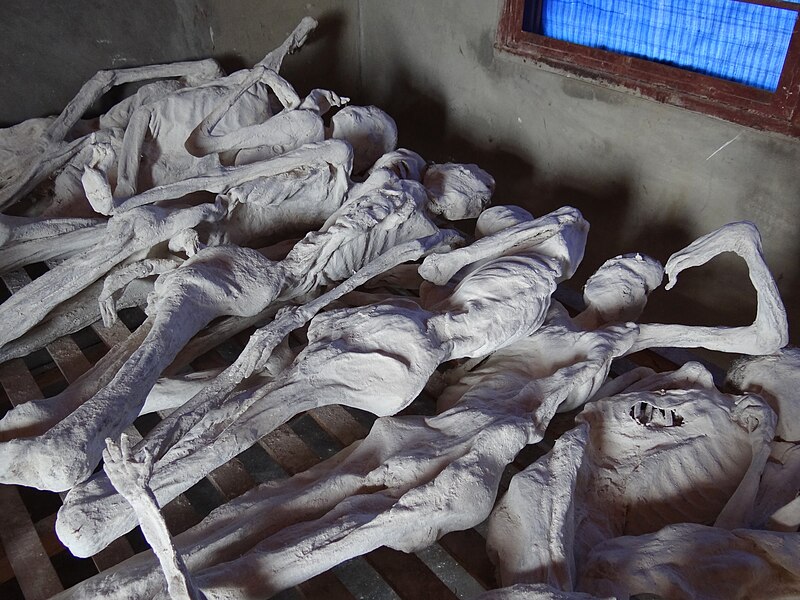
02 Classroom Block A and Lime-Preserved Remains
This technical school classroom block stands as a profoundly shocking site where a newly constructed vocational training facility was transformed in nineteen ninety-four into a location of systematic mass extermination, and where the physical remains of victims are preserved using white lime powder. Look through the open doorway directly into the classroom space before you. …
03 Victims' Clothing and Belongings Exhibition
This exhibition hall displaying victims clothing and personal belongings presents a deeply distressing reality where thousands of stacked, soil-stained garments serve as undeniable material evidence of human lives abruptly cut short by genocidal violence. Direct your gaze toward the center of the room before you. You will see a massive mound of faded shirts, trousers, dresses, and earth-caked footwear piled high in the middle of the space. …
04 Mass Burial Trenches and Septic Pit Area
This area of hillside mass burial trenches and the former septic pit represents a deeply disturbing site where perpetrators hastily dug trenches and used underground waste facilities to conceal the bodies of thousands of genocide victims. Guide your gaze down toward the grassy slope before you, where long concrete structures and boundary markers define the contours of the mass graves. …
05 Archaeological Preservation Workshop
This former field conservation workshop represents a landmark site where formal archaeological techniques were adapted under challenging field conditions to establish a scientific approach to genocide evidence preservation. Direct your eyes toward the wooden side door and low stone foundation walls of the workshop structure before you. …
06 Hilltop Memorial Structure and Burial Crypts
This hilltop memorial structure and underground burial crypts section presents a breathtaking contrast between the peaceful, rolling green hills of Southern Rwanda and the monumental scale of memory housed beneath this sacred soil. Direct your eyes upward to the stone memorial structure standing at the summit, and then look down toward the entrance descending into the underground burial crypts. …
07 Closing
As you step onto the exit path and enter the reflection garden, your solemn pilgrimage through the Murambi Genocide Memorial comes to a close. Today, you have walked through the former technical school classrooms preserved with white lime powder, viewed the mountains of soil-stained clothing and personal belongings, contemplated the hillside mass burial trenches and former septic pit, learned about the scientific field preservation protocols in the workshop, and paid your respects at the summit…