 Photo Wikimedia Commons
Contents
History & cultureBY TELLBY7 sections · numbered as on the map01 Orientation
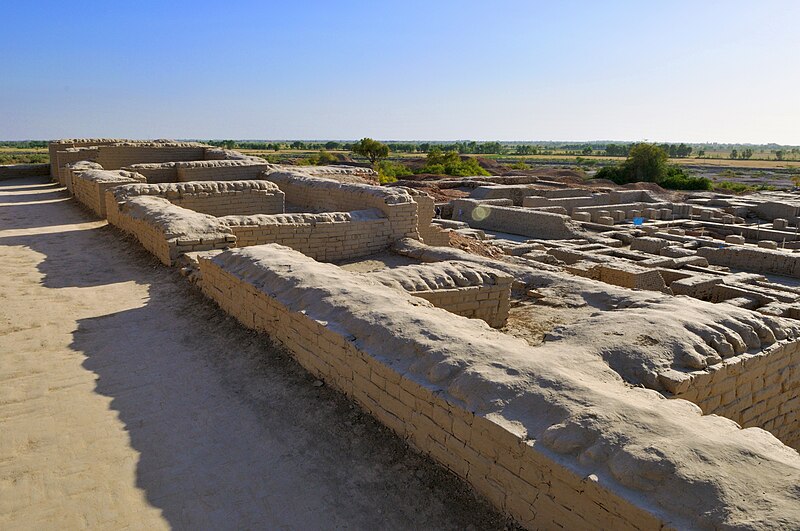
Welcome to Mohenjo-daro, one of the most remarkable urban centers of the ancient world and a crowning achievement of the Indus Valley Civilization. Thriving between 2350 BC and 1800 BC, this ancient metropolis represents an extraordinary leap forward in human history, demonstrating unprecedented sophistication in town planning, civil engineering, and architectural design. Recognized as an irreplaceable testimony to early human civilization and urban organization, Mohenjo-daro has been inscribed on the UNESCO World Heritage list to safeguard its universal value for all humanity.
The site is situated within the arid expanse of the Sindh region, where extreme climatic conditions prevail and annual rainfall rarely exceeds five inches. However, centuries of continuous agricultural cultivation and intensive irrigation in the surrounding plains have artificially elevated the regional water table. This rising subsoil moisture, interacting with the intense surface dryness of the desert environment, has set in motion a devastating environmental process. Soluble salts deeply embedded within the soil profile, predominantly sodium sulphate and sodium chloride, are continually mobilized and drawn upward through the subsoil matrix into the historic masonry.
Today, the five-thousand-year-old fired brick architecture of Mohenjo-daro faces an existential preservation crisis driven by these hydrologic and chemical forces. As subsoil moisture rises through the microscopic capillary channels of the porous bricks and evaporates into the dry atmosphere, the dissolved salts recrystallize inside the brick fabric. This phase transition generates immense internal crystallization pressure that shatters the internal bond of the fired clay, converting ancient structural bricks into fine powder, triggering longitudinal cracking, and threatening whole streetscapes with progressive structural collapse.
This audio guide takes you on an immersive technical journey through the key structural zones of the DK sector. Our itinerary begins at the Leaning Wall of Main Street, proceeds to the Chief House with its industrial steel exoskeleton, explores the perpendicular basement compartments of South Street, examines the catastrophic northern wall failure area, and concludes at the experimental site featuring lightweight bamboo trusses and traditional sacrificial mud plastering.
As you step along these ancient pathways, please exercise extreme care not to disturb or step upon the fragile brickwork. We invite you to contemplate both the enduring genius of ancient Indus urbanism and the complex scientific challenges involved in protecting this irreplaceable legacy against the relentless erosion of time and salt.
02 The Leaning Wall of Main Street
We are standing along Main Street, the principal north-south thoroughfare that served as the commercial spine of ancient Mohenjo-daro. Beyond its significance as a masterpiece of ancient urban design, this corridor showcases a profound dynamic of mechanical and chemical degradation threatening historic brick masonry. Subsoil groundwater loaded with dissolved salts—most notably sodium sulphate and sodium chloride—is continuously drawn upward into the fired clay bricks through capillary action. …
03 Chief House and Steel Support Structure
You are standing before the exterior wall of the Chief House, an imposing complex believed to have served as the administrative core of ancient Mohenjo-daro. This historic wall presents a classic engineering dilemma regarding asymmetric heritage reinforcement. To counteract lateral ground thrust and the dead load of the brickwork—which exerts a pressure exceeding forty pounds per square foot—past conservation teams installed rigid steel supports against the exterior face. …
04 Perpendicular Basement of South Street
We have reached the South Street sector, an extraordinary district where perpendicular basement compartments and foundational masonry are exposed. Beneath these subterranean ruins lies a remarkable engineering fact regarding ancient load distribution and foundation mechanics. Five thousand years ago, Indus builders faced the daunting challenge of supporting multi-story fired-brick structures upon the soft alluvial soils of the Indus floodplain. …
05 North Wall Collapse and Brick Replacement Area
You are standing before the northern wall section, the site of a tragic partial structural collapse that occurred in March twenty thirteen. This damaged zone presents a cautionary lesson in conservation engineering, illustrating the unintended consequences of incompatible restoration interventions. During interventions undertaken between two thousand and twelve, conservation teams attempted to stabilize salt-degraded walls by laying heavy new replacement bricks directly over weathered ancient…
06 Bamboo Buttress and Mud Plaster Site
We have arrived at the experimental conservation site featuring low-cost bamboo buttresses and traditional mud plastering. A remarkable finding from recent architectural conservation studies here is that lightweight, renewable natural materials like bamboo and clay slurry are significantly more effective at preserving fragile mud-brick architecture than heavy steel or cement interventions. …
07 Closing
You have completed the audio guide tour of Mohenjo-daro, one of the earliest and most masterfully planned urban centers in human history. Flourishing between 2350 BC and 1800 BC along the fertile floodplain of the Indus River, this ancient metropolis represents an extraordinary milestone in civil engineering and municipal architecture. …