Contents
History & cultureBY TELLBY7 sections · numbered as on the map01 Orientation
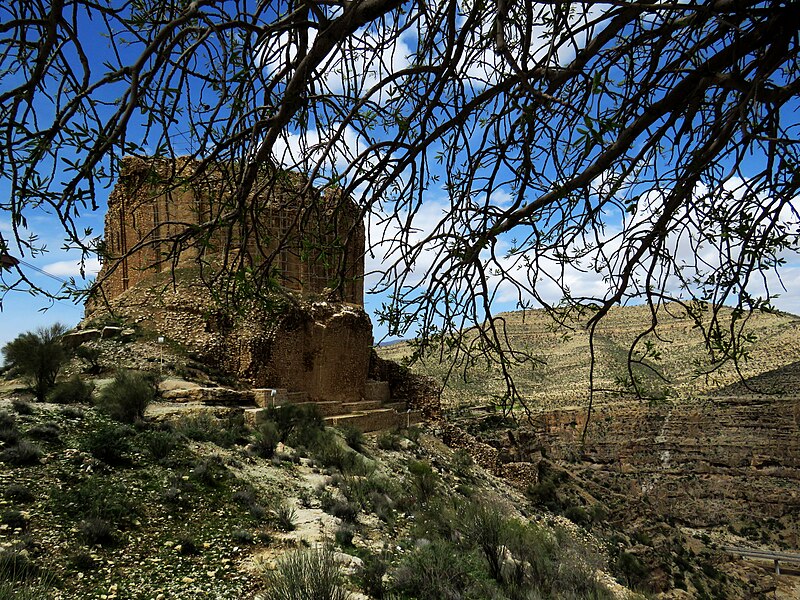
Welcome to Qal'eh Dokhtar, a breathtaking ancient fortress where the majestic spirit of the Fars region and the deep historical legacy of a great empire endure across the millennia. This grand and imposing monument stands as the foremost and most iconic stronghold among the eight cultural locations that comprise the Sassanid Archaeological Landscape of Fars Region, officially inscribed as a UNESCO World Heritage Site in 2018. Perched dramatically along the crest of a rugged mountain ridge, this monumental castle represents a magnificent architectural triumph that visually embodied the grand imperial ambitions and sacred religious devotion of Ardashir I, the illustrious founder of the Sasanian Dynasty. Seamlessly integrated with the rocky cliffside, this formidable structure continues to resonate with the profound wisdom and power of ancient Iranian civilization.
Situated strategically on a steep mountain slope commanding an unhindered view over the vital ancient trade route and mountain pass connecting the cities of Firuzabad and Kavar, Qal'eh Dokhtar was originally constructed in the year 209 AD. During this crucial historical period, Ardashir I was a regional ruler in Fars under the suzerainty of the Parthian Empire. Longing to liberate his homeland and establish a new imperial order, he undertook the building of this impregnable stronghold prior to his final military campaign that overthrew the Parthians and forged the Sasanian Empire. Designed as an unassailable defensive bastion and a crucial shield for the surrounding territory, this very mountain ridge served as the historical springboard for the rise of one of antiquity's most powerful empires.
The name Qal'eh Dokhtar, also commonly known as Dezh Dokhtar, translates literally to The Maiden's Castle in ancient Persian tradition. Historical chronicles and local lore reveal that this title reflects the solemn dedication of the stronghold to Anahita, the ancient goddess associated with water, abundance, fertility, and divine purity. By invoking the concept of a maiden, the builders symbolized the unassailable invulnerability and pristine defense of the fortress, seeking the eternal protection of the deity against any foreign invader or siege. This deep religious veneration for Anahita, who was revered as the royal house's supreme guardian, permeates the architectural ethos of the entire complex.
Our guided walking itinerary begins along this sloping mountain approach, ascending through the fortified outer stone walls and lower defensive gateways into the interior complex. We shall then explore the expansive central courtyard and dedicated sacred spaces, proceed to the soaring upper palace featuring the magnificent domed hall at the mountain peak, and conclude our tour at the outer ridge lookout that offers sweeping panoramas over the Firuzabad valley. As you walk, prepare to experience the architectural genius of Sasanian builders who mastered the natural landscape to protect their sovereign realm. Let us now step forward toward our first exploration point.
02 Section 1
It is truly extraordinary in the annals of ancient warfare and global architectural history that such an overwhelming mountain fortress was erected atop a precipitous cliff before the formal establishment of the Sasanian Empire.
Please cast your eyes slowly upward along the sloping rocky path beneath your feet. …
03 Section 2
Even if a foreign invader were fortunate enough to breach a single lower gate along these outer fortification walls, the castle was engineered so that they could never escape the lethal shower of arrows raining down from the defensive structures higher up the mountain.
Please look at the thick fortification walls and the remains of rounded towers standing imposing on your right. …
04 Section 3
The startling revelation and most sacred secret of this mountain-top stronghold is that it was not merely a military fortress, but a divine sanctuary and home dedicated to Anahita, the ancient goddess of water, abundance, fertility, and sacred purity.
Please stand in the center of the expansive main courtyard and look up toward the central upper palace. …
05 Section 4
The truly monumental historical revelation of this site is that the massive domed structure—which ultimately became the defining archetype and signature of Sasanian architectural heritage—was attempted and perfected for the very first time right here inside this mountain palace.
Please cast your eyes upward toward the magnificent soaring arch structures and the elegant curves of the high ceiling above your head. …
06 Section 5
The ultimate strategic triumph of this high ridge lookout is that its expansive field of view served as a natural watchtower capable of observing and controlling every movement through the Firuzabad valley pass in a single glance.
Please look out over the winding valley and ancient pass stretching far beyond the outer ramparts. The vital ancient trade and transport route connecting Firuzabad and Kavar winds dramatically through the mountain pass far below your feet. …
07 Closing
Today, we have journeyed together through the enduring history and victorious legacy of Qal'eh Dokhtar, erected upon this rugged mountain summit in the year 209 AD as the foundational springboard of the great Sasanian Empire. From the strategic mountain approach connecting Firuzabad and Kavar to the formidable outer gates, the broad central courtyard, the soaring upper palace where the world's first squinch dome was perfected, and the sweeping lookout over the valley pass, we have experienced…