 Photo Wikimedia Commons
Contents
History & cultureBY TELLBY7 sections · numbered as on the map01 Orientation
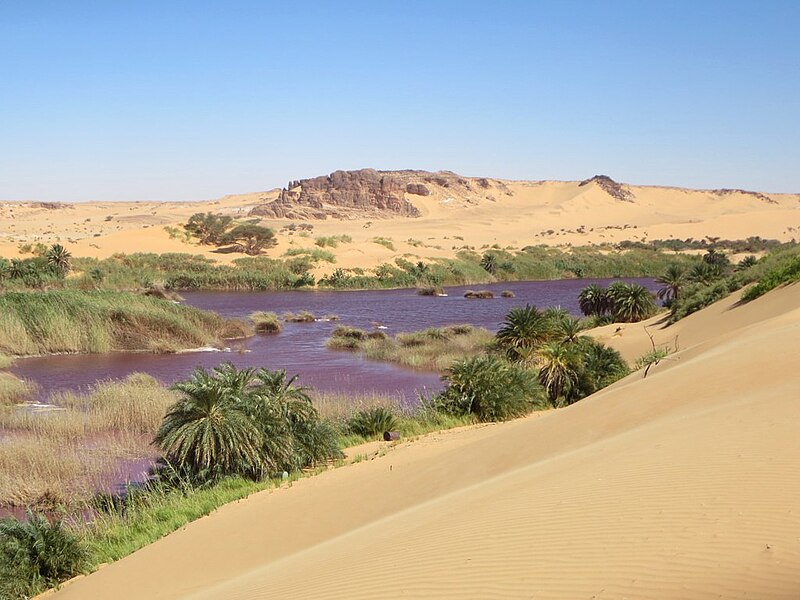
Welcome to the Lakes of Ounianga, an unprecedented hydrological sanctuary of eighteen interconnected bodies of water situated in the hyperarid heart of the Sahara Desert within northeastern Chad. Inscribed as a UNESCO World Heritage site, this breathtaking natural wonder survives in one of the hottest and driest regions on Earth through an ancient underground water system that has continuously replenished the depression since prehistoric times. Spanning an expansive basin beneath the towering sandstone escarpments between the Tibesti Mountains and the Ennedi region, the site is divided into two primary geographic clusters separated by tens of kilometers of open desert: the northern Ounianga Kebir group and the southeastern Ounianga Serir group. The natural persistence of these water bodies defies the harsh reality of an environment where annual rainfall remains strictly below two millimeters, while the ferocious Saharan heat and perpetual cloudless skies drive annual evaporation rates exceeding six meters. The total surface area of water covers approximately twenty square kilometers, framed by striking linear sand dunes of brilliant orange hues that have pushed into the depression from the northeast over millennia. As you look out across this dramatic landscape from our orientation viewpoint, you can observe the stark, surreal contrast between the barren, wind-sculpted sand dunes, the dark sandstone cliffs, and the deep turquoise colors of the lake surfaces. Below the burning sands lies a massive regional sandstone aquifer charged during the wet millennia of the early Holocene epoch, which acts as a vast subterranean reservoir continuously discharging freshwater to sustain these relic lakes against the relentless evaporative pull of the desert air. Over the course of our audio journey, we will explore how this delicate ecological miracle operates, examine the unbroken climatic records buried beneath the lake sediments, discover the ancient human settlements that fought against the encroaching sands, and marvel at the hydrogeological mechanisms that keep the peripheral lakes completely fresh in a land of extreme evaporation.
02 Lake Yoa - The 10,000-Year Climate Clock
Beneath this shimmering saltwater lake lies a untouched geological clock recording ten thousand nine hundred and forty continuous years of Earth's climate history. As the largest water body in the Ounianga Kebir cluster, Lake Yoa extends across vast expanse of deep water surrounded by dramatic desert formations. …
03 Sand Fences of the Ancient Farmers
Five thousand years ago, local villagers built massive V-shaped stone and palm fences stretching up to seven hundred meters just to stop the desert sand from swallowing their palm orchards. Standing here on this ancient elevated agricultural ridge, direct your eyes to the left across the barren floor where long, V-patterned alignments extend in distinct parallel rows toward the sandstone notches in the cliffside. …
04 Lake Teli - The Desert's Natural Evaporation Pump
This hyper-saline lake stays salty so that all nine lakes surrounding it can remain completely fresh! Positioned at the exact geographic center of the Ounianga Serir cluster, Lake Teli serves as the master engine for a hydrogeological system that has no equal in any other desert on Earth. Cast your eyes over the wide open expanse of Lake Teli and notice its completely bare, dark water surface, dominated by three prominent sandstone islands rising sharply from its water, the largest of which…
05 Lake Boku - Floating Reed Islands & Ancient Descendants
Two-thirds of this thirteen-meter-deep lake is capped by a meter-thick floating carpet of living reeds that protects its freshwater from vanishing into thin air. Stand right near the shoreline edge of Lake Boku and look directly down at the dense mat of vibrant green reeds gently swaying over thirteen meters of crystal-clear fresh water. …
06 The High Diatomite Cliffs - Footprints of a Lost Inland Sea
Eighty meters above where you stand right now, ancient lake beds and fossilized shells are perched high up on dry cliff walls! Look up toward the northern sandstone escarpment and observe the bright white, chalky horizontal sediment bands that stretch across the upper face of the brown rock cliffs. These elevated white layers represent the preserved shoreline deposits of an enormous early Holocene palaeolake that filled this entire basin thousands of years ago. …
07 Closing
As our journey through the Lakes of Ounianga comes to a close, we stand before one of the most astonishing eco-hydrological marvels on Earth. Here in the hyperarid expanse of the Chadian Sahara, where annual rainfall is virtually nonexistent and ferocious heat drives six meters of evaporation each year, eighteen interconnected lakes continue to glow like polished emeralds against the golden dunes. …