Contents
History & cultureBY TELLBY8 sections · numbered as on the map01 Orientation
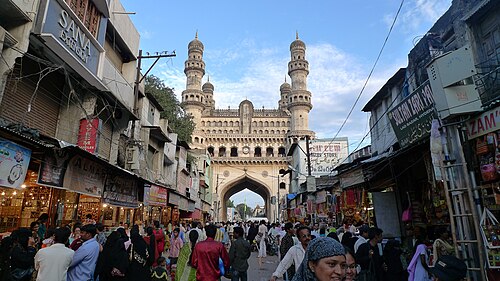
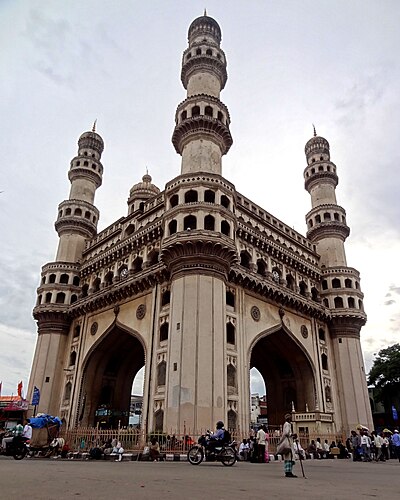
Welcome to the vibrant heart of Old City Hyderabad in the state of Telangana, India. You are standing before one of the most majestic, historic, and spiritually revered Islamic monuments on the Indian subcontinent: Mecca Masjid, also locally known as Makkah Masjid. Serving as the principal congregational sanctuary for the city, this awe-inspiring complex spans a tremendous site area of 6.2 hectares, equivalent to 15.2 acres, and possesses the extraordinary capacity to hold 10,000 worshippers simultaneously. Positioned just steps away from iconic heritage landmarks including the four-turreted Charminar monument, the majestic Chowmahalla Palace complex, and the bustling traditional commerce of Laad Bazaar, Mecca Masjid offers an ideal orientation point for discovering the rich architectural tapestry of the Deccan Sultanates. The site is recognized as a premier state-protected monument under the Telangana Department of Heritage. The origin of this grand sanctuary dates back to the early seventeenth century. Following the establishment of Hyderabad's first congregational mosque, the Jama Masjid, built in 1597 CE by Muhammad Quli Qutb Shah, his successor Sultan Muhammad Qutb Shah, the sixth monarch of the Qutb Shahi dynasty of Golconda, commissioned this grander imperial mosque in 1617 CE and personally laid its foundation stone. The colossal building program extended across several decades of meticulous craftsmanship, surviving dynastic transitions until its final completion in 1694 CE under the authority of Mughal Emperor Aurangzeb. Reflecting its exceptional synthesis of regional Deccani art and imperial Mughal masonry, UNESCO placed the Mecca Masjid complex on its World Heritage Site Tentative List in 2014 under the regional nomination title Monuments and Forts of the Deccan Sultanate. As you begin your self-guided walk through this holy sanctuary, please observe the essential visitor guidelines and spatial etiquette. Mecca Masjid welcomes all visitors daily from 4:00 AM until 9:30 PM with no entry fee required. Guests are asked to maintain a quiet, dignified demeanor and step slowly across the courtyard. While female visitors are welcomed throughout the open courtyard spaces and the royal burial grounds, entry into the interior of the main prayer hall is reserved for men according to long-standing religious customs, and modest attire covering arms and legs is required for all. The most comfortable season for walking through these expansive stone precincts is during the cool, dry winter months between November and February. Please take a deep breath and proceed forward at a peaceful pace as we begin our journey into this legendary sanctuary.
02 The Main Entrance Gate and Flanking Minarets
Please slowly direct your steps toward the massive main entrance gateway of the mosque complex. Leaving the lively soundscape of Old City Hyderabad behind, focus your gaze on the towering entry structure ahead, where two stately minarets flank the main gateway. These entrance minarets define the sacred boundary of the sanctuary against the urban skyline, embodying the harmonious symmetry, structural balance, and geometric poise characteristic of Qutb Shahi architecture. …
03 The Courtyard and Historic Sundial
As you step through the main gateway into the interior of the complex, the surrounding enclosure opens dramatically into a vast, breathtaking open-air courtyard. Known in traditional Islamic architecture as the sahn, this expansive paved courtyard covers a remarkable area of 108 square meters. Designed to accommodate thousands of worshippers under the open sky, the sahn creates an immediate feeling of liberation, lightness, and spiritual expanse. …
04 The Grand Arches and the Sacred Soil
Please stop directly before the grand facade of the main prayer hall. Looming directly in front of you is a monumental elevation defined by five open, arched entryways carved from dark grey granite. These massive open arches allow natural air and light to flood into the hall within, relieving the visual weight of the heavy stone and imbuing the structure with a refined architectural harmony. …
05 The Main Prayer Hall and the Monolithic Niche
Now stand at the solemn threshold of the main prayer hall and look into its immense, shadowy interior. The interior dimensions of this congregational hall are astonishingly vast: it measures 67 meters, or 220 feet, in length, 54 meters, or 177 feet, in width, and achieves a towering ceiling height of 23 meters, or 75 feet. …
06 The Royal Tombs of the Asaf Jahi Dynasty
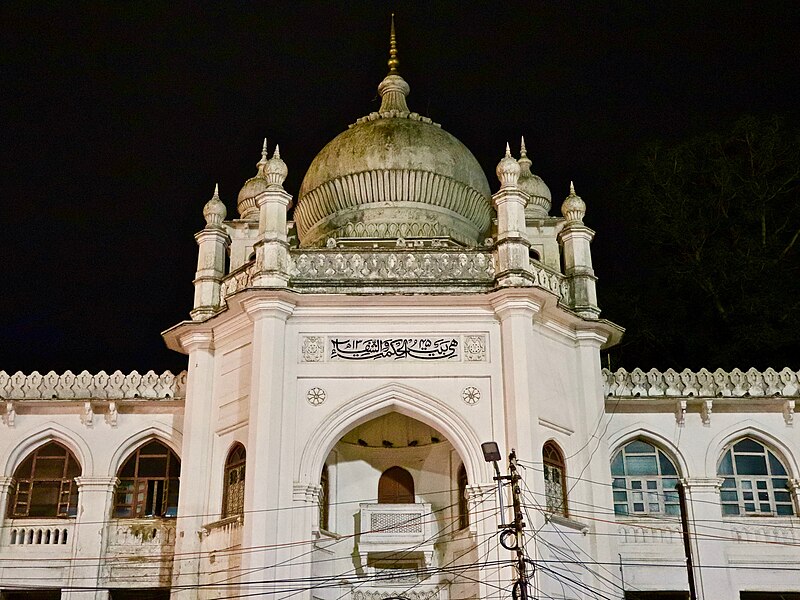
Now guide your steps toward the southern end of the mosque complex, where the heavy, dark granite of the seventeenth-century mosque gives way to an atmosphere of polished white elegance. Here stands the royal tomb complex of the Asaf Jahi dynasty, the famed Nizams who ruled Hyderabad from the eighteenth into the twentieth century. …
07 The Towering Minarets and Architectural Fusion
Step back into the broad expanse of the open courtyard and turn your gaze upward toward the soaring minarets and upper parapets of the main prayer hall. The primary minarets flanking the hall are topped with bulbous domes and seamlessly integrated with arcaded balconies that border the roofline. Notice how the circular balcony railings and arched arcades wrap around the vertical granite shafts, adding structural rhythm, shadow, and visual lightness to the immense stone mass of the building…
08 Closing
As we make our way back toward the main exit gateway, pause to cast a final, contemplative glance across the peaceful courtyard of Mecca Masjid. Standing for over 330 years in the heart of Old City Hyderabad, this monumental sanctuary remains a powerful testament to imperial vision, spiritual devotion, and medieval engineering. …