Contents
History & cultureBY TELLBY7 sections · numbered as on the map01 Orientation
Welcome to Sundarbans National Park, a majestic landscape holding the largest continuous mangrove forest on Earth and an extraordinary sanctuary where nature reigns supreme. Named after the exquisite Sundari tree, Heritiera fomes, which flourishes across these tidal lands, this astonishing realm is part of the world's largest delta covering eighty thousand square kilometers. It was formed over millennia by the immense volume of sediments deposited by three mighty rivers, the Ganges, the Brahmaputra, and the Meghna, as they converge upon the Bengal Basin. Spanning a total area of ten thousand square kilometers across land and water, with nearly six thousand square kilometers situated within Indian territory, this wilderness is defined by an intricate network of interconnecting waterways, low-lying alluvial islands, mudbanks, and coastal dunes. As you travel aboard your vessel into these winding channels, the cool breeze carries the rich scent of tidal earth and dense saline foliage. The primary water channels, often stretching over a mile in width, run predominantly in a north-south direction, forming an aquatic labyrinth that guides explorers deep into the heart of an untouched biological sanctuary. Positioned precisely where the freshwater of the river systems meets the saline tide of the Bay of Bengal, the Sundarbans was inscribed as a UNESCO World Heritage Site in 1987 due to its exceptional biological evolution and extraordinary ongoing natural processes. It functions as a vital wetland nursery for marine organisms and serves as a crucial climatic buffer protecting vulnerable coastal settlements against the devastating forces of tropical cyclones and monsoonal storm surges. Most remarkably, this ecosystem stands as the only mangrove habitat on Earth inhabited by the Royal Bengal tiger, where these grand predators have adapted to a life amid saline waters and dense vegetation, swimming effortlessly across wide estuarine rivers. Every single day, two high tides and two low tides reshape the coastline, continually molding the mudbanks and altering the contours of the land. Listen closely to the gentle rustle of mangrove leaves and the steady rhythm of water against the hull of your boat. The dense green canopy rising from the brackish water creates a serene yet mysterious atmosphere where human influence remains carefully restricted. Throughout this audio guide, you will discover the key highlights of this legendary sanctuary, beginning at the Sajnekhali Mangrove Interpretation Centre and Bird Sanctuary, proceeding to the wildlife observation points at Sudhanyakhali and the elevated walkways of Dobanki, exploring the centuries-old ruins of Netidhopani, and navigating the vast mudflats that showcase the dynamic geomorphology of nature. Prepare yourself for an unforgettable journey into one of the planet's most unique natural wonderlands.
02 Sajnekhali Mangrove Centre and Bird Sanctuary
Rising vertically from the oxygen-deprived mud and saline tide, the extraordinary respiratory roots known as pneumatophores represent one of the most astonishing evolutionary adaptations of the mangrove forest. As you look out beyond the canopy of your boat toward the tangled forest edge, observe the countless spike-like wooden projections thrusting upward through the dark mudbanks. …
03 Sudhanyakhali Watchtower
The Sundarbans stands as the only location on Earth where the majestic Royal Bengal tiger has successfully adapted to live within a saline mangrove ecosystem, swimming effortlessly across wide river channels that span over a mile across. As you stand atop the observation platform at the Sudhanyakhali Watchtower, look directly across the railed deck toward the artificially constructed freshwater pond positioned right before you. …
04 Dobanki Canopy Walkway
Walking safely through the dense upper canopy of a dangerous mangrove jungle along an elevated walkway enclosed completely by high steel mesh fencing is the astonishing highlight of the Dobanki experience. As you step onto this raised platform, look down at the sturdy metal grid beneath your feet and look up at the thick canopy of mangrove branches interlaced overhead. …
05 Netidhopani Ancient Ruins
Hidden deep within the heart of an impenetrable mangrove jungle lie the four-hundred-year-old red brick ruins of an ancient temple and fortified settlement, presenting an astonishing historical contrast to the surrounding wilderness. As you view the site from the Netidhopani Watchtower, gaze through the thick forest foliage at the weathered red brick walls and the decaying structural remnants of ancient towers. …
06 Sundarbans Mudflats and Waterways
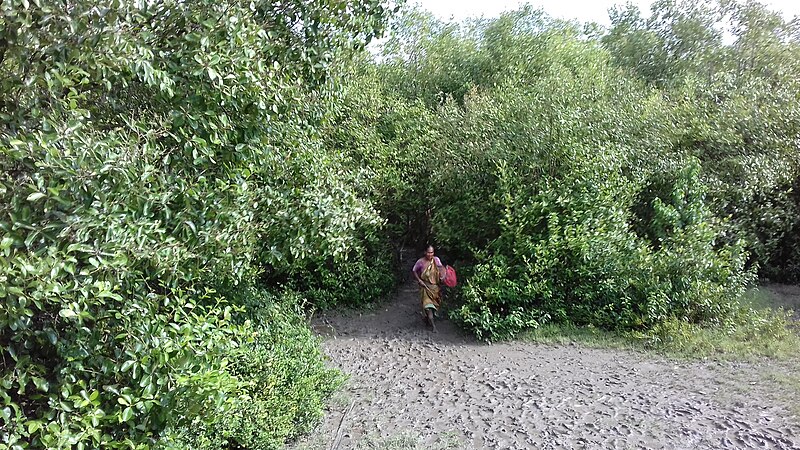
Undergoing a complete morphological transformation twice every day due to the powerful action of flow and ebb tides, the mudflats of the Sundarbans represent one of the most dynamic living estuarine ecosystems on Earth. As the water rapidly recedes alongside your boat, look down at the glistening dark mudflats emerging from beneath the tide. …
07 Closing
We extend our heartfelt gratitude to you for joining us on this comprehensive audio guide tour of Sundarbans National Park, the world's largest single patch of mangrove forest and an extraordinary sanctuary of global significance. Throughout our journey today along the labyrinthine tidal waterways, we have explored the miraculous respiratory roots of the mangroves, the rich bird sanctuary of Sajnekhali, and the extraordinary realm where the Royal Bengal tiger reigns supreme over land and water. …