Contents
History & cultureBY TELLBY7 sections · numbered as on the map01 Orientation
Welcome to the Yazılıkaya Rock Sanctuary, the most sacred open-air holy site of the Hittite Empire. Located on the rugged limestone slopes of Boğazkale in central Anatolia, Turkey, this extraordinary sanctuary stands apart from traditional roofed Bronze Age temples, having been sculpted directly into the natural clefts of massive living rock outcrops. The name Yazılıkaya translates to inscribed rock in the local language, reflecting how ancient Hittite artisans carved their vast pantheon of deities directly into the cliff faces thousands of years ago. Inscribed as a UNESCO World Heritage site alongside the imperial capital, this sanctuary reached its definitive architectural and artistic form during the late thirteenth century BCE under the Hittite New Kingdom, situated just two kilometers northeast of the monumental gates of Hattusha.
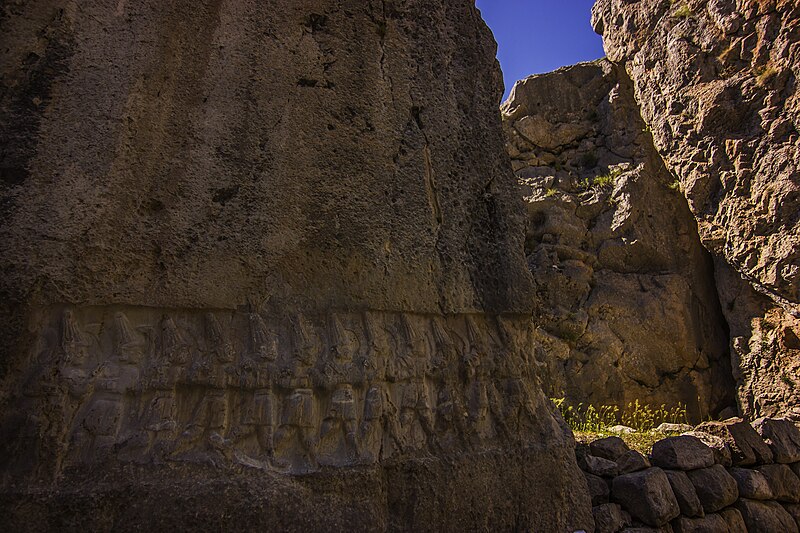
At the entrance where you now stand, a complex of grand temple halls and courtyards once completely separated the sacred rock chambers from the secular outside world. Although the roofs and upper stone walls have long dissolved through the passage of millennia, leaving only stone foundations and clear ground outlines today, ancient worshippers once gathered within these formal entrance structures to prepare themselves mentally and spiritually before stepping into the open-air galleries beyond. Across the entire sanctuary, a total of eighty-three sculpted figures and portraits are preserved, representing the comprehensive religious worldview of the empire. The sanctuary is divided into two primary natural rock galleries: Chamber A, the larger open-air hall featuring a grand procession of sixty-four divine figures marching along its rock faces, and Chamber B, a narrower, more secluded gallery devoted to royal posthumous commemoration and the mysteries of the underworld.
Our audio tour today will guide you step by step along this ancient sacred pathway. We will begin at the stone foundation ruins of the entrance temple complex before walking into the soaring rock gallery of Chamber A to behold the dramatic meeting of the supreme divine pair. Afterward, we will pass through a shaded rock fissure guarded by winged lion-headed demon reliefs to explore the intimate carvings of the Sword God and the divine embrace in Chamber B. As you walk along these ancient stone paths, you are retracing the exact steps taken by Hittite Great Kings and high priests during sacred spring New Year festivals and state rituals. Listen closely to the timeless stories etched into these towering limestone cliffs. Let us now focus our attention on the ancient stone foundations before us as we begin our immersive journey into the spiritual heart of the Hittite world.
02 Foundations of the Entrance Temple
Thousands of years ago, this very threshold was completely enclosed by a massive roofed temple structure that severed the outer mundane world from the sacred rock sanctuary within. Look closely at the stone pillar bases and the rugged foundations of walls remaining around your feet and across the surrounding ground. …
03 Chamber A Procession and King Tudhaliya IV
On the towering rock walls surrounding you in Chamber A, intricate Luwian hieroglyphic inscriptions are carved directly above the head of each deity, allowing modern scholars even after thousands of years to read the precise name and attributes of every single god. As you step into this primary open-air gallery, look toward the left cliff face where a long line of male deities marches forward wearing traditional short kilts, pointed footwear, and horned caps. …
04 Chamber A The Meeting of Teshub and Hebat
This central relief section represents a monumental synthesis of religious union, harmonizing the deities of countless conquered nations to complete the divine cosmic order of the Hittite Empire. Focus your attention on the center of the main wall, where Teshub, the supreme storm god standing upon the bowed shoulders of two mountain gods, meets Hebat, the sun goddess who stands firm atop a fierce panther. …
05 Chamber B Entrance and the Demon Guardian
This narrow rock passage was regarded by ancient worshippers as the literal gateway to the underworld, where travelers believed they had to seek divine permission from terrifying demon guardians before stepping safely into the sacred realm beyond. As you step close to the entrance of the rock fissure, look carefully at both side walls of the narrow passage where reliefs of winged, lion-headed demons stand like eternal sentinels guarding the threshold. …
06 Chamber B The Sword God and King in Divine Embrace
Here stands an extraordinary rock relief of the Sword God, whose hilt integrates a human head with four crouching lions, while its long blade drives deep into the living bedrock earth. As you stand inside Chamber B, turn your eyes to the right rock wall to behold the remarkable figure of Nergal, the underworld god carved in the monumental form of a sword. …
07 Closing
Thank you for visiting the Yazılıkaya Rock Sanctuary with our audio guide today. We hope this immersive journey through these ancient stone chambers has given you a profound appreciation for the spiritual life, theological sophistication, and open-minded culture of the Hittite Empire. Rather than suppressing the native traditions of conquered lands, the Hittites systematically embraced foreign deities into their official state religion, earning their civilization the famous historical title of…