 Photo Wikimedia Commons
Contents
History & cultureBY TELLBY7 sections · numbered as on the map01 Orientation
Welcome to the tranquil valley of Taxila, where ancient stone paths hold the spiritual memories of two millennia. You are currently standing at the magnificent Dharmarajika complex, beautifully situated along the quiet banks of the Tamra stream, just south of the rising Hathial ridge and approximately three kilometers east of the modern Taxila Museum. Among the many monastic settlements scattered across this ancient crossroads, Dharmarajika stands preeminent as the oldest, most expansive, and most historically significant Buddhist sanctuary in the entire region.
Recognizing the immense cultural and historical weight of these remaining ruins, UNESCO officially designated the ancient monuments of Taxila as a World Heritage site in nineteen eighty. This global honor acknowledges how Taxila served as a supreme center of learning, art, and faith, where Eastern philosophy and Hellenistic aesthetics intertwined along the busy trade corridors of Asia.
The sacred name Dharmarajika carries a profound spiritual meaning deeply rooted in the history of the faith. It derives from Dharmaraja, meaning the Lord of Law, a title devoutly bestowed upon Gautama Buddha. It also reflects the royal epithet assumed by Emperor Ashoka, who founded the initial shrine to house sacred bodily relics of the Enlightened One. Locally, however, the site is widely known as Chir Tope, a evocative local phrase meaning Scarred Hill. This colorful name describes the deep, gaping trenches cut through the earthen mounds over centuries of decay and early archaeological exploration.
As you look across the landscape, you will notice that the complex is organized into two distinct functional zones. The southern section forms the primary sacred precinct, dominated by the colossal central core stupa and enclosed by a labyrinth of smaller votive monuments, image chapels, and private shrines. To the north lies the sprawling monastic area, a quiet quadrangle of stone residential cells, assembly rooms, and domestic quarters where hundreds of monks lived, recited scriptures, and pursued spiritual liberation.
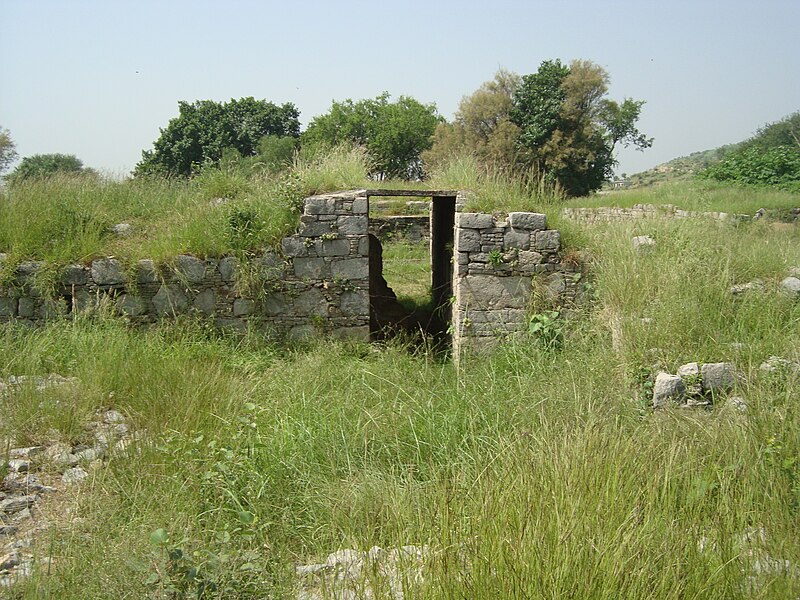
To begin your immersive journey through this sacred sanctuary, please follow the designated stone path leading forward toward the ancient ceremonial entrance display structure, known to archaeologists as Building H.
02 Building H: The Portal of Sacred Relics
Before you set foot inside the sacred inner circle of the main sanctuary, standing directly in front of the weathered stone remains of Building H brings you face-to-face with an astonishing and unyielding ancient rule of worship. Centuries ago, pilgrims traveling to this holy mountain refuge from the bustling, grid-planned Hellenistic city of Sirkap—located just a short distance to the northwest—were strictly forbidden from stepping into the primary stupa courtyard or approaching the central…
03 The Main Stupa and the Path of Circumambulation
Standing at the physical and spiritual heart of the sanctuary before the Great Core Stupa presents a truly staggering encounter with ancient monumentality. This immense sacred shrine rests upon a massive circular stone drum spanning an extraordinary one hundred thirty-one feet in diameter, with its cylindrical stone base rising forty-five feet high above the surrounding courtyard.
Please step directly onto the wide, stone-paved circumambulation path that circles the base of the monument. …
04 The Votive Stupas and Stucco Art of Northern Avenue
As you leave the central mound and explore the dense labyrinth of smaller peripheral stupas, you encounter an astonishing divergence in how ancient Buddhist sanctuaries were funded and created. Unlike other legendary sites such as Sanchi in central India, where monuments were constructed through collective community donations, these surrounding votive stupas were built individually by single wealthy patrons, prosperous Silk Road merchants, and prominent foreign donors who sought to generate…
05 Life in the Monasteries and the Hun Invasions
Stepping out of the sacred stupa courtyard and into the northern monastic area brings you face-to-face with a deeply tragic turning point in ancient history. In the fifth century CE, this serene intellectual complex—which had served for centuries as a thriving university housing dozens of resident monks, scholars, and translators—was brutally sacked and burned to the ground by invading White Hun forces, bringing a violent and permanent end to over six hundred years of continuous monastic…
06 The Discovery of the Silver Scroll Inscription
Standing before this modest perimeter side chapel brings you to the exact spot of one of the most astonishing breakthroughs in Asian archaeological history. Inside this unpretentious stone room, archaeologists uncovered a delicate silver casket that held a tightly rolled silver scroll. When carefully unrolled and translated, the ancient inscription etched upon its surface provided the precise calendar year and historical backstory for the enshrinement of Gautama Buddha's sacred bone relics at…
07 Closing
Standing upon this elevated vantage point looking out over the rolling stone contours and quiet earthen mounds of Chir Tope, your walking audio tour through a millennium of Gandharan history comes to a peaceful close. From this panoramic viewpoint, the full scale of the sanctuary spreads before your eyes. …