Contents
History & cultureBY TELLBY8 sections · numbered as on the map01 Orientation
Welcome to the Daimabad Archaeological Site, an extraordinary historical location where the ancient past of the Indian subcontinent comes alive in vivid detail. You are currently standing in the Shrirampur taluka of Ahmednagar district in Maharashtra, India. This celebrated heritage zone is situated on the left bank of the Pravara River, which flows as a major tributary into the great Godavari River. Daimabad is widely recognized by historians and archaeologists as a critical landmark because its rich discoveries prove that the Late Harappan civilization extended its cultural and technological influence far south into the Deccan Plateau. The archaeological story of this site began in nineteen fifty eight when it was first identified by the researcher B P Bopardikar. Following this monumental discovery, expert teams from the Archaeological Survey of India undertook three major series of excavations to systematically uncover the ancient settlement. The initial excavation was carried out between nineteen fifty eight and nineteen fifty nine under the direction of M N Deshpande. A second phase of detailed exploration was led by S R Rao in nineteen seventy four and nineteen seventy five. Finally, between nineteen seventy five and nineteen seventy nine, S A Sali directed the third and most comprehensive excavation at the site. These digs revealed a continuous occupational deposit measuring five meters in thickness, containing five distinct Chalcolithic cultural phases based on their characteristic painted ceramics. Archaeologists unearthed remarkable painted pottery, refined tools, and sophisticated bronze objects that reflected clear Harappan stylistic influences mixed with local traditions. Fascinatingly, evidence indicates that after its last inhabitants deserted the village at the beginning of the first millennium BCE, around one thousand BCE, Daimabad remained entirely uninhabited and undisturbed by human presence for over three thousand years until modern excavations commenced. As you walk through these tranquil grounds today, you are exploring an intact window into prehistoric times. Please follow our audio guide as we take you through each fascinating stratum of this site, unravelling the rich daily life, trade networks, metallurgical achievements, and cultural heritage of the ancient communities who once flourished along the Pravara River.
02 Savalda Culture Habitation Zone
You are now observing the lowest and earliest occupational stratum of Daimabad, representing Phase One, known as the Savalda Culture habitation zone. Radiocarbon dating and comprehensive archaeological analysis place this foundational period before twenty three hundred or twenty two hundred BCE, making it the absolute oldest settled village layer discovered at the site. …
03 Late Harappan Settlement and Burial Mound
We are now standing at the site of Phase Two, representing the Late Harappan culture settlement and burial mound, dated from approximately twenty three hundred or twenty two hundred BCE to eighteen hundred BCE. During this transformative period, the village at Daimabad expanded dramatically to cover an impressive total area of about twenty hectares, indicating a substantial increase in population, trade activity, and overall structural organization. …
04 Daimabad Culture Pottery and Smelting Site
You have reached the zone representing Phase Three, designated as the Daimabad Culture phase, which flourished between eighteen hundred BCE and sixteen hundred BCE. Stratigraphic analysis of the site revealed a fascinating historical detail: a break in occupation lasting approximately half a century occurred between the end of the Phase Two Late Harappan period and the beginning of Phase Three. …
05 Malwa Culture Temple and Coppersmith Workshop
You are now standing in the area corresponding to Phase Four, which represents the Malwa Culture period, dating from approximately sixteen hundred BCE to fourteen hundred BCE. This phase is characterized by significant advances in domestic architecture, organized metallurgy, and elaborate religious practices. The mud houses built during the Malwa phase were remarkably spacious and predominantly rectangular in plan. …
06 Jorwe Culture Fortification and Occupational Huts
You have arrived at the zone corresponding to Phase Five, representing the fortified settlement and occupational quarters of the Jorwe Culture, which spanned from fourteen hundred BCE to one thousand BCE. During this final Chalcolithic phase, Daimabad expanded to its maximum size of approximately thirty hectares, solidifying its status as the largest prehistoric regional center in Maharashtra. …
07 Discovery Site of the Daimabad Bronzes
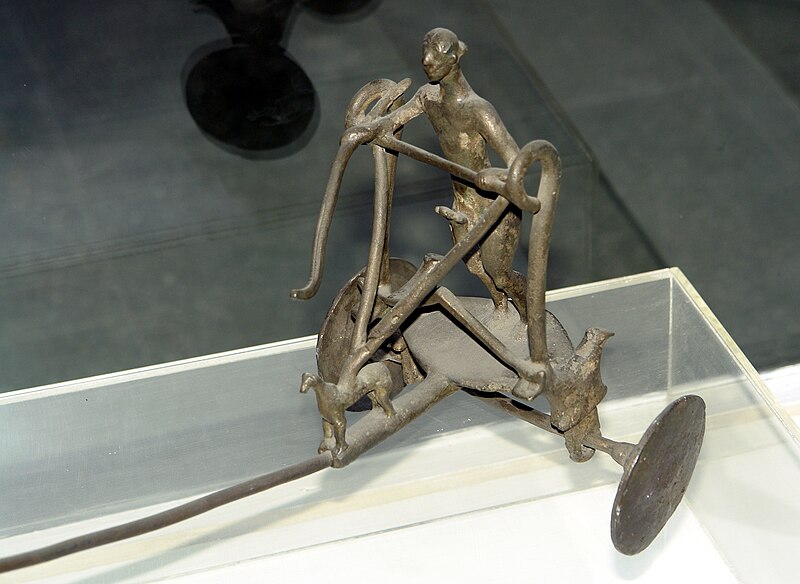
You are standing at the exact location where one of the most astonishing archaeological treasures in Indian history was uncovered, known as the Daimabad Bronze Hoard. In nineteen seventy four, a local villager named Chhabu Laxman Bhil from the Bhil community was digging for firewood at the base of a wild shrub when his tools struck a cache of heavy metal objects. …
08 Closing
Thank you very much for joining us on this audio guide tour of the Daimabad Archaeological Site. As you have discovered during your walk today, Daimabad fell into a profound silence when its last Chalcolithic inhabitants abandoned the settlement at the beginning of the first millennium BCE, around one thousand BCE. …