Contents
History & cultureBY TELLBY7 sections · numbered as on the map01 Orientation
Welcome to Lamu Old Town, an extraordinary living heritage site serenely anchored along the East African coastline. You are standing on the historic waterfront where the glittering waters of the Indian Ocean meet a maritime settlement shaped by centuries of continuous human narrative. Situated on Lamu Island approximately three hundred and fifty kilometers north of Mombasa, this sanctuary belongs to the larger Lamu Archipelago, which includes the neighboring islands of Manda, Pate, and Kiwayu. Covering a central historic core of over fifteen hectares, Lamu Old Town is renowned as the oldest and best preserved Swahili settlement in East Africa. While numerous competing coastal seaports along the Swahili coast were abandoned over time, Lamu has remained continuously inhabited for more than seven hundred years, sustaining its functional urban life and vibrant traditions across generations. This living urban landscape achieved global recognition as a World Heritage site not merely for its surviving architecture, but as the authentic cradle of Swahili civilization. Over seven centuries, intense commercial and cultural interactions among indigenous Bantu communities, Arab traders, Persian migrants, Indian merchants, and European maritime powers generated a uniquely sophisticated coastal culture. Looking inland from the seafront landing, your eyes meet a majestic panoramic shoreline lined with two-storey stone structures. The continuous rows of open ground floor arcades and airy upper verandas offer a striking visual harmony to all who approach the island by sea. As you venture beyond the harbor promenade into the interior town, motorized vehicles are completely absent, giving way to the soft rhythms of foot traffic and burdened donkeys. The intricate labyrinth of narrow, winding streets was thoughtfully engineered according to historic Arab land distribution principles and urban planning traditions. These tight thoroughfares define small residential wards known as mitaa, where closely related family lineages have resided side by side for centuries in profound social cohesion. The structural integrity of the town relies on native natural resources, combining porous coral rag stone, hand smoothed lime mortar, and resilient mangrove timber poles engineered to endure intense tropical moisture and marine salinity. With over sixty five percent of its historical structures maintained in excellent physical condition, Lamu stands as an exceptional testament to Swahili architectural technology. As the sea breeze carries the soft sounds of this timeless port, let us embark on an unforgettable walking journey through seven centuries of living history.
02 Lamu Museum: Swahili Ethnography and Woodworking
You are standing before the flagship repository of regional coastal heritage, the main building of the Lamu Museum. Facing the tranquil waters of the harbor, this magnificent coral stone structure was originally commissioned in the early nineteen hundreds as a private town residence for Abdallah Bin Hemed Said Al Busaidy, a paramount confidant to the Sultan of Zanzibar. Over the decades, this aristocratic mansion experienced extraordinary historical transitions. …
03 Mwana Arafa Jambeni: History of Resilience and Adaptation
Walking along the seafront promenade past the donkey sanctuary brings you to the Mwana Arafa Jambeni building, a historic nineteenth-century residence of immense architectural charm. Locally remembered for decades as Daktari wa Ng'ombe, or the District Veterinary Office, this grand stone structure endured a harrowing historical chapter. …
04 Lamu Fort Library: From Prison to Knowledge Sanctuary
Passing through the monumental arched gateway of the Lamu Fort leads you into a tranquil interior courtyard housing the Lamu Fort Library. Between nineteen ten and nineteen eighty-four, this imposing defensive fortress served as a high-security prison, detaining inmates behind thick masonry walls. Following its decommission as a penal institution in nineteen eighty-four, the National Museums of Kenya executed an extensive rehabilitation project, officially opening this library in nineteen…
05 Swahili House and Street Labyrinth: Inner Courtyards and Niches
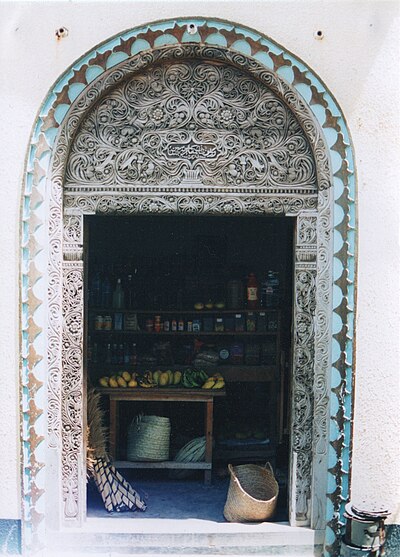
Wandering deeper into the winding residential alleys brings you into contact with the secret interior world of Swahili domestic architecture. Viewed from the street, traditional Swahili stone houses display plain, unadorned exterior facades built of rough coral stone, featuring almost no windows at ground level to guarantee absolute family privacy. …
06 Riyadha Mosque and Seafront Barazas: Community and Faith
Arriving in the central gathering square brings you before the historic Riyadha Mosque, surrounded by wide stone seating benches. Established in the nineteenth century, this mosque developed into one of the most paramount centers for Islamic scholarship and Swahili cultural learning in East and Central Africa, attracting scholars and pilgrims from across the Western Indian Ocean. …
07 Closing
You have now journeyed through the historic streets, world-class museum galleries, and sacred gathering spaces of Lamu Old Town, where over seven hundred years of continuous human history resonate in every coral stone wall. As you stand by the waterfront listening to the soft lap of Indian Ocean waves, take a quiet moment to reflect on the extraordinary living character of this coastal sanctuary. …