 Photo Wikimedia Commons
Contents
History & cultureBY TELLBY7 sections · numbered as on the map01 Orientation
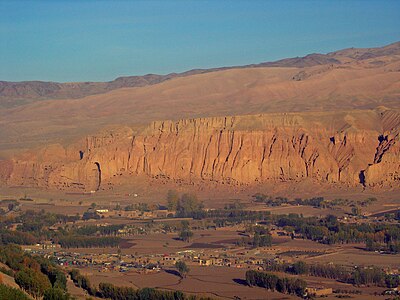
Welcome to the breathtaking Bamiyan Valley, a monumental sanctuary resting deep within the high plateau of the Hindu Kush mountains at an elevation of two thousand five hundred meters. Situated at a vital crossroads of the historic Silk Road, this extraordinary valley served as a profoundly sacred haven where merchants, travelers, and Buddhist monks found physical rest and spiritual solace after enduring grueling journeys across arid deserts and treacherous mountain passes. The site stands recognized as a UNESCO World Heritage Site because it preserves an irreplaceable testament to the profound cultural exchange and artistic synthesis between Eastern and Western civilizations that flourished along these ancient trade routes over many centuries. Long ago, devout Buddhist monks gathered within this secluded valley, laboriously carving hundreds of monastic caves directly into the towering sandstone cliff faces. Living as hermits in small cave chambers cut into the rock, these dedicated practitioners devoted their lives to quiet meditation, spiritual contemplation, and the pursuit of ultimate truth. To express their deep faith, they adorned the interior walls of their caves with elaborate religious sculptures and brightly colored frescoes that reflected the rich traditions of Gandharan art. As caravans moved along the Silk Road, wealthy merchants, regional rulers, and nobility offered generous patrons and gifts to these monastic communities to seek divine protection for their perilous travels and secure prosperity for their trading empires. Supported by this royal and commercial patronage, master artisans undertook the monumental task of hewing colossal Buddha statues directly out of the living sandstone rock. Standing majestically within immense arched niches, these giant sculptures dominated the landscape, inspiring awe and reverent devotion in all who passed through the valley. The valley became a vibrant epicenter where Indian Buddhist philosophy, Persian imperial traditions, and Hellenistic artistic styles seamlessly intersected. Though centuries of environmental exposure and historical turmoil have dimmed their original vibrant colors and altered their physical form, the sacred energy and artistic devotion embedded within these rock walls continue to resonate powerfully today. As you walk through this historic valley surrounded by dramatic cliffs and ancient caves, you are invited to explore a magnificent legacy where faith, art, and history seamlessly converge. Let the quiet serenity of the valley guide your steps as we begin our journey into the wondrous history of Bamiyan.
02 The Eastern Buddha Niche: The Sacred Shah Mama
The thirty eight meter Eastern Buddha, constructed around five hundred seventy CE during the reign of the Hephthalite principalities, holds the remarkable distinction of being carved decades earlier than the even larger Western Buddha standing nearby. Direct your gaze along the soaring sandstone wall directly before you, where the imposing outline of the Eastern niche recesses dramatically into the cliff face. …
03 Ceiling Mural: The Sun God on a Golden Chariot
The presence of a grand mural depicting a solar deity, blending Greco Roman stylistic elements and Iranian Persian mythology right on the ceiling directly above the head of the Buddha in a Buddhist sanctuary, represents a magnificent synthesis of global cultures. Cast your gaze upward into the shadow of the concave vaulted ceiling medallion of the niche. …
04 Side Wall Murals: The Hephthalite Royal Donors
The prominent patrons who provided immense financial resources and political backing to erect the monumental Buddhas of Bamiyan were the ruling elites of the Hephthalites, a northern nomadic people characterized by round, beardless faces and distinct nomadic traditions. Direct your gaze along the lower sandstone wall lining both flanks of the niche where painted processions of historical figures are clearly depicted. …
05 The Western Buddha Niche: Salsal, Light of the Universe
The colossal fifty five meter Western Buddha, affectionately known as Salsal, was revered as the tallest standing carved Buddha statue in the entire world prior to its tragic destruction in March two thousand one. Direct your view toward the colossal sandstone archway opening ahead, where a gigantic niche reaching fifty eight meters high is deeply recessed into the sandstone cliff face. …
06 Adjoining Caves: The World's Earliest Oil Paintings
The groundbreaking scientific discovery that the earliest surviving oil paintings in human history were created right inside these Bamiyan cave chapels during the middle seventh century, predating the European invention of oil painting by as much as six hundred years, completely revolutionized global art history. Direct your gaze along the dark rock openings honeycombed across the cliff wall and observe the delicate remnants of painted murals still clinging to the sandstone surfaces. …
07 Closing
Standing here at the central viewing platform, the panoramic vista of the Bamiyan Valley offers a profoundly moving experience that lingers deep within the human soul. Following the tragic destruction in March two thousand one, the colossal Buddha statues vanished, leaving behind towering empty niches cut into the sandstone cliff face. …