 Photo Wikimedia Commons
Contents
History & cultureBY TELLBY8 sections · numbered as on the map01 Orientation
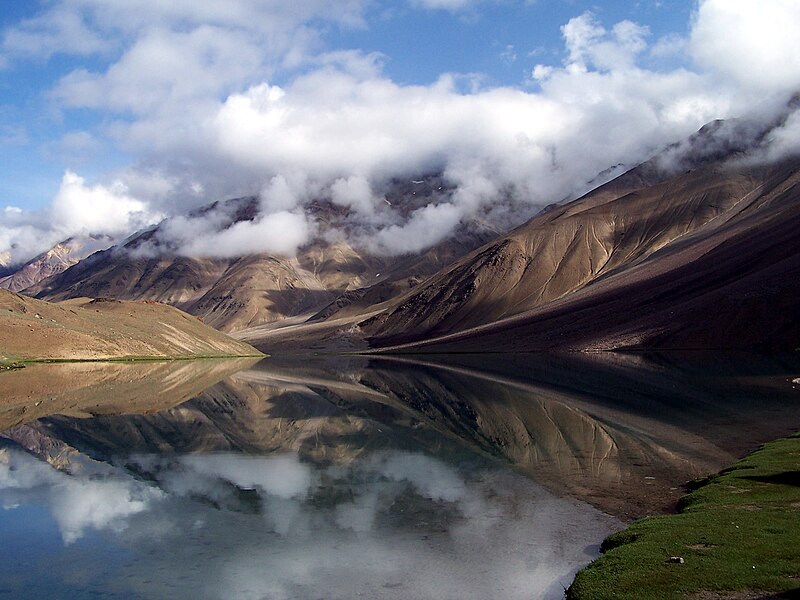
Welcome to the official high altitude audio guide for Chandra Taal, the legendary jewel of the Western Himalayas. You have safely arrived at the breathtaking Samudra Tapu plateau in the Lahaul and Spiti district of Himachal Pradesh, India, standing at an impressive elevation of approximately four thousand three hundred meters above sea level. Having traveled past the rugged outpost of Batal and over the formidable Kunzum Pass, you now stand upon a pristine alpine plain nestled secretly between the Chandra River valley and the snow capped peaks of the Chandrabhaga mountain range. Geographically, Chandra Taal belongs to the Chandra River drainage basin within Lahaul, yet because Kunzum Pass acts as the high mountain gateway separating Lahaul and Spiti, this region is intimately connected with the Spiti travel experience. In the local native language, the name Chandra Taal translates directly to the Lake of the Moon. This poetic designation stems from the natural crescent formation of the water body, which mimics the gentle curve of a half moon resting amid stark mountain topography. Even in this harsh and high altitude environment, the lake shines like a tranquil turquoise oasis sheltered in a natural mountain basin. Because you are currently located at an altitude exceeding four thousand meters, the atmospheric pressure is remarkably low, meaning the air is thin and oxygen levels are substantially reduced while solar radiation is exceptionally intense. To prevent acute mountain sickness and physical exhaustion, it is essential to move at a slow and deliberate pace, drink plenty of water, and allow your body adequate time to acclimatize properly. The weather in this high desert environment remains chilly throughout the daytime, and as soon as the sun dips below the western ridges, temperatures plunge dramatically, often reaching minus five degrees Celsius even during the peak summer months. Visitors must come prepared with heavy thermal layering, windproof jackets, insulated gloves, and warm headwear. To preserve this eco sensitive sanctuary, strict conservation guidelines are enforced. Overnight camping along the immediate shoreline is strictly prohibited to prevent water contamination and land degradation. Camping is permitted only at regulated campsites located two kilometers prior to the lake. Furthermore, local communities hold Chandra Taal in profound spiritual reverence as a holy sanctuary. Visitors must respect this sacred environment by avoiding loud vocal noises, music playback, or any disruptive behavior. Every piece of trash and personal waste must be packed out completely without leaving a trace behind, and hikers must remain strictly on established footpaths to protect the delicate alpine flora. With steady breathing and a respectful mind, let us now step forward to explore the sacred Lake of the Moon.
02 The Final Approach: Walking Trail from the Parking Area
We are currently standing at the trailhead of the final walking path, having arrived at the end of the unpaved mountain road that branches off from National Highway five hundred five. To reach this remote location, travelers navigate a dramatic journey either from Manali via the Atal Tunnel, Gramphu, and Chatru covering approximately one hundred twenty kilometers, or from Kaza across the lofty Kunzum Pass covering about ninety six kilometers. …
03 The Crescent Turquoise Waters: First View of the Lake
The very moment you round the final bend of the walking trail, the astonishing panorama of Chandra Taal opens grandly before your eyes. Spreading gracefully beneath the vibrant blue Himalayan sky, the lake exhibits its iconic crescent formation, resembling a celestial half moon resting peacefully amid high mountain solitude. …
04 The Blooming Meadows: Alpine Wildflowers and Grazing History
As we walk along the expansive alpine meadows fringing the shores of Chandra Taal, we encounter a landscape steeped in rich botanical beauty and historical pastoral tradition. Broad grasslands stretch smoothly across the banks of the lake, forming a vibrant green ribbon against the surrounding arid mountains. …
05 Glacial Cirque and Scree Slopes: Source of the Chandra River
Positioned along this elevated observational vantage point, we can closely examine the dramatic glacial cirque and scree slopes that form the geological foundation of Chandra Taal. Looking across the soaring rock faces surrounding the water, one can trace the powerful forces of glacial erosion that carved this high mountain landscape over millennia. Geologically, Chandra Taal is classified as a classic glacial cirque lake and high altitude freshwater body. …
06 Ramsar Site and Alpine Sanctuary: Fauna of Chandra Taal
Positioned along the lake sanctuary, this section highlights the ecological significance of Chandra Taal as an internationally recognized wetland refuge. On November eighth, two thousand five, the site was officially designated as the Chandertal Wetland Ramsar Site, bearing official reference number fifteen sixty nine. It is distinguished as one of only two high altitude wetlands in India to receive this prestigious conservation status under the Ramsar Convention. …
07 The Circuit Trail and Stargazing: A Celestial Theater
One of the most rewarding activities at Chandra Taal is trekking along the three to four kilometer circuit trail that loops completely around the lake shore. Walking this scenic loop requires approximately one to two hours of gentle hiking, offering constantly changing vantage points of the turquoise waters and surrounding mountain peaks. …
08 Closing
Our audio guide tour of Chandra Taal, the sacred Lake of the Moon, has now come to its official conclusion. As the sun begins to set behind the soaring Himalayan crests, temperatures in this high altitude desert environment plummet rapidly below freezing. For your personal health and safety, please begin your return walk before daylight fades, heading back toward the designated campsites or onward to your next destination such as Batal, Kunzum Pass, Kaza, or Manali. …