Contents
History & cultureBY TELLBY7 sections · numbered as on the map01 Orientation
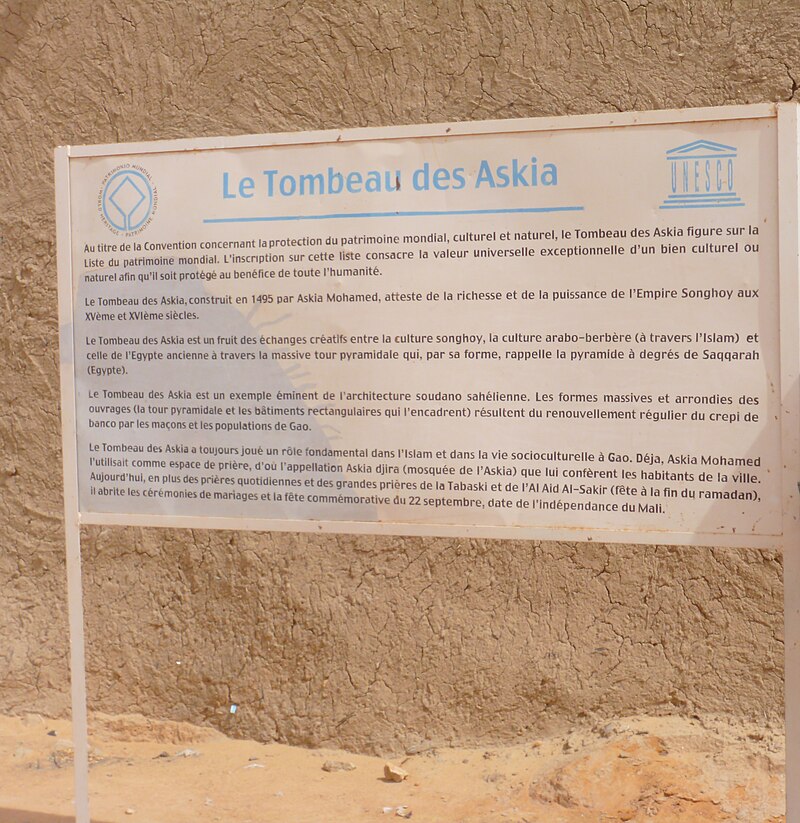
Welcome to the entrance of the Tomb of Askia complex, one of the most extraordinary earthen architectural masterworks in the West African Sahel. Situated in the historic city of Gao near the banks of the Niger River, approximately three hundred and twenty kilometers east-southeast of Timbuktu, this monumental complex was established in 1495 during the golden age of the Songhai Empire. Following his transformative pilgrimage to Mecca, Emperor Askia Mohamed declared Islam the official state religion and commissioned this grand sanctuary in his imperial capital. The Tomb of Askia represents a brilliant synthesis of West African indigenous building techniques and Islamic architectural requirements, illustrating how local master masons adapted North African and Sahelian influences to satisfy sacred functions. The core property spans 4.24 hectares and is buffered by an expansive 82-hectare protection zone that encompasses the surrounding historic urban fabric, stretching between the Gadeye and Farandjireye quarters down to the riverbank. Gao itself appears as a striking desert oasis along the Niger, where rectilinear streets are lined with traditional mud-brick courtyard homes with flat earthen roofs, creating a harmonious urban backdrop for this monumental sanctuary. At the heart of the four-hectare site stands the dramatic seventeen-meter-high stepped pyramidal tomb tower, serving historically both as a monumental royal landmark and as the central minaret of the Great Mosque. Flanking this central earthen pyramid are two flat-roofed mud-brick sanctuary buildings designed as sacred prayer halls: the larger hall for men on the east and a smaller, independent hall for women on the west. Enclosing these structures is an extensive ancestral cemetery containing historic stone stelae with Arabic epigraphy, while to the east extends a vast one-hectare open-air assembly ground used for collective gatherings during the grand festival of Tabaski. The property was inscribed on the UNESCO World Heritage List in 2004 under criteria (ii), (iii), and (iv) for its Outstanding Universal Value as an exemplary vestige of the Songhai Empire and its living tradition of earth construction. However, following political instability and armed conflict in northern Mali in 2012, combined with severe water erosion from winter rainstorms, the property was added to the List of World Heritage in Danger. As you begin your visit today, you step into a living sanctuary where centuries of spiritual devotion, imperial legacy, and local community resilience converge.
02 The Pyramidal Tower and Scaffolding Timbers
The seventeen-meter-high stepped pyramidal tower standing at the core of the Tomb of Askia complex is a breathtaking earthen monument wrapped in legends claiming it was built using mud and timber brought directly from Mecca by the emperor himself. Look up at the soaring walls of the pyramid. You will notice dozens of weathered wooden perches projecting dramatically outward from the earthen surface in all directions. …
03 The Men's Prayer Hall and Sanctuary Pillars
Located directly east of the central pyramid tower, the Men's Prayer Hall is a grand sacred sanctuary supported by a dense forest of sixty-nine stout mud-brick pillars that hold up a massive flat roof. Walk deeper into the quiet sanctuary and look at the middle of the easternmost wall, where you will observe a distinctive double-niched mihrab carved gracefully into the earthen plaster. …
04 The Women's Prayer Hall and Community Resilience
Situated directly to the west of the central pyramidal tower, the Women's Prayer Hall stands in balanced architectural symmetry with the Men's Hall, representing an exceptionally rare standalone female sanctuary in the West African Sahel. Take a moment to examine the low earthen wall on your left and the carefully finished flat roof structure above. …
05 The Mosque Cemetery and Royal Burial Mystery
Extending outside the inner boundary wall that surrounds the tomb and prayer halls lies the ancient Islamic cemetery, a deeply revered burial ground that remained actively in use until the late 1980s for descendants of the Askia dynasty and the esteemed Haidara family line. Look down at your feet and across the surrounding earth to observe the numerous low stone stelae carved with intricate Arabic epigraphy. …
06 Open-air Assembly Ground and the Legend of Tondi Kara
Sprawling across one hectare on the eastern side of the complex, the Open-air Assembly Ground is a vast public plaza where the entire Muslim population of Gao gathers for grand communal prayers during the annual Tabaski festival. Look across the open plaza toward the assembly mihrab structure erected in 1970 using modern materials. …
07 Closing
Thank you for joining this audio guide tour of the Tomb of Askia complex. The monumental earthen architecture you have explored today is far more than a physical vestige of the past; it is a vibrant, living heritage sustained by the spiritual devotion and enduring stewardship of the people of Gao. For over five centuries, this grand sanctuary has survived through the relentless cycle of Sahelian climate challenges, seasonal rainfall, and sand-laden desert winds. …