 Photo Wikimedia Commons
Contents
History & cultureBY TELLBY7 sections · numbered as on the map01 Orientation
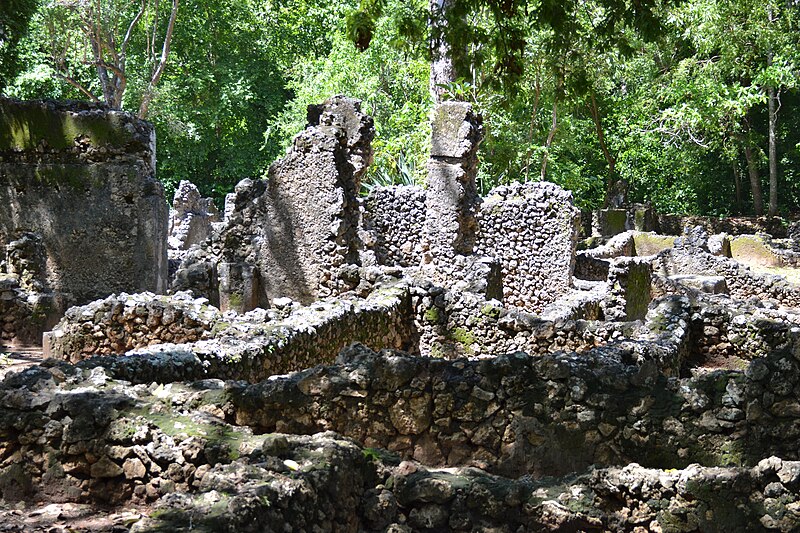
A very warm welcome to the Ruins of Gedi, a magnificent ancient stone city hidden deep within the dense coastal forest of Arabuko-Sokoke in Kilifi County, near the coastal town of Malindi in eastern Kenya. In July twenty twenty four, this extraordinarily preserved archaeological sanctuary earned official recognition as Kenya's eighth UNESCO World Heritage site. It stands as one of the most complete and evocative testaments to the Swahili urban civilization that flourished along the East African coast from the tenth through the seventeenth centuries. As you step off the coastal road and walk along shaded forest pathways under a thick canopy of indigenous trees and giant baobabs, you are stepping back into a prosperous medieval metropolis that once housed over two thousand five hundred residents. Although located near the Indian Ocean coastline and Mida Creek, Gedi was uniquely situated slightly inland within the primeval forest. This strategic positioning provided natural defense against maritime raiders, access to fertile agricultural land, and continuous fresh water supplies from underground wells. During its golden era between the fourteenth and sixteenth centuries, Gedi was a vital node in the vast Indian Ocean trade network connecting East Africa with Arabia, Persia, India, Southeast Asia, and China. Wealthy merchants living in this stone-built city exchanged indigenous African commodities such as elephant ivory, refined gold, ebony timber, copal gum, and mangrove poles for luxurious overseas imports. Excavations have unearthed fine porcelain bowls from Ming Dynasty China, glazed ceramics from Persia, colorful glass cane beads from Venice, iron lamps, and metal scissors from Spain. Managed today by the National Museums of Kenya, the site preserves an intact urban landscape featuring coral rag defensive walls, grand mosques, an elaborate royal palace, elite residences, and ancient cemetery tombs. As you begin this guided audio walking tour, take a moment to listen to the soft rustle of leaves, the call of coastal birds, and the gentle breeze moving through ancient branches. Together, we will uncover the architectural genius, vibrant daily life, trade connections, and unsolved mysteries of this silent Swahili sanctuary.
02 The Outer Wall: Boundary of Forest and Civilization
The very first architectural monument we encounter along our walking route is the grand outer defensive wall and its formal stone gateway. A truly surprising fact about this expansive perimeter is that although it enclosed an area of forty five acres, modern archaeological investigations reveal it served primarily as a social boundary and status marker rather than a formidable military fortification designed to resist heavy artillery. …
03 The Palace: Seat of the Sheikh
Passing through the outer gateway and moving directly into the heart of the urban core, we arrive at the expansive Royal Palace Complex, which served as the seat of power for Gedi's ruling Sheikh. Open your imagination to one of the most surprising architectural facts discovered at this site: high-value porcelain bowls brought from Ming Dynasty China were embedded directly into the smooth lime plaster spandrels and archways of this palace as opulent interior decoration. …
04 The Great Mosque: Prayer Without Minarets
Following the grid-pattern stone street from the palace complex brings us directly to the Great Mosque, the largest and most sacred religious monument in Gedi. An intriguing and surprising fact about this grand place of worship is that despite being one of the most substantial medieval Islamic halls along the East African coast, it was built without a minaret tower. …
05 The Dated Tomb: Key to Gedi's Timeline
Stepping into the peaceful cemetery section adjacent to the Great Mosque, we stand before the celebrated Dated Pillar Tomb. The most surprising aspect of this monument is that it provided archaeologists with the single most critical chronological key for dating the entire city of Gedi. Tall pillar tombs constructed of refined coral masonry represent a highly distinctive architectural style unique to medieval Swahili coastal settlements, erected specifically to honor high-ranking civic leaders,…
06 The House of the Scissors: Medieval Urban Luxury
Arriving at the residential quarter of the city center, we explore the Elite Coral Houses, exemplified by the famous House of the Scissors. The most surprising fact regarding these medieval residences is that over six hundred years ago, wealthy Swahili households enjoyed advanced indoor flush lavatories, private sunken courtyards, and sophisticated underground drainage sumps. …
07 Closing
As we conclude our audio guide journey through the Ruins of Gedi, we stand at the edge of the forest to ponder the central mystery that has fascinated historians, archaeologists, and travelers for generations: why was this prosperous Swahili city suddenly and completely abandoned in the early seventeenth century? Scholars have proposed several interconnected factors based on archaeological evidence recovered across the site. …