Contents
History & cultureBY TELLBY7 sections · numbered as on the map01 Orientation
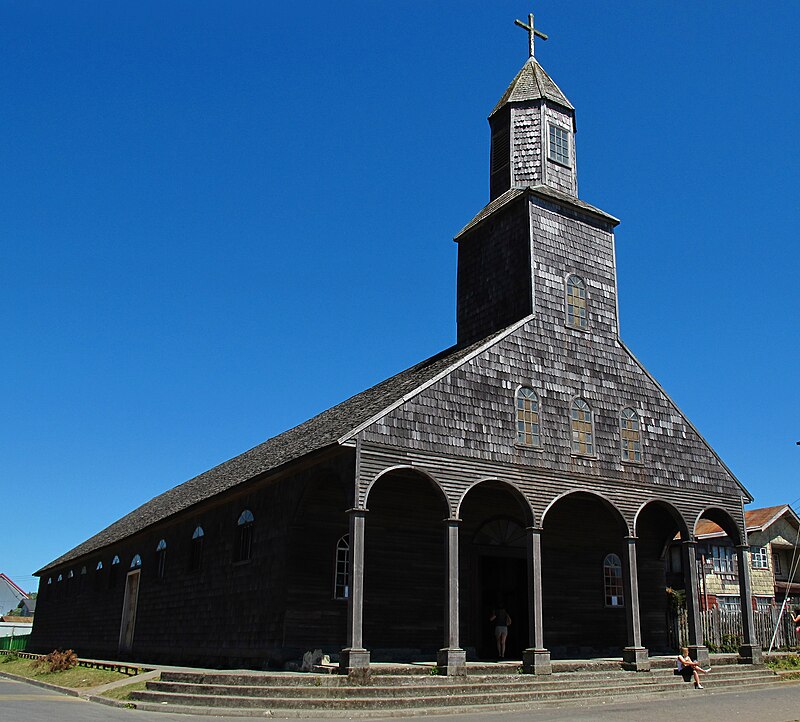
Welcome to the historic coastal settlement of Achao on the island of Chiloe. You are currently standing in the center of the town plaza, directly facing the majestic Church of Santa Maria de Loreto. In the year two thousand, this sacred landmark was inscribed on the UNESCO World Heritage list as an outstanding testament to the synthesis between European Jesuit evangelical traditions and native indigenous woodworking wisdom. Following the violent Mapuche uprising that swept southern Chile between fifteen ninety eight and sixteen hundred and four, the Chiloe archipelago was abruptly isolated from the mainland. In contemporary colonial accounts, Spanish chroniclers famously referred to this remote archipelago as the stern of the ecumene and the hidden corner of the world. This profound geographic isolation gave rise to two coeval worlds within the same era, operating on vastly different historical rhythms. Cut off from external trade and governance, the islanders cultivated a distinct lifestyle known as life within walls along the sheltered channels of the inner sea. Over generations of solitude, native inhabitants and Spanish friars developed a deeply unified maritime society that harmonized dense rainforest timber, coastal marine resources, and profound spiritual faith into every aspect of daily existence. The Church of Santa Maria de Loreto stands as the oldest surviving timber church in the entire archipelago, serving as a living monument to human endurance and collaborative craftsmanship. Because no new waves of European settlers arrived during the seventeenth and eighteenth centuries, a unique blended culture emerged where indigenous Veliche customs merged seamlessly with Catholic practices. The local people learned to navigate treacherous ocean currents, harvest resilient timber from ancient forests, and construct grand sanctuaries without relying on imported stone or mortar. Please take a moment to stand near the middle of the public square and absorb the visual harmony of the sanctuary before you. Observe the gentle sweeping lines of the front arcade, the tiered wooden bell tower reaching into the coastal sky, and the weathered texture of the timber shingles that have braved centuries of Patagonian rain and wind. Notice how effortlessly the building blends with the rolling green hills and the tranquil waters of the inner sea just beyond. Every beam, column, and wall tile was fashioned by hand using local rainforest species. As you stand here in the ocean air, prepare to discover the extraordinary history behind this wooden marvel. When you are ready, let us walk slowly toward the exterior wall of the chapel to examine its marvelous construction techniques.
02 The Alerce Shingles and Coastal Shell
Approach the exterior wall of the chapel and take a moment to examine the magnificent wooden shingles covering the outer surface directly before you. It is a truly astonishing fact that these wooden tiles have defended the sanctuary against centuries of punishing Patagonian rain and relentless coastal winds without relying on a single iron nail for structural stability. …
03 Portico Arches and Shipbuilders' Craft
Please step beneath the sheltered gallery of the front portico and pause directly before the main entrance doors. As you look up at the sweeping wooden arches overhead, consider a remarkable structural truth. The complex engineering of this sacred landmark was not conceived by mainland civil architects, but by master naval shipwrights who applied the exact same joint techniques used to construct traditional wooden plank boats known as dalcas. …
04 The Vaulted Ceiling and Inverted Hull
As you step through the main threshold into the interior of the chapel, you are instantly embraced by an extraordinary spatial transformation. Stepping into the central nave is like standing inside the overturned hull of a grand wooden sailing vessel floating gracefully in space. Please pause in the middle of the central aisle and tilt your eyes directly upward toward the sweeping barrel vault ceiling spanning high overhead. …
05 High Altar and Local Statuary Craft
Approach the high altar located at the far sanctuary end of the nave and take a position near the communion rail. As you gaze upon this ornate structure, consider an astounding truth. The entire elaborate Baroque altarpiece before you was carved locally out of native Chilean hardwoods without using a single block of imported European marble, stone, or plaster. …
06 Bell Tower and Inner Sea Outlook
Step out into the side courtyard facing the coastline and pause where you can comfortably view the full height of the bell tower. As you look up, consider a remarkable dual purpose behind this monumental timber structure. The soaring wooden steeple was engineered not only to summon parishioners to religious services, but served as a vital navigational landmark, or senal maritima, for mariners negotiating the treacherous currents of the surrounding archipelago. …
07 Closing
As our tour comes to a conclusion, please take a final look back at the Church of Santa Maria de Loreto from the edge of the central plaza. This remarkable sanctuary is far more than an ancient architectural relic. It represents the living soul and enduring spirit of the Chiloe archipelago. Within these wooden walls lies the extraordinary synthesis of indigenous Veliche craftsmanship, deep forest knowledge, and Jesuit evangelical faith, giving birth to a cultural landscape found nowhere else on…