 Photo Wikimedia Commons
Contents
History & cultureBY TELLBY7 sections · numbered as on the map01 Orientation
Welcome to the UNESCO World Heritage Site of the Hima Cultural Precinct, a sanctuary that has stood resilient against the desert winds and shifting sands for thousands of years. This extraordinary cultural treasure provides a profound and timeless testament to the enduring relationship between humanity and the surrounding natural environment in the heart of the Arabian Peninsula. Located approximately 80 kilometers north of the city of Najran, this remarkable site is situated along the western boundary of the vast Rub al Khali desert. The unique geographic landscape, defined by harsh desert terrain and majestic sandstone mountain massifs, transformed this region into a vital strategic hub and rest stop for ancient travelers and passing commercial caravans. The main concentration of the Hima Cultural Precinct stretches over an impressive distance of 55 kilometers from north to south, preserving innumerable traces of human civilization within its magnificent desert scenery. This expansive cultural territory serves as an irreplaceable natural archive, holding unique and valuable information on human populations and their changing environments from the pre-Neolithic period all the way up to modern times. The countless petroglyphs and intricate inscriptions carved into the rugged rock faces and weathered boulders offer an invaluable window into the daily lives, spiritual beliefs, and artistic expressions of ancient inhabitants. Furthermore, because this region functioned as a crossroads for trade routes connecting diverse cultures, it preserves layered evidence of human presence across distinct historical epochs. As you follow this audio guide through the desert landscape, you will explore a remarkable chronological journey, beginning with the earliest stone tool manufacturing sites, moving to polished sandstone rock art walls and multilingual inscriptions, and concluding with ancient stone structures scattered along the mountain slopes. We invite you to walk slowly through these timeless desert surroundings, listening to the quiet whispers of the wind while feeling the deep historical pulse of Arabia as you trace the footsteps of ancient generations. Now, let us move toward our first stop to witness the very beginnings of human craftsmanship and early survival at the Lower Palaeolithic Tool Site.
02 Stop 1: Lower Palaeolithic Tool Site
We begin our first story with the astonishing fact that this dark, desolate rock zone represents an authentic stone tool production site of the Early Lower Palaeolithic Oldowan culture, one of the earliest toolmaking technologies in human history. During the distant Early Lower Palaeolithic Oldowan period, the very hands of early humans worked upon these rocks, shaping stone tools for survival and leaving an indelible mark that has endured through untold ages. …
03 Stop 2: Rock Varnish Petroglyph Wall
We open our second stop with the astonishing fact that by chipping away the dark rock varnish to reveal the lighter sandstone beneath, ancient artists created bold, high-contrast visual art. These ancient creators did not merely draw images on stone; they possessed a profound understanding of how desert climatic forces altered rock surfaces over millennia and transformed those physical properties into powerful visual expression. …
04 Stop 3: Al-Musmad and South Arabian Inscriptions
We begin our third stop with the astonishing fact that exquisitely carved onto this rock is the South Arabian script featuring the unique 29-letter al-musmad alphabet. Developed in the southern region of the ancient Arabian Peninsula, this distinctive writing system represents a priceless linguistic heritage left behind on stone by merchants and locals traveling along desert trade routes. Directing your gaze, look at the geometric characters lined up within the rock crevice to your right. …
05 Stop 4: Multilingual Caravan Inscriptions
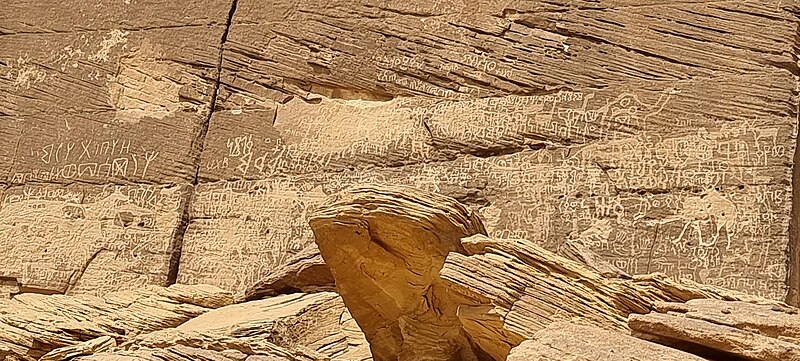
We unfold our fourth stop with the astonishing fact that at this single crossroads on ancient trade routes, inscriptions ranging from Aramaic-Nabatean to Greek and early Islamic scripts come together in one place. Bir Hima functioned not only as an inland hub for the Arabian Peninsula but also as a vital intersection within a vast commercial network linking the Mediterranean world and the broader Middle East. …
06 Stop 5: Ancient Stone Structures and Cairns
We open our fifth stop with the astonishing fact that thousands of cairn structures and tombs are extensively developed along the Jabal Qara massif. This desert mountainside served as a vast final resting place where ancient populations reposed and where prehistoric communities constructed sacred monuments that still define the desert ridges. Following my visual direction, look at the stone mounds stacked in circular forms along the hill ridges. …
07 Closing
We extend our deepest gratitude to all visitors who have joined us on this profound and majestic tour through the Hima Cultural Precinct. The vast archaeological territory you explored today represents a monumental human cultural heritage precinct stretching over an extraordinary distance of 55 kilometers, starting from the small settlement of Hima at its southern end all the way to the road east from Yadamah and the majestic eastern ridges of Jabal al-Kawbab. …