 Photo Wikimedia Commons
Contents
History & cultureBY TELLBY7 sections · numbered as on the map01 Orientation
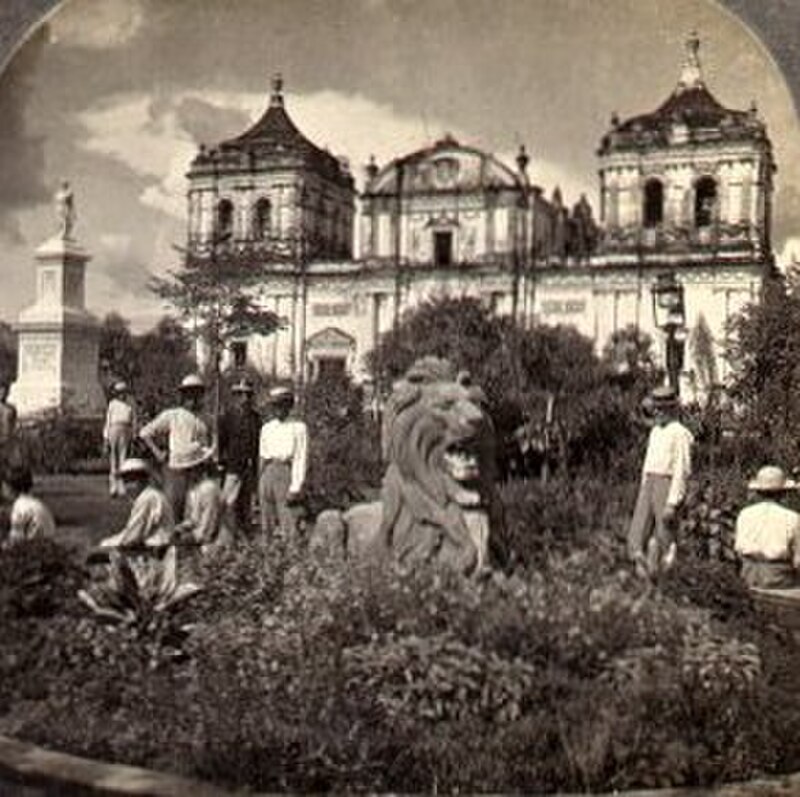
Welcome to León Cathedral, a monumental architectural masterpiece rising proudly against the dramatic backdrop of the Maribios volcanic chain. Inscribed as a World Heritage site by UNESCO, this grand basilica represents an exceptional fusion of European architectural traditions and local Central American identity. The cathedral stands as a supreme testimony to the transition from the expressive ornamentation of the Baroque movement to the refined balance of Neoclassicism, capturing the evolving artistic consciousness of the region across more than a century of construction. Spanning 105.83 meters in length and 57.13 meters in width, covering a massive floor area of over 5,295 square meters, it ranks among the largest cathedrals in all of Latin America. The history of this monumental sanctuary began in 1747 under the guidance of Bishop Isidro Marín Bullón y Figueroa, who initiated the clearing of a dilapidated former structure to build a cathedral worthy of the regional episcopal seat. In fact, this monumental basilica represents the sixth church constructed on this sacred ground, succeeding five earlier houses of worship that were destroyed by earthquakes or outgrown by the expanding population. Designed by the celebrated Guatemalan architect Diego José de Porres Esquivel, the master plan adapted traditional Spanish American rectangular layouts while introducing innovative structural elements derived from the Antigüeño Baroque style. Construction progressed across generations, uniting Creoles, indigenous laborers, and local artisans until its final consecration in 1860. What makes this cathedral truly remarkable is its extraordinary structural resilience. Situated in a region constantly endangered by severe earthquakes and active volcanoes such as Cerro Negro, Telica, and Momotombo, the cathedral was engineered with exceptionally dense masonry walls and low, thick towers specifically calculated to absorb seismic impacts. During our audio guide journey today, we will explore 5 key locations in walking sequence around and inside the cathedral. We begin outside at the West Facade, examining its striking Atlantes figures and eclectic architectural details. Next, we step into the expansive Central Nave, marveling at the unique natural light streaming from forty rooftop cupolas. Our third stop brings us to the famous Tomb of Rubén Darío, where a sorrowful weeping lion guards the beloved poet. We will then admire the monumental Stations of the Cross paintings created by Antonio Sarria along the side walls. Finally, we will step into the peaceful Patio del Príncipe cloister to learn about the cathedral's historic rooftop fortress before wrapping up our tour.
02 The Monumental West Facade and Atlantes
Standing before the monumental West Facade of León Cathedral, one is immediately captivated by its formidable mass and dense, weathered stone texture. What makes this structural giant genuinely astonishing is its miraculous survival through centuries of catastrophic disruption. This massive front curtain wall has endured deadly volcanic eruptions from nearby Cerro Negro, which repeatedly buried the city under thick blankets of suffocating ash, as well as brutal military conflicts. …
03 The Spacing Nave and the Luminous Dome
Stepping into the central nave of León Cathedral, visitors are immediately embraced by a luminous, tranquil atmosphere that sharply contrasts with the solid, fortress-like exterior. What makes this vast sanctuary genuinely extraordinary is that despite its exceptionally thick masonry walls and few structural windows engineered for seismic safety, the interior is flooded with soft, radiant illumination. …
04 Tomb of Rubén Darío
Beneath the stone floors of León Cathedral lie seven subterranean crypts housing the remains of twenty-seven distinguished figures who shaped the history and culture of Nicaragua. Among the ten bishops, five priests, independence hero Miguel Larreynaga, renowned musician José de la Cruz Mena, scientist Luis H. …
05 Via Sacra Murals by Antonio Sarria
Walking along the outer aisles of the cathedral, visitors are confronted by a magnificent gallery of large oil paintings hanging sequentially along the stone walls. The origin of this breathtaking artistic ensemble traces back to a single pastoral journey to the eastern town of Masaya. During a routine diocesan visit, the bishop encountered a striking church painting that so deeply moved his spiritual sensibilities that it led directly to the creation of one of Central America's greatest series…
06 Patio del Príncipe and Roof Terraces
Stepping into the rear section of the cathedral complex, visitors enter a peaceful, sunlit cloister known as the Patio del Príncipe. Yet behind the calm atmosphere and immaculate white lime finish lies a surprising military history. The roof of this sacred cathedral was twice converted into a formidable military fortress equipped with heavy defense cannons during periods of intense national conflict. …
07 Closing
Today we have journeyed together through León Cathedral, a monumental masterpiece of Central American architecture and an enduring symbol of Nicaraguan national identity. From the heroic West Facade and its powerful Atlantes sculptures to the radiant natural light illuminating the Central Nave, the weeping lion guarding the tomb of Rubén Darío, the monumental Via Sacra murals of Antonio Sarria, and the tranquil Patio del Príncipe cloister, every stone of this magnificent basilica echoes with…