Contents
History & cultureBY TELLBY7 sections · numbered as on the map01 Orientation
Welcome to the entrance of the magnificent Bamiyan Valley, a sanctuary where history, sacred faith, and artistic innovation cross paths in the heart of Central Asia. As you step into this breathtaking landscape, you are standing within a UNESCO World Heritage Site recognized globally for its exceptional cultural significance. Located approximately one hundred thirty kilometers northwest of Kabul, this extraordinary valley is situated high in the Hindu Kush mountain range, resting at a sweeping elevation of two thousand five hundred meters above sea level. For many centuries, this high-altitude refuge served as a vital spiritual and commercial crossroads along the ancient Silk Road, bridging the vast commercial markets of China with those of the Western world. It was here that diverse cultures, languages, and belief systems converged, fostering a vibrant intellectual and spiritual haven.
The unique cultural heritage of Bamiyan emerged from a profound synthesis of Eastern and Western traditions, giving rise to a distinct expression of Gandharan Buddhist art. From as early as the second century CE under the Kushan Empire, Bamiyan developed into a thriving center for Buddhist monasticism, philosophy, and creative expression. Monks built a vast network of religious complexes, living as hermits inside over a thousand caves carved directly into the soaring sandstone cliffs. They adorned these rock-cut dwellings with religious statues, delicate relief carvings, and brilliant frescoes that reflected artistic influences from ancient India, Sasanian Persia, and the Hellenistic world.
This vibrant tradition of artistic and spiritual devotion persisted through centuries of political transformation. Historical records show that Bamiyan remained a major Buddhist center through various dynastic shifts, weathering the eighth-century incursions under the Abbasid Caliphate of Al-Mahdi around seven hundred seventy CE, briefly reclaiming its Buddhist identity in eight hundred seventy CE, until the final Ghaznavid Islamic rule in nine hundred seventy-seven CE. Radiocarbon dating of cave murals across the valley spans from four hundred thirty-eight CE all the way to nine hundred eighty CE, proving that continuous monastic and creative activity endured across generations of changing rulers.
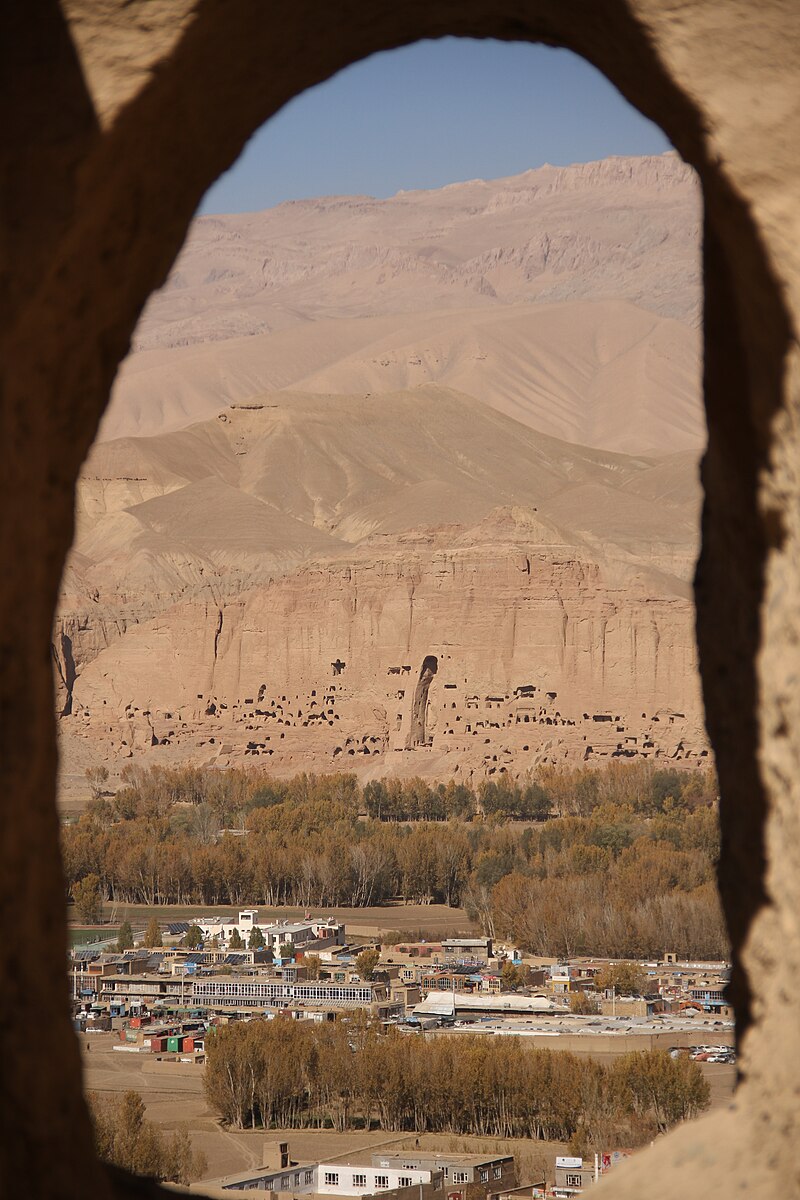
As you begin your journey today, your walking route will guide you along the base of this massive sandstone cliff face. You will walk past ancient monastic cells, elevated chapels, and the towering alcoves that once sheltered the world's most impressive standing Buddha sculptures. Though time and tragic events have altered these monuments, the soaring niches and surrounding caverns still convey the profound ambition of the ancient craftspeople. Please proceed slowly along the path, allowing the dramatic landscape and the quiet echo of history to immerse you in the extraordinary story of Bamiyan.
02 Spot 1 – The Eastern Buddha Niche (Shah Mama)
Scientific radiocarbon dating performed on organic structural materials discovered within the statue's internal framework revealed that this monumental thirty-eight-meter standing Buddha was commissioned and built between five hundred forty-four and five hundred ninety-five CE, with a narrow high-probability range between five hundred forty-nine and five hundred seventy-nine CE during the historic era of Hephthalite rule. …
03 Spot 2 – Ceiling Vault Mural of the Sun God
High above the head of the Eastern Buddha, sixth-century Buddhist artists painted an extraordinary mural featuring a Persian solar deity directly within the central medallion of the ceiling vault arch.
Please tilt your head high upward toward the curving ceiling vault towering inside the upper recess of the thirty-eight-meter niche. …
04 Spot 3 – Murals of the Hephthalite Donors & Kings
Ancient rulers and powerful noble patrons had their own life-sized likenesses permanently painted onto the interior side walls of the Buddha niche to proclaim their royal devotion and generous financial sponsorship to the entire world.
Please direct your eyes to the lower side walls lining the interior cavity of the thirty-eight-meter niche and the entrance of the adjoining chapel. …
05 Spot 4 – The Western Buddha Niche (Salsal)
Scientific radiocarbon testing of internal organic structural components revealed that this colossal fifty-five-meter standing Buddha was built between five hundred ninety-one and six hundred forty-four CE and was known historically as Salsal, a phrase translating to the light shines through the universe.
Please stand back and direct your eyes upward toward the colossal sandstone alcove towering fifty-eight meters high from the valley floor into the open sky. …
06 Spot 5 – Adjoining Caves & Discovery of Early Oil Paintings
These humble rock-cut monk caves contain the world's oldest known surviving oil paintings, created in the mid-seventh century CE, at least six hundred years before oil painting techniques emerged in Renaissance Europe.
Please step carefully toward the low carved entrances of Cave G and Cave E, situated adjacent to the Western Buddha alcove. …
07 Closing
As you stand at this elevated viewpoint overlooking the panoramic expanse of the Bamiyan Valley, you are gazing upon a sanctuary defined by profound loss and enduring hope. In March two thousand one, following a decree issued on February twenty-sixth by Taliban leader Mullah Omar, a deliberate process of destruction began. …