 Photo Wikimedia Commons
Contents
History & cultureBY TELLBY7 sections · numbered as on the map01 Orientation
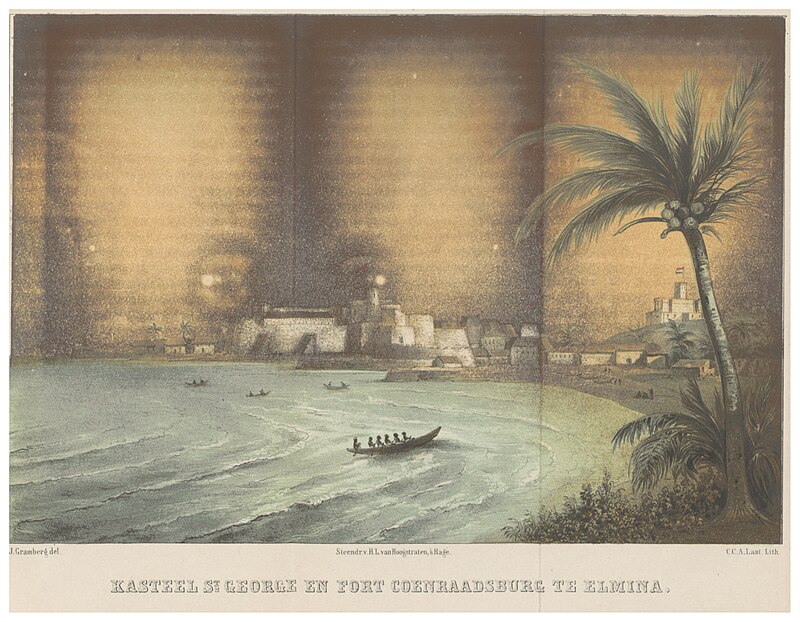
Welcome to Fort Coenraadsburg, also widely known as Fort St. Jago, situated high atop a commanding hill overlooking the historic coastal town of Elmina in Ghana. As you stand at this elevated hilltop entrance, take a moment to absorb the breathtaking panoramic views stretching out before you. Directly below, the massive white walls of St. George's Castle rise beside the blue waters of the Atlantic Ocean, flanked by the lively fishing harbor along the Benya Lagoon and the vibrant urban tissue of the surrounding settlement. This remarkable military site was inscribed on the UNESCO World Heritage List in nineteen seventy-nine as part of the collective entry Forts and Castles, Volta, Greater Accra, Central and Western Regions. Its designation by UNESCO underscores its profound significance as an irreplaceable material witness to the intense centuries-long European competition for control over West African trade routes and the tragic legacy of the transatlantic slave trade. In spatial terms, academic classifications categorize this structure as a Type Four fort, defined as an inland hill fortification surrounded by dense town buildings. The location of this fort illustrates the strategic importance of high ground in early modern military warfare. Unlike many other European fortresses along the Gold Coast, which served dual purposes as commercial trading posts and storage depots, Fort Coenraadsburg was designed and constructed purely as a military stronghold. Built by the Dutch in the sixteen sixties under the direction of Director General J. Valckenburgh, this fortress was constructed using durable local sandstone to replace earlier temporary earthen fortifications. The primary objective of its construction was to secure the high ground behind Elmina Castle, preventing rival European powers from mounting artillery on this hill to bombard the castle below. Today, the fort stands as a silent testimony to the complex layers of West African history, evolving from a Portuguese chapel in the sixteenth century into a Dutch fortress, a British administrative facility, and now a protected national monument. Due to its delicate structural condition, coastal weathering, and ongoing preservation challenges, entry to the site is facilitated through guided tours led by knowledgeable local site custodians under the oversight of the Ghana Museums and Monuments Board. Recent conservation efforts under the UNESCO Integrated Management Plan seek to safeguard these historic stone walls for future generations. As you prepare to explore the fort precinct, notice how the formidable stone walls and strategically positioned bastions dominate the surrounding landscape. From this vantage point, you can appreciate the tactical foresight of seventeenth-century military engineers who recognized that controlling this single hill was the absolute key to dominating the entire region of Elmina. Please follow your guide as we begin our journey into the fascinating history and architecture of this historic military monument.
02 Section 1
Surprisingly, unlike the vast majority of European fortifications constructed along the West African coast, which directed their heaviest firepower toward the ocean to fend off pirate raids or rival naval fleets, this fortress turned its most formidable cannons directly inland toward the surrounding hills. This design represents a striking reversal of conventional military architecture on the Gold Coast. …
03 Section 2
Surprisingly, in the sixteen sixties, Dutch Director General J. Valckenburgh took the bold decision to completely demolish the earlier temporary earthworks on this hill and replace them with a permanent stone fortress constructed entirely from locally quarried sandstone, officially naming it Fort Coenraadsburg in honor of his own distinguished lineage. …
04 Section 3
Surprisingly, in addition to its function as a vital artillery outpost protecting Elmina Castle, this fortress operated under Dutch rule as a strict military prison and penal institution specifically designated for European officers and enlisted men who violated military codes. While the vast slave dungeons across the river in Elmina Castle held captive Africans destined for forced transportation across the Atlantic Ocean, the detention cells within Fort Coenraadsburg were reserved exclusively…
05 Section 4
Surprisingly, after the Dutch officially handed over all their Gold Coast possessions to Great Britain under the historical treaty of eighteen seventy-two, the British military and civil authorities constructed an entire second-story addition on top of the original Dutch fortress base. This structural expansion adapted the former military stronghold for civilian public services, transforming the site into a regional hospital, a sanatorium, and a rest house for British colonial officers. …
06 Section 5
Surprisingly, long before artillery cannons were installed on this hilltop to dominate the coast, Portuguese sailors and settlers built a tiny religious chapel dedicated to Saint Jago here in the fifteen fifties, which stood peacefully on the ridge for over eighty years until it was completely destroyed during the fierce Dutch bombardment of sixteen thirty-seven. …
07 Closing
This concludes our audio guide tour of Fort Coenraadsburg, also known as Fort St. Jago. The historical site we have explored today encapsulates a rich, multi-layered past spanning over four centuries of West African history. From its origins in the fifteen fifties as a modest Portuguese chapel dedicated to Saint Jago, to its transformation in the sixteen sixties into a formidable Dutch artillery fortress, its subsequent adaptation by the British in the nineteenth century as a hospital and rest…