Contents
History & cultureBY TELLBY7 sections · numbered as on the map01 Orientation
Where the scorching sands of the Sahara Desert meet the vast grasslands of the Sahel, you stand at a historic crossroads that has welcomed trade caravans and travelers for centuries. Niger is an arid, landlocked nation sharing borders with seven neighboring countries: Libya, Algeria, Nigeria, Benin, Burkina Faso, Mali, and Chad. At the heart of this vast geography lies the Agadez region, which accounts for fifty-two percent of Niger's total territory, making it the single largest territorial subdivision in all of Africa. From ancient times, this historic city flourished as a vital hub along the trans-Saharan trade routes linking the Mediterranean coast to the heart of West Africa. Indeed, with eighty-four percent of migration within the Economic Community of West African States occurring internally across the region, Agadez served as a monumental gathering point where diverse human journeys, commercial cargoes, and cultural traditions converged amidst the desert.
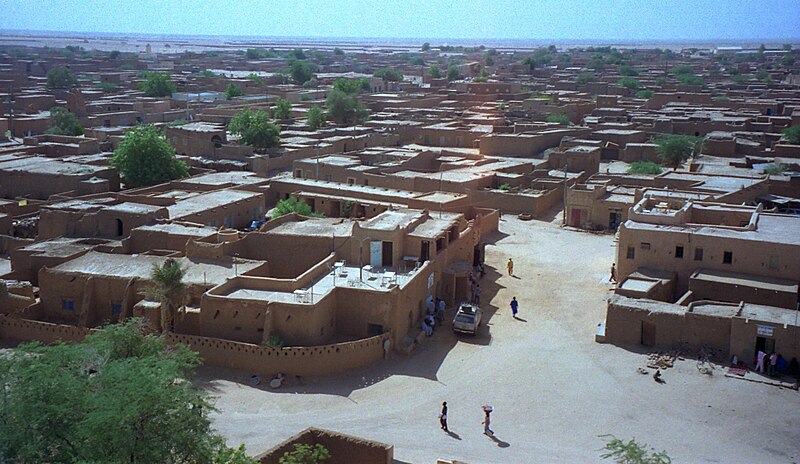
The Historic Center of Agadez represents the pinnacle of ancient commercial trade routes and traditional earth architecture. Without relying on formal heritage classification numbers or technical jargon, the reason for its global recognition is remarkably simple. It stands as an extraordinary living monument to human resilience, trade, and adaptation in one of the world's most challenging desert environments. Constructed entirely using sun-dried mudbrick, straw, and native timber, its homes, public squares, and narrow alleyways demonstrate how human ingenuity transformed local natural materials into a thriving urban sanctuary. It remains an irreplaceable architectural masterpiece that has sustained human mobility and community life across centuries of Saharan history.
Our guided walking route will take you through the very heart of this living historic center. We will begin our journey at the majestic Sultan's Palace, where traditional governance, customary law, and desert diplomacy have been practiced for generations. From there, we will approach the Grand Mosque of Agadez, home to the world's tallest mudbrick minaret towering proudly over the urban landscape. Continuing along our path, we will visit the Agadez City Hall, a site where traditional mud architecture intersects with modern administrative realities and border control policies. We will then explore the Niger Chamber of Commerce and former trade hub, where official passenger manifests and travel permits were once systematically processed under state regulation. Finally, we will wander through the historic residential mudbrick alleys and former transit quarters, discovering how ancient caravan pathways evolved into modern transit networks. Let us step forward into the timeless stories carried by the desert wind.
02 Sultan's Palace of Agadez
For centuries, this magnificent mudbrick palace served as the seat of desert rulers who presided over deep-rooted traditions and customary laws, standing as one of the most authoritative clay structures in West Africa. Behind these hand-crafted earthen walls lay the supreme authority that guided desert trade caravans, resolved complex tribal disputes, and maintained stability across the vast trade routes connecting the Mediterranean to the African interior. …
03 Grand Mosque and Mudbrick Minaret
Constructed without a single piece of structural steel or modern cement, crafted entirely from raw earth, straw, and internal timber supports, this extraordinary tower holds the proud title of the world's highest mudbrick minaret. For generations, this soaring earthen beacon served as an unmistakable navigational landmark visible from miles away across the desert horizon, guiding weary trade caravans and desert travelers safely to the heart of the oasis city. …
04 Mairie d'Agadez
Preserving traditional mudbrick architectural design, the Agadez City Hall stands as a symbolic battleground where an ancient West African transit center directly intersected with modern international law and European border control enforcement. Within these earthen administrative walls, centuries of traditional human mobility were transformed overnight by national legislation, fundamentally altering local governance, security operations, and the regional economy. …
05 Chamber of Commerce and Trade Hub
In the years before strict prohibition, this building operated as a fully transparent transport registration hub where every passenger's name, driver details, origin, and desert destination were meticulously recorded on official government manifests while municipal taxes were collected. The Niger Chamber of Commerce, Agriculture, Industry, and Crafts served as the central node of a state-supervised transportation network that provided accountability, security, and administrative oversight for…
06 Historic Mudbrick Alleys and Transit Houses
Once a vibrant residential neighborhood where hundreds of thousands of transiting migrants lodged openly, purchased daily supplies, and found temporary work, these mudbrick alleys were transformed into a secretive underground space following legal prohibition. What was once an open, bustling transit community integrated into local neighborhood life quickly dissolved into a concealed network operating far from public view. …
07 Closing
Our journey through the Historic Center of Agadez, where the vast sands of the Sahara embrace the Sahel, now draws to a meaningful close. Today, we have walked through a city that served for centuries as a vital sanctuary for trans-Saharan trade caravans, and which continues to function as a crucial crossroads of human migration, commerce, and resilience in West Africa.
Agadez is far more than a collection of historic mudbrick structures. …