Contents
History & cultureBY TELLBY7 sections · numbered as on the map01 Orientation
Welcome to the Mission of San Miguel de Velasco, a breathtaking historical sanctuary set deep within the tropical forests, rolling valleys, and winding rivers of eastern Bolivia. Known locally in the native Migueleño Chiquitano language as Samiñere, this extraordinary settlement represents one of the most culturally vibrant and artistically refined strongholds established during the Jesuit evangelical period. In 1990, UNESCO inscribed the Jesuit Missions of Chiquitos onto the World Heritage list, celebrating their exceptional synthesis of European Baroque design and indigenous craftsmanship, as well as their unmatched degree of architectural preservation compared to former reductions elsewhere on the South American continent. Among all the historic missions comprising this celebrated circuit, San Miguel de Velasco stands out for its remarkably ornate timber interior, rich gilded altarpieces, and living cultural traditions that continue to thrive to this day.
The geographic selection of San Miguel de Velasco was guided by both practical necessity and environmental wisdom. Perched upon a raised, level plain that forms a natural elevated isthmus surrounded by dense virgin rainforest and river channels, the location was deliberately chosen to secure fresh, healthy air and superior natural defensive advantages. This elevated terrain also allowed the Jesuit fathers and native builders to skillfully manage local stream gradients, constructing an integrated network of artificial water reservoirs that guaranteed an uninterrupted water supply for household consumption and agricultural production throughout the year. The settlement was officially founded in 1721 by two Jesuit friars, Felipe Suarez and Francisco Hervas. At that time, the neighboring mission of San Rafael had experienced unprecedented population growth, prompting the missionaries to establish a new reduction to accommodate the expanding native families. Under their dedicated leadership, diverse indigenous groups were gathered together, developing a highly organized and prosperous agrarian sanctuary hidden within the forest.
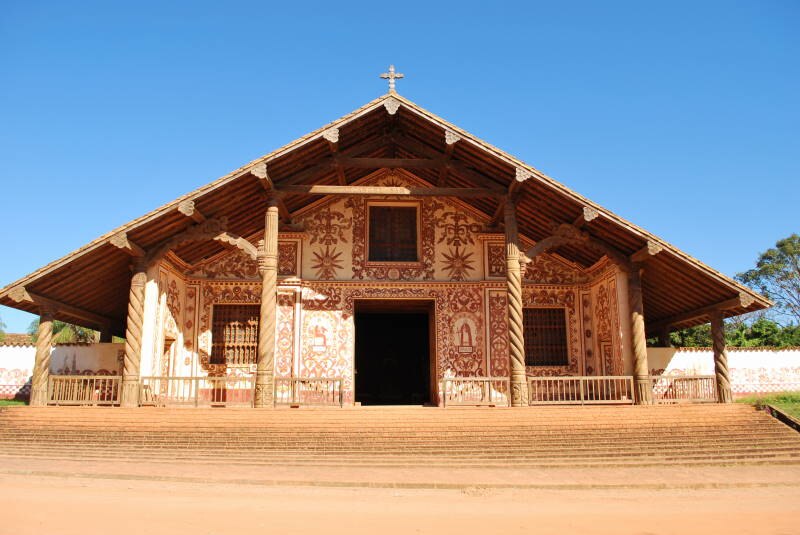
Our guided audio walk today will lead you through every dimension of this living cultural monument. We will commence at the vast central plaza, where the distinctive social layout and town planning of the Chiquitano reductions unfold. From there, we will approach the majestic church facade to examine its sixteen massive, hand-carved Solomonic wooden pillars and sweeping tile roof structure. Stepping into the solemn twilight of the nave, we will admire the brilliant gold-leafed main altar illuminated by natural sunlight streaming through high roof skylights, followed by an exploration of the vibrant fresco wall murals and the extraordinary tradition of homilies delivered in the native Migueleño Chiquitano language. Finally, we will learn about the miraculous twentieth-century restoration directed by Swiss architect Hans Roth and the Franciscan friars, as well as the world-renowned Baroque music festivals that keep the musical soul of the mission alive. Please take a moment to savor the tranquil atmosphere of this forest sanctuary as we begin our walk toward the central plaza.
02 Main Plaza & Village Layout
Unlike the rigid gridiron urban layouts typical of conventional Spanish colonial towns across South America, the urban design of San Miguel de Velasco presents an extraordinarily unique spatial organization. Standard Spanish colonial settlement plans across the Americas divided land into uniform square blocks radiating outward from a central square, strictly complying with Royal Ordinance 127 promulgated by King Philip II. …
03 Solomonic Wooden Pillars & Roof Architecture
The engineering strategy utilized in constructing the church of San Miguel de Velasco presents a brilliant architectural inversion that completely set aside traditional European masonry sequence. In classical European construction, stonemasons laid heavy foundation stones and built solid perimeter walls before finally raising the roof timber framework on top. …
04 Gilded Altar & Roof Skylight
Stepping into the nave of San Miguel de Velasco delivers a striking visual contrast between shadow and light. To shield the sacred interior from the sweltering tropical heat and blinding equatorial sun, the exterior walls were built with relatively small, low-set windows sheltered beneath deep outdoor loggias, leaving the nave wrapped in a cool, contemplative twilight. Yet, as your eyes move toward the presbytery, this solemn darkness gives way to a breathtaking spectacle. …
05 Mural Paintings & Native Homily Tradition
The interior walls and elevated wooden pulpit of San Miguel de Velasco preserve a deeply moving heritage of cultural resilience that sets this reduction apart from standard colonial sites. In most colonial churches throughout the Americas, Catholic mass and homilies were delivered strictly in Latin or Spanish. …
06 Franciscan Restoration & Living Traditions
The magnificent wooden cathedral we admire today stands as a triumphant story of architectural revival following decades of severe neglect and near-total destruction. Over the two centuries following the expulsion of the Jesuits, the harsh tropical climate, relentless humidity, and wood-boring insects caused severe structural deterioration across the settlement. Rotting timber columns, leaking roofs, and crumbling adobe walls pushed San Miguel de Velasco to the brink of irreversible collapse. …
07 Closing
Our memorable audio journey through San Miguel de Velasco has now come to a gentle close. San Miguel is far more than a silent historical monument frozen in time; it is a vibrant, breathing sanctuary where living cultural traditions continue to thrive within the daily lives of its residents. Each year on September 27th and 28th, during the feast days of its patron saint, Saint Michael the Archangel, the entire town bursts into joyous celebration. …