 Photo Wikimedia Commons
Contents
History & cultureBY TELLBY7 sections · numbered as on the map01 Orientation
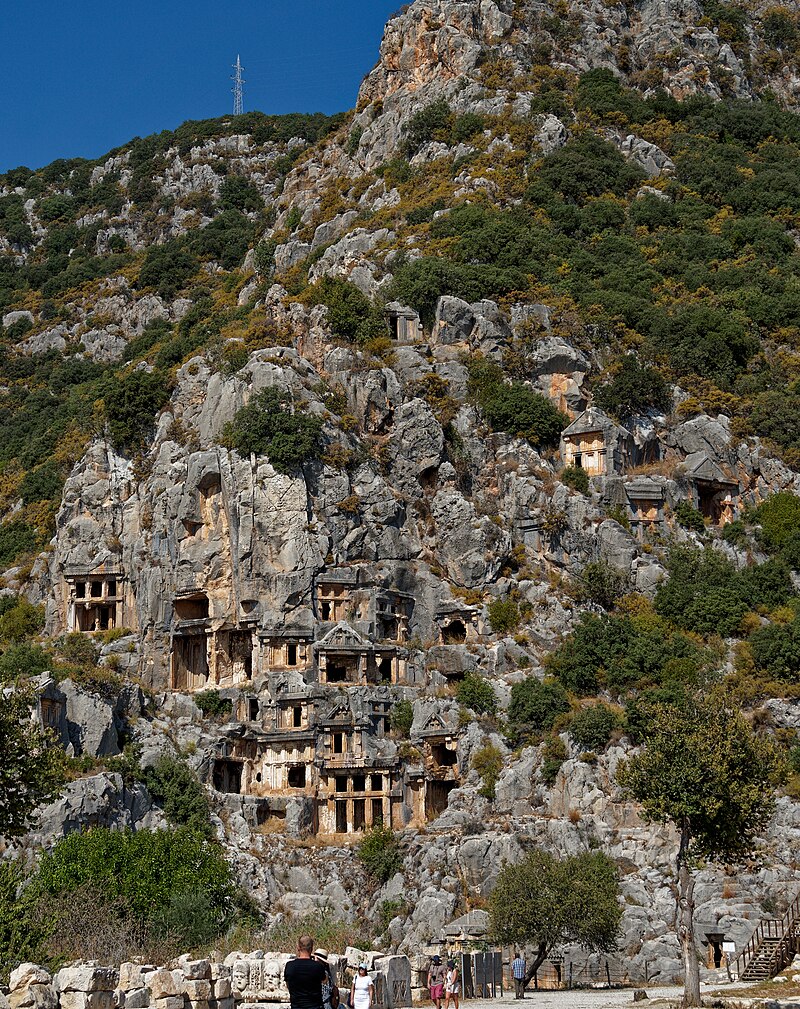
Welcome to Ancient Xanthos, the supreme administrative heart of the Lycian civilization and a legendary city imbued with an extraordinary narrative of resilience. Located near the peaceful village of Kinik in the Kas district of Antalya Province in southern Turkey, this remarkable site served as the magnificent ancient capital of the Lycian League. Inscribed as a UNESCO World Heritage Site in nineteen eighty-eight alongside its neighboring federal sanctuary of Letoon, Xanthos was recognized internationally for its uniquely original rock-cut funerary art and its monumental archaeological value. In particular, the colossal pillar tombs and rock-cut sarcophagi of Xanthos represent the finest expressions of Lycian funerary architecture, directly influencing the design of subsequent monuments across major regional capitals such as Patara and Myra. The name of the city is believed to derive from the ancient Greek word for yellow, while the native Lycian citizens proudly referred to their ancestral home as Arna in their own indigenous language. The archaeological site of Xanthos is grandly situated upon two elevated hills that command a sweeping view of the fertile plain along the banks of the River Xanthos, locally known as Esen Cay. Upon a steep, formidable rocky cliff immediately adjacent to the winding river stands the ancient Lycian Acropolis enclosed by sturdy defensive fortification walls. Further to the north lies the higher and noticeably more expansive Roman Acropolis, together forming the dramatic structural spine of the ancient metropolis. As you stroll along these peaceful, sun-drenched hill slopes today, you can vividly feel the echoing whispers of ancient mythologies and momentous historical events that unfolded right where you walk. The immortal pages of Homer's epic poem, the Iliad, bear the indelible mark of Xanthos. During the Trojan War around eleven eighty-four BC, the heroic Lycian commanders Glaucus and Sarpedon embarked on their noble expedition to support Troy directly from the lands bordering the River Xanthos. Furthermore, in those classic poetic verses, the miraculous talking horse driven by the Greek hero Achilles was also named Xanthos. Thus, from the enchanted realm of classical mythology to the tangible realities of a formidable Mediterranean civilization, Xanthos represented the ultimate pride and sacred homeland for the Lycians. Today, we invite you to explore this resilient city together. Despite enduring catastrophic invasions and fires throughout its long existence, Xanthos repeatedly rose like a phoenix from its own ashes. Magnificent architectural ruins and monumental tombs now await your discovery. Let us now step forward toward our first official stop, the historic Lycian Acropolis.
02 Lycian Acropolis and the Persian Siege
The Lycian Acropolis standing directly before your eyes represents an exceptionally tragic yet immortal symbol of human liberty, a citadel whose courageous inhabitants chose to engulf their entire city in a catastrophic inferno and perish to the last man rather than submit to the overwhelming Persian invaders. …
03 The Harpy Tomb and Lost Reliefs
Did you know that the intricate and breathtaking relief sculptures adorning the top of the monumental pillar tomb directly before you are actually cast replicas? The original stone panels, celebrated worldwide as supreme masterpieces of ancient Lycian funerary art, no longer rest here in their historical home but are displayed thousands of kilometres away in a museum in London. Take a moment now to observe the majestic column structure standing proudly right in front of you. …
04 The Xanthian Obelisk and the Lost Language
Did you know that the dense ancient characters carved into all four sides of this stone pillar served as the ultimate key to deciphering the completely lost ancient Lycian language? This single monolithic pillar represents an astonishing archaeological miracle that allowed modern scholars to hear the long-silent voices of ancient Anatolia once again. Step closer now toward the rectangular stone pillar directly in front of you, known to scholars as the Xanthian Obelisk or the Inscribed Pillar. …
05 The Ancient Theatre and Roman Revival
Did you know that this grand ancient theatre was completely rebuilt under the Roman leader Mark Antony after the city suffered yet another near-total annihilation in forty-two BC during the bloody Roman civil war? Beneath these quiet stone seating tiers lies the tragic yet heroic story of a people who chose death over submitting to foreign extortion. Take a moment to take in the sweeping view of the theatre expanding before your eyes. …
06 Roman Acropolis and Early Christian Basilica
Did you know that here on this hill, after thousands of years serving as a pagan capital dedicated to ancient deities, a monumental Christian cathedral was erected in the sixth century following a devastating earthquake? Upon this broad plateau lies a fascinating layer of history where classical pagan antiquity seamlessly transitioned into the Early Christian era. Take a look now across the expansive summit of the Roman Acropolis stretching out before you. …
07 Closing
As we stand on this breathtaking hilltop overlooking the magnificent valley where the River Xanthos, now known as Esen Cay, flows peacefully toward the sea, it is time to bring our journey through Ancient Xanthos to a close. The sweeping panorama of the fertile plain and the silent ruins stretching below us quietly preserve the enduring memory of the countless generations who once called this land home. Xanthos holds one of the most poignant and inspiring stories in human history. …