 Photo Wikimedia Commons
Contents
History & cultureBY TELLBY7 sections · numbered as on the map01 Orientation
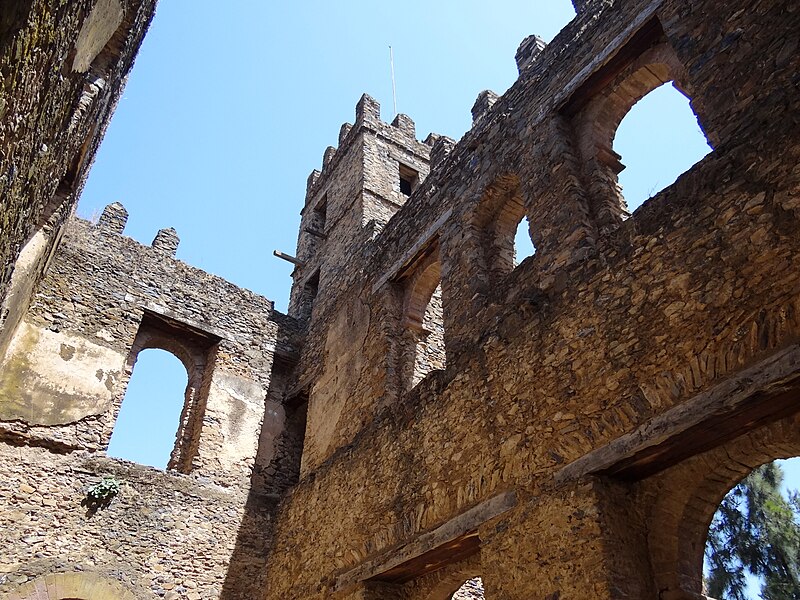
Welcome to Fasil Ghebbi, the extraordinary royal fortress city of Gondar, Ethiopia. You are standing at the threshold of a monumental historical enclosure that served as the political, administrative, and spiritual center of the Ethiopian Empire from the seventeenth to the nineteenth century. Fasil Ghebbi was inscribed as a UNESCO World Heritage site because it marks a monumental turning point in East African history. For centuries prior to its founding, Ethiopian monarchs maintained a peripatetic court, traveling continuously across the highlands and dwelling in temporary royal encampments. In ancient Ge'ez and Amharic royal chronicles, such mobile imperial camps were referred to as katama or makkababya. Emperor Fasilides decisively shattered this ancient roving tradition in sixteen thirty six by selecting Gondar as the permanent imperial capital of the empire. Within this protected precinct, he and his royal successors constructed a formidable stone fortress city that symbolized political permanence, administrative centralization, and imperial majesty. The entire royal enclosure is shielded by an imposing curtain wall extending nine hundred meters in length, constructed from local dark brown basalt and punctuated by twelve traditional stone gates. These historic entryways controlled movement between the royal court and the bustling city beyond. Among them are Fit Ber, also known as Jan Tekle Ber, which opened onto the central Adababay market square; Tazkaro Ber, the Gate of Funeral Commemoration; Adenager Ber, which connected the enclosure to the weavers' quarter; and Gimjabet Mariyam Ber, which led directly to the treasury and churchyard. The architectural brilliance of Fasil Ghebbi lies in its unique cross cultural synthesis. It seamlessly weaves native Ethiopian Orthodox masonry traditions with Indian Gujarati stonecraft, Arab Islamic motifs, Portuguese structural engineering, and European Baroque aesthetics introduced by Jesuit missionaries. As you embark on your walking tour today, your route will guide you through six major imperial landmarks. You will first explore the flagship Castle of Emperor Fasilides, before proceeding to the intellectual repository at the Library and Chancellery of Yohannes the First. From there, you will visit the evocative ruins of the Palace of Emperor Iyasu the First, followed by the ceremonial hall of Dawit the Third. Finally, your route will lead you just outside the main enclosure to the aquatic pavilion known as Fasilides' Bath. While walking among these ancient monuments, please observe critical conservation rules. These weathered basalt structures, lime mortar joints, and timber components are exceedingly delicate. Please refrain from climbing on walls, touching decorative stone masonry, or disturbing fragile surfaces. Watch your step along uneven stone paths and exposed tree roots. Now let us step forward together into the glorious history and enduring majesty of Fasil Ghebbi.
02 Castle of Emperor Fasilides
The astonishing fact that a massive seventeenth century stone castle adorned with domed corner turrets, arched parapets, and vertical battlements rises imperially against the skyline of the East African highlands never fails to leave travelers from around the globe spellbound. Please direct your gaze toward the magnificent three story central keep standing directly in front of you, observing its rugged masonry walling crafted from dark brown basalt and its imposing corner towers that crown the…
03 Library and Chancellery of Yohannes I
The extraordinary fact that this refined two story stone complex served centuries ago as the supreme intellectual vault storing Ethiopia's imperial archives, theological manuscripts, and illuminated diplomatic correspondence offers a mesmerizing glimpse into the sophistication of the Gondarine state. Please direct your attention toward the upper floor of the Library and Chancellery building, observing its elegant arched window bays, clean geometry, and solid basalt masonry that has endured…
04 Palace of Emperor Iyasu I
The astonishing historical reality that the interior of this now roofless palace was once lavishly adorned with gilded Venetian mirrors, polychrome glass, and delicate ivory inlays leaves visitors spellbound by its bygone splendour. Please direct your eyes directly ahead toward the soaring skeletal framework of this monumental edifice, taking in the grand upper vaulted ceiling arches and the massive serpentine tree roots that embrace the dark brown basalt walls. …
05 Dawit III's Banquet Hall
The delightful historical twist that a hall originally dedicated as the solemn House of the Throne acquired its romantic modern moniker, the House of Song, due to a linguistic misreading by later scholars never fails to charm visitors from around the world. Please direct your sight toward the open air structure before you, taking in the broad single story banquet hall, its rhythmically placed arched window openings, and the prominent round tower standing proudly at the southeastern corner. …
06 Fasilides' Bathing Palace
The astounding fact that this vast stone reservoir remains completely empty for most of the year, only to be filled with river water annually to transform into a sacred swimming pool during the Ethiopian Epiphany festival, creates an unforgettable impression on every traveler. Please turn your attention toward the center of the rectangular sunken basin, where a charming two story stone pavilion stands wrapped in a dense, net like web of massive banyan and wild fig tree roots. …
07 Closing
Our journey through Fasil Ghebbi, the glorious royal fortress city of the Gondarine Empire, has now come to a close. The historical compound you have explored today holds an exceptionally profound place in Ethiopian and world heritage history. By establishing Gondar as a permanent capital in the seventeenth century and breaking away from the centuries old roving court tradition, Fasil Ghebbi created an enduring sanctuary for governance, religious art, theology, and monumental architecture. …