 Photo Wikimedia Commons
Contents
History & cultureBY TELLBY7 sections · numbered as on the map01 Orientation
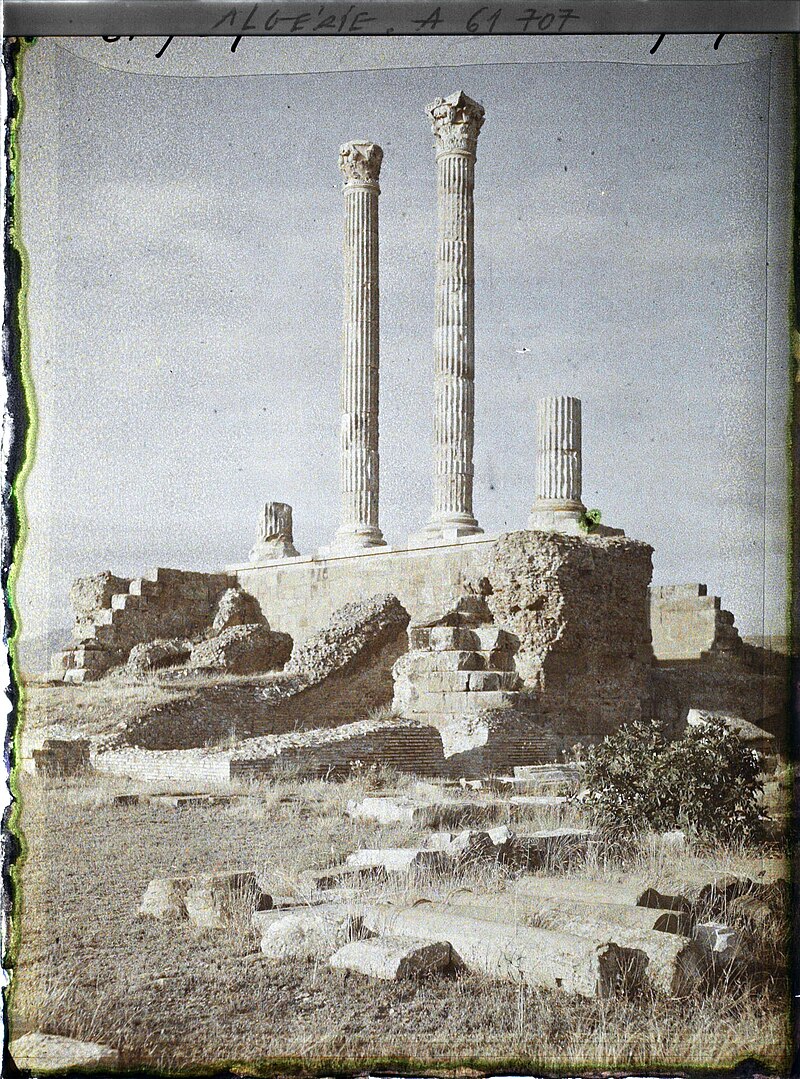
Welcome to Timgad, one of the most remarkable and impeccably preserved ancient Roman cities anywhere in the entire world. Nestled gently upon the expansive high plateaus of the Aurès Mountains in eastern Algeria, roughly thirty-five kilometers east of the regional center of Batna, this monumental archaeological site was inscribed as a UNESCO World Heritage Site in nineteen eighty-two. Revered globally as the Pompeii of Africa, Timgad offers an unmatched window into the brilliant urban planning and civil engineering of the high Roman Empire. The city was founded in the year one hundred AD by explicit imperial decree of Emperor Trajan. It was given the grand formal title of Colonia Marciana Ulpia Traiana Thamugadi, a name that honored the personal family lineage of Emperor Trajan while preserving the native Berber settlement name of Thamugadi. Emperor Trajan established this planned urban community primarily as a military veteran colony, granting rich plots of agricultural land to retired legionnaires of the Third Augustan Legion after their decades of honorable service across the frontiers of the empire. Because the Roman military survey engineers were presented with an uninterrupted blank canvas upon an open mountain plain, they were able to execute the ultimate Roman architectural ideal of grid urban design. The original settlement was laid out as a neat rectangle measuring three hundred fifty-four meters by three hundred twenty-four meters. It was anchored by two broad primary avenues that crossed at an exact right angle in the civic center. The principal north-to-south street, known as the Cardo Maximus, and the primary east-to-west street, known as the Decumanus Maximus, functioned as the structural spine of the city. These main thoroughfares neatly partitioned the entire internal urban core into uniform square residential blocks, each measuring precisely twenty meters on every side. Although Timgad was initially ringed by defensive fortification walls to protect the new settlers from local mountain tribes, the community experienced rapid economic growth throughout the second and third centuries. As the population multiplied, citizens dismantled the original outer walls to expand urban life outward, constructing grand public baths, elegant markets, a library, and sprawling residential neighborhoods. As you begin your walking tour today, please take careful note of your physical steps. You are walking directly upon the authentic limestone paving slabs laid down by Roman stone masons two millennia ago. Because these stones are uneven, weathered, and can be slippery underfoot, please watch your step carefully and take a relaxed pace. Sturdy walking footwear is strongly recommended. Furthermore, because Timgad sits elevated in a high mountain environment, sudden wind gusts are common and temperatures can drop quickly. Ensure you have warm layers, effective sun protection, and adequate drinking water as we begin our journey.
02 Museum of Timgad: Mosaic Masterpieces
Please step inside the doors of the Museum of Timgad, situated convenient to the primary site entrance. This exhibition hall serves as a dedicated sanctuary for the most fragile and breathtaking artistic treasures unearthed across the sprawling ruins of ancient Thamugadi. One truly extraordinary fact to appreciate as you step inside is that the brilliant floor mosaics displayed across these walls were originally created as a far superior alternative to imported marble. …
03 The Forum: Civic Heart and Philosophy of Life
As you journey southward along the North Cardo avenue, you arrive at the expansive central plaza known as the Forum, positioned precisely at the primary intersection with the main east-to-west highway, the Decumanus Maximus. One surprising and delightful historical fact to discover upon stepping into this open civic plaza is that ancient Roman citizens carved their pragmatic, lighthearted philosophy of everyday life directly into the hard stone flooring of the square itself. …
04 The Public Library: A Beacon of Roman Knowledge
You have now arrived at the ruins of the Public Library of Timgad, situated directly adjacent to the western boundary of the Forum plaza. A truly astonishing historical fact regarding this refined structure is that it represents one of the extremely rare positively identified freestanding public libraries in the entire ancient Roman Empire. …
05 The Ancient Theatre: Grand Stage of the Aurès
Ascending the southern hillside brings you to the grandest and most imposing monument in Thamugadi, the Ancient Theatre. Constructed directly into the natural parabolic slope of the hill, this sweeping stone auditorium was built to accommodate three thousand five hundred spectators simultaneously. A truly astonishing fact regarding this ancient amphitheater is its flawless acoustic engineering. …
06 Trajan's Arch: The Imperial Gateway
Arriving at the western terminus of the Decumanus Maximus highway brings you face to face with Trajan's Arch, the undisputed architectural icon of Timgad. Standing a monumental twelve meters high, this triumphal arch served as the grand western gateway into ancient Thamugadi. One truly surprising visual fact to appreciate as you stand before this monument is how the sandstone material reacts to the late afternoon sunlight. …
07 Closing
Our walking journey through the ancient Roman grid city of Thamugadi has now drawn to a complete close. Together, we have traced the living story of Timgad, beginning with the brilliant floor mosaics preserved in the site museum, continuing through the lively civic square of the Forum, the quiet manuscript alcoves of the Public Library, the acoustic splendor of the hillside Theatre, and the wheel-rutted paving stones beneath Trajan's Arch. …