 Photo Wikimedia Commons
Contents
History & cultureBY TELLBY7 sections · numbered as on the map01 Orientation
Located approximately twenty-four kilometers northeast of Madagascar's capital city of Antananarivo in the central highlands, the Royal Hill of Ambohimanga stands as the supreme spiritual heart and premier cultural monument of the Merina people. Perched atop a prominent hill that rises steeply four hundred and fifty feet above the surrounding valley on its eastern side and slopes gently westward, this fortified royal settlement, known locally as a rova, represents the best-preserved precolonial royal compound in the island's history. Elevated above neighboring hills, Ambohimanga holds a distinguished place among the traditionally designated twelve sacred hills of Imerina, symbolizing paramount political and spiritual authority relative to other regional hill settlements. Recognized by UNESCO as a World Heritage Site in 2001, the designated protected area encompasses fifty-nine hectares of core historic structures surrounded by an extensive protective buffer zone of four hundred and twenty-five hectares. For at least five centuries, Ambohimanga has maintained its profound sacred character, serving as an active place of worship where pilgrims from across Madagascar and the wider West Indian Ocean islands continue to gather to honor ancestral spirits. The deep history of this hill traces back to the island's earliest inhabitants, the Vazimba, who settled the highlands between 200 BCE and 300 CE after arriving by pirogue from southeastern Borneo. Four sacred Vazimba burial sites on and around Ambohimanga hill remain active places of pilgrimage and ancestral veneration today. By the fifteenth century, Merina migrants established hilltop settlements here, gradually transforming the original valley forests into extensive terraced rice paddies cultivated by the Tantsaha clan to sustain the growing population. The crest of the hill remains crowned by a primary forest that was historically preserved from highland deforestation due to its deeply sacred status. This pristine forest contains endemic tree species such as the zahana and native medicinal plants like Anthocleista, Dracaena, and Phyllarthron vines, all holding spiritual importance. The architectural and spatial layout of Ambohimanga incorporates complex cosmological spatial principles, balancing the four cardinal points radiating from a unifying center with a sacred emphasis on the northeastern direction associated with ancestral blessings. As you begin your walking tour today, please observe the site's solemn atmosphere and strictly respect local traditional taboos, known as fady, which prohibit items such as pigs, pumpkins, corn, onions, hedgehogs, and snails, as well as the cutting or collecting of wood from the sacred forest. Walk quietly along the ancient stone pathways, maintain proper reverence, and prepare to discover the living history and spiritual sanctuary of Madagascar.
02 Ambatomitsangana Gate
Every single morning and evening at this formidable entrance, a coordinated garrison of twenty royal soldiers had to assemble and exert their combined physical strength to roll a massive stone disc door into position. This monumental circular barrier, known in the Malagasy language as a vavahady, measured an astonishing four point five meters in diameter and thirty centimeters in thickness, weighing approximately twelve tons. …
03 Fidasiana Courtyard in Bevato Compound
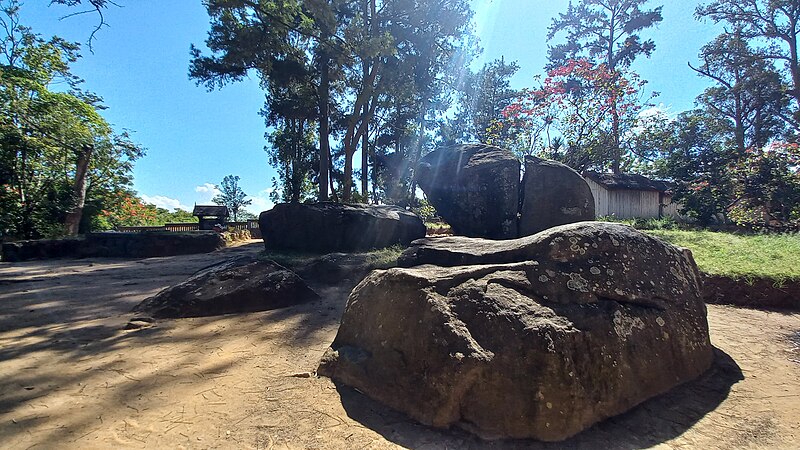
Welcome to the historic Bevato compound and its expansive central esplanade, known as the Fidasiana courtyard. This sacred ground served as the grand stage for the most significant political and spiritual ceremonies in Merina history, including royal enthronements, public decrees, and the elaborate Fandroana festival, also known as the Royal Bath New Year. …
04 Mahandrihono Palace
As you step across the threshold into the Mahandrihono compound, feel the immediate shift from the open, sunlit courtyard of Bevato into the quiet, reverent sanctuary housing Madagascar's most extraordinary architectural treasure: the original palace of King Andrianampoinimerina. Constructed around 1790, this unpretentious single-room wooden structure is the only original royal palace from King Andrianampoinimerina's era left entirely intact today. …
05 Royal Pavilions
Standing in stark aesthetic contrast to the simple rosewood palace of King Andrianampoinimerina are two ornate nineteenth-century royal pavilions, representing a dramatic shift toward European architectural influences at the Malagasy royal court. The smaller of these two pavilions, known as Tranofitaratra, or the Glass House, was constructed in 1862 under the orders of Queen Ranavalona II. …
06 Nanjakana Compound Lookout
Welcome to the Nanjakana compound, the highest elevated structure within the entire rova of Ambohimanga. This lofty compound is the setting for one of the most tragic and dramatic historical accidents in Malagasy royal history. In 1861, during the elaborate royal funeral ceremonies held here for Queen Ranavalona I, an accidental spark ignited a barrel of gunpowder brought to the compound for ceremonial salutes. …
07 Closing
As our walking tour comes to a conclusion, we reflect upon the enduring cultural legacy of the Royal Hill of Ambohimanga. More than just an extraordinary collection of precolonial palaces, defensive walls, and stone gateways, Ambohimanga remains a living symbol of Malagasy national identity, spiritual power, known as hasina, and unbroken cultural continuity. …