Contents
History & cultureBY TELLBY7 sections · numbered as on the map01 Orientation
Welcome to Naqsh-e Jahan Square in Isfahan, a magnificent UNESCO World Heritage site whose Persian name translates to the Image of the World. This vast urban square stands as an exceptional architectural realization in Iran, a region where historic Islamic cities were traditionally tightly laid out with narrow winding alleyways and without sizeable open public spaces. Covering an immense area of nearly nine hectares, measuring five hundred and sixty meters in length by one hundred and sixty meters in width, this harmonious urban ensemble reflects the brilliant imperial vision of the Safavid Dynasty at the turn of the seventeenth century. In the year 1598, Shah Abbas the Great made the monumental strategic decision to transfer the capital of his empire from the northwestern city of Qazvin to Isfahan. Prior to his reign, Iran suffered under a fractured and decentralized political structure where provincial governors and the military Qizilbash faction constantly contested royal authority. By completely remaking Isfahan into a grand imperial metropolis, Shah Abbas sought to undermine this divided political system and consolidate absolute centralized power around the throne. Isfahan provided an ideal geographic sanctuary; situated as a fertile oasis nurtured by the Zayande River amidst an arid surrounding landscape, it placed the new capital at a safe distance from potential military assaults by the Safavids' formidable rivals, the Ottoman Empire and the Uzbeks. Furthermore, shifting central control closer to the Persian Gulf allowed Shah Abbas to exert direct oversight over vital maritime trade routes that were rapidly becoming lucrative for European mercantile powers, notably the British and Dutch East India Companies. The master scholar and urban planner responsible for this colossal undertaking was Shaykh Bahai. He anchored the city's modern layout around two central structural features: the grand Chaharbagh avenue, lined with diplomatic residences and major state institutions, and this colossal central square. Shaykh Bahai conceived the square as a multi-functional public stage where the monarch and his subjects could interact. The perimeter of the vast esplanade was enclosed by continuous two-storey arcades housing hundreds of merchant shops. At the four cardinal points, four monumentally significant structures were erected: the Qeysarie Gate to the north leading into the grand bazaar, the exquisite Sheikh Lotfollah Mosque to the east, the towering Shah Mosque to the south, and the majestic Ali Qapu Palace to the west. In Safavid times, the sandy central plaza hosted troop assemblies, royal parades, polo matches, vibrant festivals, and public executions. Today, this extraordinary space remains a living monument of Persian social, cultural, and political history. Let us now begin our walking journey by proceeding toward the northern entrance of the square.
02 Qeysarie Gate and the Imperial Bazaar
Welcome to the Qeysarie Gate, the grand ceremonial entrance leading directly into the Imperial Bazaar of Isfahan. At the very top of this towering portal, on the open balcony positioned above the main entrance archway, musicians in the service of the Safavid court regularly performed public concerts, filling the air with reverberating trumpets and drums that resounded across the vast expanse of the square below. …
03 Sheikh Lotfollah Mosque
You are now standing before the magnificent Sheikh Lotfollah Mosque, located on the eastern axis of Naqsh-e Jahan Square. Unlike standard congregational mosques designed to accommodate thousands of public worshippers, this sanctuary was constructed exclusively as a private place of prayer for the royal court of Shah Abbas the Great. …
04 Shah Mosque / Masjed-e Shah
Welcome to the Shah Mosque, also known historically as the Masjed-e Shah or Abbasid Grand Mosque, positioned at the southern anchor of Naqsh-e Jahan Square. As you approach this masterpiece of Safavid architecture, observe its ingenious geometric orientation. While Naqsh-e Jahan Square is aligned along a precise north-south axis, Islamic religious tradition dictates that mosques must face southwest toward Mecca. …
05 Ali Qapu Palace
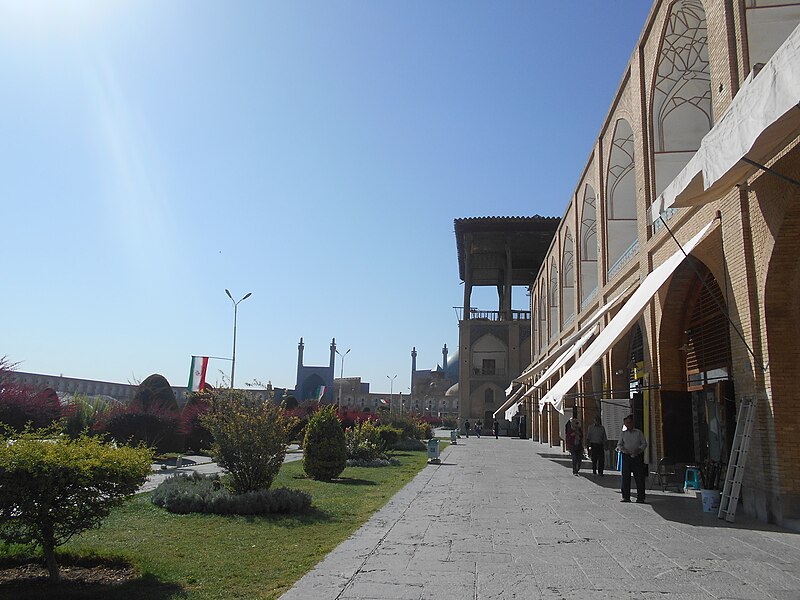
Standing before you on the western axis of Naqsh-e Jahan Square is the magnificent Ali Qapu Palace, which served as the monumental entrance to the sprawling Safavid royal residential complex. A truly extraordinary secret lies hidden on the sixth floor of this multi-storey pavilion in the famous Music Room. The walls and vaulted ceiling of this banquet hall are covered with intricate plaster stucco cutouts formed in the shapes of various flasks, vases, and drinking cups. …
06 The Square Arcades
You are now walking alongside the continuous two-storey arcades that frame the entire perimeter of Naqsh-e Jahan Square. During the daylight hours, these arcades house hundreds of bustling merchant shops offering exquisite Persian carpets, delicate handicrafts, and precious trade goods. As night falls, the commercial activity gives way to vibrant teahouses and illuminated walkways where local citizens and visitors gather to relax under the evening sky. …
07 Closing
Standing here by the broad central pool, we reflect upon the enduring architectural, historical, and cultural legacy of Naqsh-e Jahan Square. True to its Persian name, the Image of the World, this extraordinary urban complex stands as a complete microcosm of the Safavid Empire, where politics, commerce, religion, and social culture were brought together into a single, cohesive master plan conceived by Shah Abbas the Great and Shaykh Bahai. …