Contents
History & cultureBY TELLBY7 sections · numbered as on the map01 Orientation
Nestled among lush green forests and rolling glacial hills where the Neris and Vilnia rivers meet, stands one of the most magnificent historic cities in Eastern Europe. Welcome to the Vilnius Historic Centre, home to the largest Baroque old town in Central and Eastern Europe. Over many centuries, despite enduring destructive wars, citywide fires, and foreign occupations, Vilnius has preserved its organic medieval town structure and extraordinary architectural heritage in remarkable harmony. Its characteristic radial street network, sweeping public squares, and intimate historic plot boundaries preserve their authentic medieval origins. In recognition of its outstanding universal value and breathtaking urban landscape, the historic centre was officially inscribed as a UNESCO World Heritage Site in 1994.
Vilnius made its first recorded appearance in written historical documents in the year 1323. Following its designation as the capital of the Grand Duchy of Lithuania, it served as the political core of Europe's largest state during the fifteenth century, stretching from the Baltic Sea in the North to the Black Sea in the South. Consequently, Vilnius exerted a profound influence on the architectural and cultural development of Eastern Europe. Above all, the city developed as a vibrant multicultural crossroads where Western and Eastern traditions merged seamlessly. Lithuanians, Jews, Ruthenians, Poles, Tatars, and other communities coexisted harmoniously, infusing the urban fabric with their distinct languages, religions, and artistic traditions. This rich exchange created an exceptional religious landscape featuring Catholic, Lutheran, Orthodox, and Jewish sanctuaries side by side.
Spanning three point fifty-nine square kilometers, the historic center encompasses seventy-four quarters, seventy streets and lanes, and nearly fifteen hundred historic buildings. Over centuries of evolution, styles of Gothic, Renaissance, Baroque, and Classicism came together to form a breathtaking architectural mosaic. Centered around the historic hill where the Upper, Lower, and Curved castles once stood, the townscape features soaring church spires, monastic complexes, the grand campus of Vilnius University, and opulent palaces of noble families such as the Tyzenhauzai, Rensai, Pacai, and Masalskiai. Today, these cobblestone streets offer a living stage where history flows into daily life. As we step into these picturesque winding lanes, we invite you to experience the authentic atmosphere and rich narratives of this European capital.
02 Cathedral Square and Cathedral Basilica
Beneath the paved stone surface of Cathedral Square where you are standing today lie buried the ancient stone foundations and hidden medieval ruins of a forgotten lower castle complex. Now, please lift your eyes and look directly across the sweeping open square toward the front of the grand sanctuary. …
03 Vilnius Castle Complex and Gediminas Tower
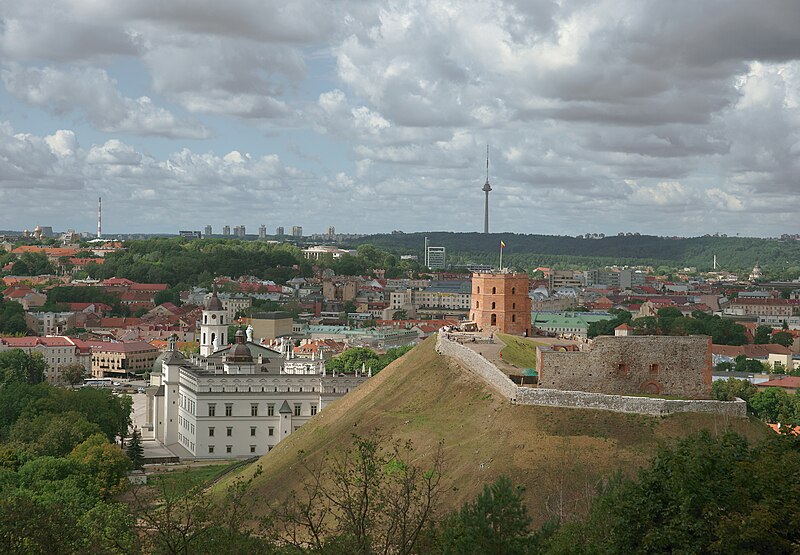
The steep glacial hill supporting Gediminas Tower has been continuously occupied since the Neolithic period, serving as a strategic defensive site where a wooden fortification was first erected around 1000 AD at the confluence of the Neris and Vilnia rivers. Now, please raise your eyes toward the summit of the hill. High above the surrounding canopy of green trees stands the iconic octagonal red brick Gediminas Tower, encircled by the rugged stone wall fragments of the ancient Upper Castle. …
04 Church of Saint Anne and Bernardine Monastery
The magnificent front facade of Saint Anne's Church is constructed entirely using thirty-three distinct shapes of custom-molded red clay bricks, forming a crowning masterpiece of late Flamboyant Gothic architecture. Please pause directly in front of the sanctuary and gaze up at the dizzying array of delicate flame-like arches and slender spires rising sharply toward the sky. …
05 Vilnius University Ensemble and St. Johns' Church
The architectural ensemble of Vilnius University is an extraordinary city within a city, comprising thirteen interconnecting historic courtyards that capture five centuries of evolving design so perfectly that it was selected to represent Lithuania in the prestigious Mini-Europe park in Brussels. Please step into the central courtyard and lift your eyes toward the soaring bell tower of Saint Johns' Church. …
06 Gate of Dawn
Out of the nine original defensive gates built into the early sixteenth-century stone defense wall that once enclosed the entire medieval city, the Gate of Dawn is the sole surviving original gateway standing today. Stand near the southern approach and look up at the archway of the Gate of Dawn. Direct your gaze to the small glass window above the passage where the venerated chapel rests. Behind that window glows the miraculous icon of the Virgin Mary, known as the Guardian of Vilnius. …
07 Closing
From the grand expanse of Cathedral Square to the regal summit of Gediminas Hill, the flaming red brick facade of Saint Anne's Church, the intellectual courtyards of Vilnius University, and the holy sanctuary of the Gate of Dawn, our audio guide tour of the Vilnius Historic Centre now comes to its completion. …