Contents
History & cultureBY TELLBY7 sections · numbered as on the map01 Orientation
Welcome to the Historic Bazaar Complex of Tabriz, a celebrated trading hub along the ancient Silk Road and one of the most venerable covered marketplaces in the Middle East. Designated a UNESCO World Heritage Site in 2010, this monumental architectural complex stands as the world's largest continuous covered brick structure. Far from being a static museum or a monument frozen in time, Tabriz Bazaar is a vibrant living heritage site preserved through the active stewardship of its own merchant community, who continue their daily commerce inside these historic vaults.
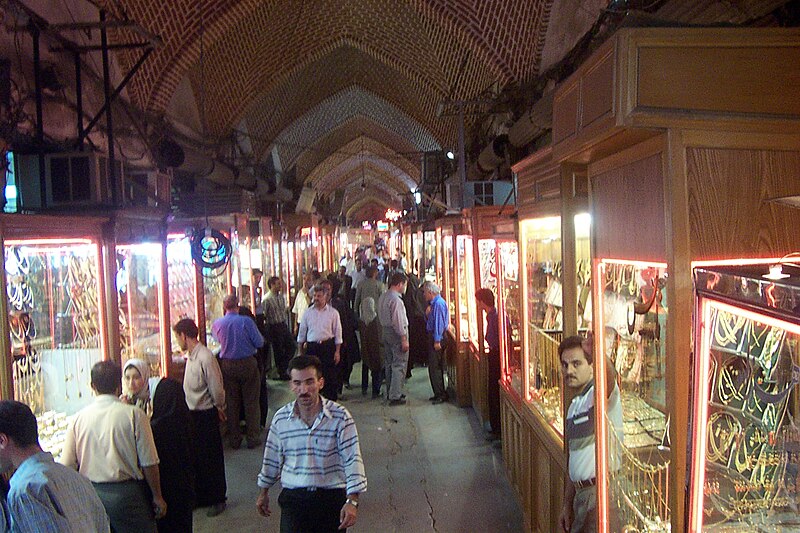
Spanning an expansive twenty-seven hectares with miles of continuous covered vaulted passages, the bazaar houses thousands of individual shops and artisan workshops. As you navigate these continuous brick corridors, you step into an urban fabric that has functioned uninterrupted for centuries. The complex is organized into distinct specialized rows and precincts dedicated to specific trades, interwoven with mosques, educational institutions, bathhouses, and traditional teahouses that together form a complete public realm. Walking along the cool vaulted alleys, you will instantly notice the delicate thermal shift from the outer streets, accompanied by the inviting aromas of dried herbs, roasted spices, and freshly brewed black tea.
Throughout history, Tabriz served as a pivotal international crossroads of commerce and cultural exchange. Its historic market was documented by dozens of legendary explorers and chroniclers across different eras. The Venetian traveler Marco Polo recorded passing through Tabriz while traveling along the Silk Road, marveling at its rich commercial activity and the vast wealth of its merchants. In the fourteenth century, the famous traveler Ibn Battuta visited the site and described its remarkable scale, diverse commodities, and economic vitality. From early Islamic geographers to imperial European ambassadors, historical accounts consistently praised Tabriz as a premier center of global trade, particularly when the city flourished as the imperial capital of Safavid Iran.
As you begin your walking tour, take time to observe the extraordinary engineering of the monolithic brick architecture surrounding you. Overhead, complex vaulted roofs and soaring domes regulate light, ventilation, and interior temperatures while creating a visually stunning geometric canvas. The physical environment you see today has been meticulously restored through traditional masonry techniques maintained by local master masons and financed directly by the shopkeepers themselves.
This audio guide will lead you through key commercial and public spaces, starting from the renowned carpet market and proceeding through gold rows, spiritual sanctuaries, quiet seminary courtyards, and unique bridge structures. Please follow the covered brick alleyways at a comfortable pace, enjoying the distinct sounds, scents, and vibrant atmosphere of this living urban monument.
02 Mozzafariyeh Timcheh: The Heart of Woven Rugs
Stepping into Mozzafariyeh Timcheh brings you face to face with one of the most magnificent commercial spaces in the Middle East, where world-renowned handwoven Persian carpets are traded and sorted strictly by knot density, fiber quality, and weave type beneath monumental brick domes constructed two hundred and forty years ago. …
03 Amir Row: Gold and Monumental Brick Domes
Entering Amir Row presents a striking spectacle where the city's central trade in gold, silver, and precious jewelry thrives beneath monumental brick arches engineered centuries ago without a single piece of modern steel reinforcement. Known as one of the most prosperous and visually captivating corridors in the entire Tabriz Bazaar complex, this vaulted row seamlessly blends high-value commercial enterprise with exceptional traditional architecture. …
04 Jameh Mosque: Spiritual Anchor of the Market
Stepping into the Jameh Mosque of Tabriz brings you into a sanctuary where faith and commerce are seamlessly unified, designed without any exterior boundary walls separating the sacred prayer halls from the busy commercial alleys of the surrounding market. As the cathedral mosque of the complex, this monumental structure serves as the spiritual and social anchor of Tabriz Bazaar. …
05 Talebiyeh Seminary: Quiet Courtyard of Learning
Stepping into the open-air courtyard of Talebiyeh Seminary reveals a peaceful sanctuary where green trees, cool air, and running water lie hidden just steps away from the noisy, crowded trading corridors of the main bazaar. Functioning as a prominent center for traditional Islamic theology and classical education, this seminary offers a stark, soothing contrast to the intense commercial activity outside its heavy brick walls. …
06 Pol-Bazaar: The Marketplace Built on a Bridge
Standing inside Pol-Bazaar over the Mehran-roud River places you directly on top of a remarkable architectural and urban engineering feat, where historic builders constructed fully functional covered shop rows directly upon a multi-arched bridge structure. By spanning the riverbed with heavy masonry arches and enclosing the upper deck within continuous brick vaults, master builders seamlessly joined two separate halves of Tabriz into a unified commercial entity. …
07 Closing
As we conclude our audio tour of the Historic Bazaar Complex of Tabriz, it is worth reflecting on the extraordinary conservation achievements that safeguard this living monument. In 2013, the comprehensive rehabilitation project of Tabriz Bazaar won the prestigious Aga Khan Award for Architecture, celebrating a ground-breaking management model built upon public participation. …