 Photo Wikimedia Commons
Contents
History & cultureBY TELLBY7 sections · numbered as on the map01 Orientation
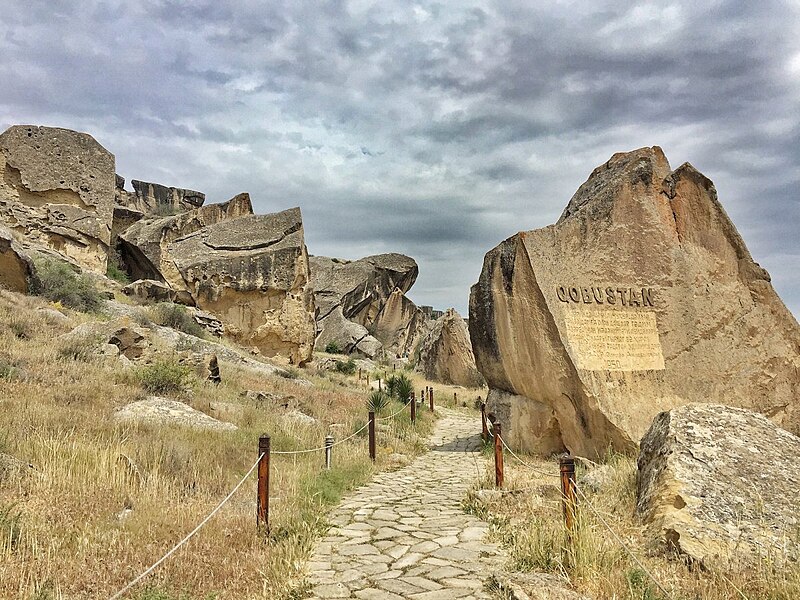
Welcome, esteemed visitors, to the Gobustan National Reserve, a sacred sanctuary where tens of thousands of years of human history stand still in breathless silence. Located approximately sixty kilometers south of the vibrant capital city of Baku along the western shores of the Caspian Sea, this expansive archaeological landscape unfolds dramatically across the majestic slopes of Boyukdash, Kichikdash, and Jingirdagh mountains. As you gaze across the surrounding terrain, you will see a striking and desolate expanse of arid hills littered with massive, weathered boulders that create an imposing outdoor gallery. Yet beneath this rugged exterior lies an extraordinarily rich cultural haven. Gobustan was designated as a UNESCO World Heritage site not merely for its extraordinary natural topography, but because it represents an outstanding open-air museum and living space where humanity continuously carved its life, beliefs, and artistic expressions into stone over a vast span of time stretching from the Upper Paleolithic era all the way to the Middle Ages. Declared a protected state preserve in 1966 and inscribed on the World Heritage List in 2007, this remarkable territory spanning roughly four thousand hectares encompasses over one thousand rocks adorned with more than six thousand ancient petroglyphs. Ever since pioneering archaeological investigations began here in 1939 under researcher Jafarzadeh, extensive excavations have uncovered more than twenty ancient settlements and over forty Bronze Age burial mounds, demonstrating an unbroken chain of human cultural continuity. The spatial organization of the reserve itself offers a vivid chronology of human evolution. The most ancient petroglyphs and living shelters are concentrated upon the elevated upper terraces of the mountains, whereas Neolithic and Eneolithic sites occupy the lower terraces, and Bronze Age, Iron Age, and medieval monuments rest near the mountain bases. Here, carved in stone, you will witness early hunters pursuing formidable aurochs and gazelles, sacred female figures symbolizing fertility and life, ancient reed boats navigating the prehistoric Caspian waters, and spirited ceremonial dances. Beyond the engravings, the reserve shelters unique historical treasures including the famous Gaval Dash musical stone, an inscription left by a passing Roman soldier in the first century AD, and nearby mud volcanoes. As the gentle sea breezes sweep across these sun-drenched rocks, prepare to embark on a memorable journey into our shared ancient past. Listen closely to the timeless echoes embedded in these rocks and begin your walk toward our first heritage site.
02 Sacred Depths of Life and Fertility: Ana-zaga Cave
Within the shadowed depths of this massive rock cavern, you are standing before a truly astounding prehistoric revelation, where pregnant female figures and wild aurochs carved over ten thousand years ago by early humans seeking fertility and abundance remain impeccably preserved. You have now entered Ana-zaga Cave, situated on the lower terrace of Boyukdash Mountain, a name that translates directly to Mother Cave and represents one of the most iconic Upper Paleolithic rock shelters in the…
03 Early Hunters on the Windswept Upper Terrace: Kaniza Shelter
Beneath the high, expansive rock shelter where you now stand, an extraordinary archaeological discovery was made, revealing highly refined flint tools and striking engravings of ox heads created by early hunters tens of thousands of years ago. Welcome to Kaniza Shelter, situated upon the elevated and windswept upper terrace of Boyukdash Mountain. Please raise your eyes and look toward the prominent face of the massive rock standing on your right. …
04 Riddles of the Ancient Caspian: The Dolphin Rock of Gaya-arasi
Standing before these arid and sun-baked rocks today, it may seem almost incredible that a massive petroglyph of a dolphin, measuring well over four meters in length, is deeply carved into the stone beneath your feet. You are currently exploring the Gaya-arasi site, nestled within a rocky ravine at the base of Kichikdash Mountain. Please trace your eyes along the flat, horizontal surface of Stone Number 5 located on the lower slope. …
05 Rowing with the Sun: Ancient Boat Petroglyphs of Firuz-2
Thousands of years ago, ancient navigators carved sacred sun symbols onto the prows of their boats, dreaming of fearless maritime voyages across unknown waters and spiritual journeys into the afterlife. You have arrived at the Firuz 2 shelter on Kichikdash Mountain, standing directly before the massive Stone Number 19, which forms the eastern natural wall of this rock shelter. Please examine closely the dense concentration of petroglyphs carved across the middle slope of Stone Number 19. …
06 Soulful Resonances of Millennia: The Gaval Dash Tambourine Stone
Measuring a mere two meters in length, this unassuming, weathered boulder conceals an astounding acoustic secret: when struck with a smaller stone, it produces a clear, resonant sound remarkably like a tambourine or traditional drum. You are standing before the celebrated Gaval Dash, a name in the Azerbaijani language that translates directly to Tambourine Stone, one of the most intriguing ancient treasures in the Gobustan State Reserve. …
07 Closing
As we stand together at the final observation platform overlooking the vast expanse of the Gobustan National Reserve, our journey across the ocean of time reaches its completion. Standing high above this ancient rock landscape, take a moment to absorb the breathtaking panorama unfolding before your eyes. …