 Photo Wikimedia Commons
Contents
History & cultureBY TELLBY8 sections · numbered as on the map01 Orientation
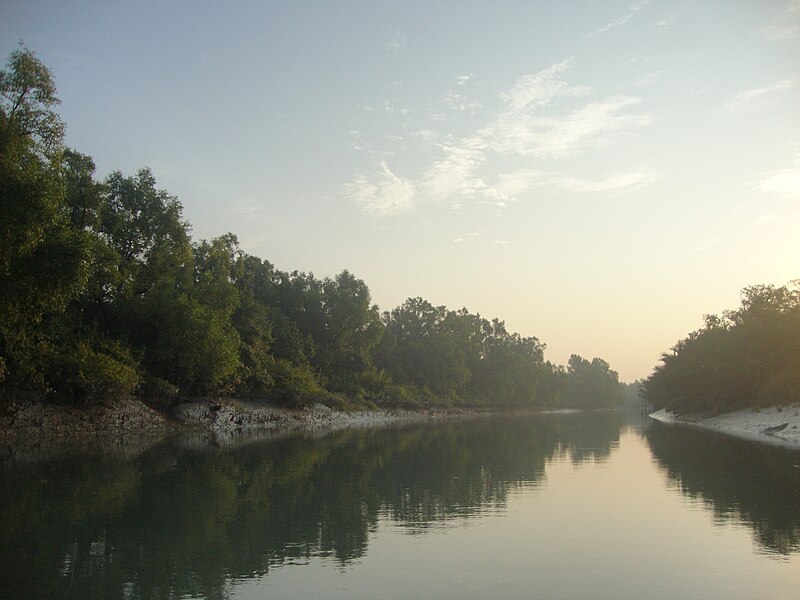
Welcome to the Sundarbans Reserved Forest, the world's largest continuous mangrove ecosystem and a celebrated UNESCO World Heritage site. This sacred sanctuary is a global treasure where unique tidal rivers, dense mangrove forests, and rare wild species coexist in perfect ecological balance across a vast deltaic floodplain spanning over ten thousand square kilometers between Bangladesh and India. Over the past six thousand years, rich sediments derived from Himalayan weathering were carried down by the mighty Ganges and Brahmaputra river systems, fusing with the powerful estuarine tides of the Bay of Bengal to build this extraordinary landmass. Twice daily, the delicate interplay between fresh river water and saline ocean water creates an unparalleled aquatic and terrestrial environment. Before British colonial rule, local inhabitants knew this vast estuarine expanse as Bhati, meaning the land of the ebb tide. In those early days, indigenous communities moved freely across the waterways to gather timber and sustain their families. As the British geographer Francis Buchanan observed in seventeen ninety-eight, the woods were not treated as private property, and every local peasant could gather whatever timber was needed. However, beginning in seventeen seventy under the East India Company, colonial administrators viewed these wetlands as disease-ridden jungles infested with dangerous wildlife and launched aggressive clearance policies to convert mangroves into taxable rice paddies. By the second half of the nineteenth century, British foresters realized that unrestrained clearance would destroy the natural protective storm barrier guarding coastal settlements and exhaust the regional timber supply. A forest department report in eighteen sixty-seven declared that the forest must become a permanent source of state revenue and an unfailing supply of wood at a fair price. Consequently, in eighteen seventy-five, the colonial government officially designated major portions of the forest as reserve land, establishing strict legal controls over timber harvesting. Today, this ecosystem is doubly protected, distinguishing between the pristine reserve forest core and the surrounding Ecologically Critical Area buffer established in nineteen ninety-nine. Standing here at the waterway entrance, you are at the threshold where human history, resource management, and raw wilderness converge. Enjoy this journey through time and nature.
02 Sundari Tree Observation Deck
Pause at the edge of the wooden observation deck and tilt your eyes downward toward the dark, glistening estuarine clay right beneath your feet. Notice the grey longitudinally cracked bark and the strong, buttressed stem of the evergreen Sundari tree standing resiliently in the brackish mud. Open your mind to the surprising fact that the entire forest gets its name Sundarbans directly from this single iconic tree species. …
03 Malanghi Salt Maker Relics
Deep beneath this seemingly untouched wilderness lie the forgotten earthen mounds and clay pots of eighteenth-century traditional salt manufacturers. Pause near the edge of the creek and look to your left. Notice those low, grassy earthen mounds rising slightly above the surrounding marsh ground. These vegetation-covered elevations are the archaeological ruins of eighteenth-century salt-boiling sites and temporary shelters operated by traditional salt manufacturers known as Malanghis and their…
04 Sheikher Tak Ancient Watchpost Ruins
Open your mind to the surprising fact that three hundred years ago, in the seventeen hundreds, this remote mangrove forest contained fortified brick structures built specifically to defend local settlers against fierce sea pirates. Raise your eyes toward the thick vines and dense canopy directly ahead. Look closely at the weathered red-brick wall emerging from the roots of the mangrove trees. …
05 Bawali Woodcutters Dock
Look down at the wooden mooring posts driven into the muddy bank where narrow country boats tie up along the water edge. Open your mind to the surprising fact that starting in eighteen eighty, every traditional woodcutter entering this forest had to pay strict government user fees based on the exact length and girth of every single log harvested. …
06 Golpatta Palm Clearing
Reveal to your mind the remarkable fact that the long, frond-like leaves growing right in the tidal water provide the essential roofing thatch for millions of coastal homes across southern Bangladesh. Look to your right along the water edge. Observe the massive feather-like green palm leaves sprouting directly out of the brackish water without a visible main tree trunk. Standing before you is the Golpatta palm clearing, known scientifically as Nypa fruticans. …
07 Wildlife Sanctuary Observation Deck
Ascend the observation deck and look out across the sweeping expanse of tidal channels and dense forest. Open your mind to the remarkable fact that this wildlife sanctuary within the reserve forest was designated a UNESCO World Heritage site in nineteen ninety-seven specifically to preserve one of the world's last remaining habitats where tigers actively swim across wide, saline tidal rivers. …
08 Closing
Standing here at the forest edge overlook, gaze softly across the vast horizons and winding waterways of the Sundarbans. The journey we have shared today is far more than a simple walk through nature; it is a profound passage through a living landscape where human history and ecological forces have continually shaped one another. …