Contents
History & cultureBY TELLBY7 sections · numbered as on the map01 Orientation
Welcome to the ancient archaeological site of Sarazm, a remarkable sanctuary whose local Tajik name translates directly as where the land begins. You are standing upon the sacred grounds of one of the oldest proto urban settlements in Central Asia, where human history was fundamentally reshaped over five thousand five hundred years ago. Inscribed in twenty ten as the very first UNESCO World Heritage Site in Tajikistan, Sarazm stands as a monumental testament to the dawn of settled human civilisations, capturing the precise historical moment when wandering pastoralists chose to build permanent mud brick homes in this fertile river valley.
The unique geographical positioning of Sarazm played a decisive role in its historic emergence and flourishing growth. Nestled between the high mountainous pastures of the Fann Mountains suitable for nomadic pastoralists and the vast plain of the Zerafshan River ideal for early irrigated agriculture, this site became a natural meeting place for diverse populations. Here, nomadic herders descending from the highlands encountered settled farmers of the lowlands. Together, they established a thriving community that quickly evolved beyond a simple farming village into a sophisticated proto urban metropolis that flourished for over a thousand years.
What makes Sarazm exceptionally outstanding on a global scale is its pioneering role as a master hub of long distance cultural and economic exchange. Long before the formal Silk Road came into existence across Eurasia, the inhabitants of Sarazm established an expansive trade network. They exchanged valuable mineral resources, forged metal tools, and handcrafted decorated pottery across vast geographic distances stretching from the steppes of Turkmenistan to the Iranian Plateau, the Indus Valley, and even to the distant shores of the Indian Ocean.
The surrounding peaks and fresh breezes of the Zerafshan Valley wrap around these quiet ruins today just as they did five millennia ago. Ancient inhabitants read the subtle shifts of the seasons and redirected river waters to erect a monumental milestone in human development.
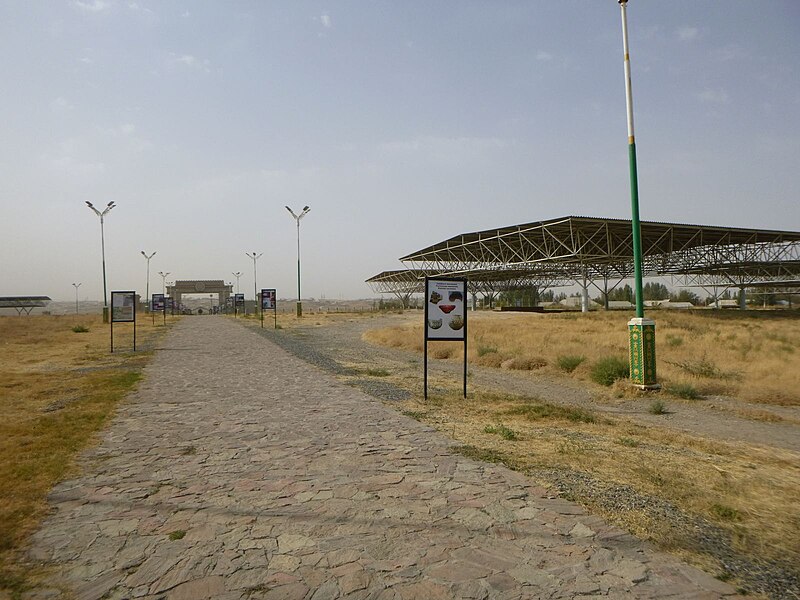
As you embark on this walking tour beneath the protective pavilions today, you will observe the unearthed mud brick walls and structural boundaries left behind by this Bronze Age culture. Each foundation tells a deep story of human ingenuity and resilience. We invite you to step back in time, open your mind to the distant past, and walk thoughtfully along the designated pathways where Central Asian urban life truly began.
02 The Veteran's Axe Unearthing Five Thousand Years of History
Did you know that a vast ancient city buried beneath the earth for over five thousand five hundred years was brought to light all because of a single bronze axe held in the hands of a retired local veteran. This truly astonishing narrative reveals how the long forgotten ruins of Sarazm were miraculously reawakened and introduced to modern human history.
Please cast your eyes upon the earthen walls and low foundations of the excavated structures sheltered beneath this expansive protective roof. …
03 Metallurgy and Crafts at the Heart of Ancient Trade
Did you know that around three thousand BCE, Sarazm served as the largest exporting metallurgical center in all of Central Asia. Long before modern industrial cities emerged during later historical epochs, this ancient settlement was already a booming industrial hub where roaring furnace fires and molten metals transformed the regional Eurasian economy. …
04 The Sacred Flame and Solar Worship Preceding Zoroastrianism
Did you know that this archaeological site features a remarkably preserved circular altar structure where sacred fires were worshipped centuries before the formal birth of Zoroastrianism in Persia. Long before codified religions spread across the Iranian Plateau and wider Central Asia during later centuries, the ancient residents of Sarazm around three thousand BCE had already established a sacred temple complex centered upon solar reverence and fire rituals. …
05 Harnessing the River Fields of Early Agriculture
Did you know that you are standing on the precise site where mountain pastoralists and valley agriculturalists united to establish Central Asia very first large scale irrigation farming system. Rather than relying solely on unpredictable seasonal rainfall, the early farmers of Sarazm engineered sophisticated earthen canals to harness the power of river waters, transforming the landscape into a blooming agricultural oasis over five thousand years ago. …
06 The Princess of Sarazm and Long Distance Trade Networks
Did you know that around three thousand BCE, a young woman in her twenties was laid to rest adorned with over ten thousand beads, gold ornaments woven into her braided hair, and more than four point five kilograms of precious lapis lazuli jewelry. Known famously among archaeologists as the Princess of Sarazm, her lavish burial tomb provides the most spectacular physical evidence that this ancient town was a thriving metropolis connected to international trade routes spanning across the ancient…
07 Closing
After flourishing as a vibrant proto urban center for nearly fifteen hundred years, the ancient city of Sarazm began to decline and was eventually abandoned around the nineteenth century BCE. Historians and climate scientists attribute this gradual end primarily to regional climate change and progressive environmental aridification. …