 Photo Wikimedia Commons
Contents
History & cultureBY TELLBY8 sections · numbered as on the map01 Orientation
A very warm welcome to all visitors arriving at the historic complex of Chhota Imambara, nestled in the ancient heart of Lucknow in Uttar Pradesh, India. Historically recognized by its formal name, Imambara Hussainabad Mubarak, or simply the Imambara of Husainabad, this monument stands as one of the most aesthetically refined and elegantly proportioned architectural masterworks defining the region. The origin of this sacred congregation hall traces back to eighteen thirty eight, during the second year of the reign of King Muhammad Ali Shah, the third King of Awadh. His ascension to the throne occurred at the advanced age of sixty three under unexpected circumstances with British support. Viewing his late in life coronation as a profound manifestation of divine grace and destiny, King Muhammad Ali Shah conceived this magnificent complex as an enduring token of allegiance to his Shia Islamic faith and an expression of heartfelt thanksgiving.
Beyond its religious intent, the complex served a vital civic purpose during a time of immense human hardship. The construction was organized as a massive famine relief initiative, offering meaningful employment and daily sustenance to thousands of laborers and craftspeople struggling against severe famine. The complete evolution and final perfection of the entire estate spanned fifty four years, resulting in the harmonious sanctuary you observe today. European travelers who visited during the nineteenth century were so captivated by its mesmerizing appearance during religious commemorations like Muharram that they bestowed upon it the celebrated moniker, the Palace of Lights. This romantic title was inspired by the dazzling spectacle created by its shining gold plated domes, soaring minarets, and the soft illumination reflecting off imported Belgian crystal glass chandeliers and floor lamps. Furthermore, the complex was designed to serve as a grand mausoleum for King Muhammad Ali Shah himself and his beloved mother, who rests peacefully beside him.
Geographically positioned west of the famous Bara Imambara and the iconic Rumi Darwaza, Chhota Imambara forms a pivotal anchor along Lucknow's five kilometer heritage corridor stretch running from Kaiserbagh to Husainabad. Recent preservation drives by civic authorities and heritage trusts have installed vibrant facade illumination, allowing the golden domes to glisten dramatically against the night sky. Our walking tour today begins at the outer perimeter, where we observe the twin Tripolia gateways flanking the eastern and western approaches. From there, we will progress through the heavy doors of the main Phatak gate, directly facing the historic Naubat Khana drum house. As we step into the central courtyard, you will marvel at the serene artificial lake fed historically by the Gomti River, along with its perfectly balanced flanking structures. Finally, we will enter the magnificent interior of the main Azakhana hall to examine its glittering treasures, royal crowns, silver throne, and sacred calligraphic art. Please take a moment to absorb the tranquil atmosphere as we begin our exploration.
02 Gateways, Main Phatak & Naubat Khana
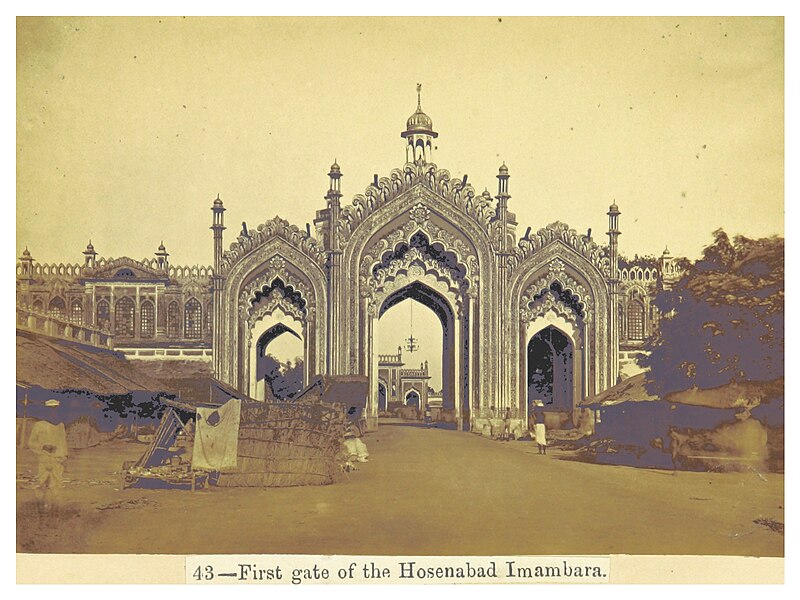
Let us now focus our attention on the impressive gateway structures that form the grand entrance to the Chhota Imambara complex. The master plan and structural arrangement of these gateways were executed under the meticulous supervision of Azimullah Khan, who served as the Superintendent of the King's Ordnance and Building Department under King Muhammad Ali Shah. …
03 Courtyard & Central Water Tank (Hauz)
As you step through the heavy wooden threshold of the main Phatak gate, the bustling noise of the outer city instantly recedes, replaced by an atmosphere of profound tranquility and geometric order. Stretching across the heart of this inner courtyard lies a serene artificial lake, known locally as the Hauz. Far from being a mere decorative pond, the Hauz serves as the central anchor of the entire complex layout, unifying the surrounding architecture into a harmonious visual composition. …
04 Tomb of Princess Asiya Begum (Miniature Taj Mahal)
As you stand alongside the central Hauz and look toward the side of the courtyard, your eyes will immediately be drawn to a breathtaking white structure that looks strikingly familiar. This elegant building is a famous scaled down replica of the world renowned Taj Mahal in Agra, crafted with exceptional artistic finesse. …
05 The Treasury Building (Jawab)
Directing your view directly across the central water tank from the tomb of Princess Asiya Begum, you will observe a twin building that appears almost identical in shape, scale, and detailing. In classical Islamic architectural theory, this building is designated as a Jawab, a word translating literally to answer or response. …
06 The Grand Azakhana & Main Hall Interior
We now step into the very heart and spiritual soul of Chhota Imambara, the grand congregation hall known as the Azakhana. Crowned externally by glittering gold plated domes, the facade of this principal building is pierced by five magnificent main doorways. These five entrances are deeply symbolic, representing the Panjetan, or the Holy Five revered in Shia Islam, comprising the Prophet Muhammad, his daughter Fatima, his son in law Ali, and his grandsons Hasan and Husain. …
07 Husainabad Mosque & Satkhanda Observatory
Exiting the main congregation hall into the courtyard, we encounter the serene Husainabad Mosque, situated atop a raised stone platform within the complex grounds. This functioning place of prayer features two magnificent minarets rising gracefully on the edges of the platform, creating an elevated architectural profile. The facade of the mosque is exquisitely decorated with sculpted floral motifs, delicate relief carvings, and formal Quranic calligraphy. …
08 Closing
As we arrive near the main exit, our audio guide tour of Chhota Imambara comes to a gentle conclusion. Before you step outside into the bustling city, we invite you to pause for a final moment and gaze back across the sweeping expanse of the courtyard. Taking in the majestic view of the shimmering gold plated domes, the calm mirror reflections on the central lake, and the harmoniously balanced flanking structures allows you to fully absorb the artistic brilliance of Nawabi Awadh. …
