Contents
History & cultureBY TELLBY7 sections · numbered as on the map01 Orientation
Welcome to the Akyrtas Architectural and Archaeological Complex, an extraordinary and profoundly captivating monument inscribed on the UNESCO World Heritage List as an essential segment of the Silk Roads network along the historic Chang'an to Tianshan Corridor. Akyrtas stands as a monumental physical testament to the flourishing transcontinental trade networks and vibrant urban civilizations that connected East Asia with the Middle East and Europe throughout the early Middle Ages. This grand architectural sanctuary played a vital strategic role along the northern trade corridor, functioning as a palatial station, high fortress, and vital residential stronghold nestled along the fertile alluvial strip between the vast open steppes and the rugged mountain chains. Geographically, the site of Akyrtas is situated approximately forty kilometers east of the ancient merchant oasis city of Taraz, and just six kilometers south of the Aksholak railway station, resting peacefully right at the picturesque foot of the majestic Kyrgyz Alatau Mountains, which form part of the greater Tian Shan mountain system. The modern scientific discovery of this cyclopean stone complex dates back over one hundred sixty years. In eighteen sixty-four, the insightful Russian artist and scholar M. S. Znamenskii became the first outside observer to systematically document these monumental ruins. Spellbound by the massive reddish sandstone walls that still stood one and a half to two meters high above the desert soil, Znamenskii rendered precise architectural drawings and evocative detailed sketches of the site. His published artwork ignited intense academic curiosity across the international scholarly community, prompting world renowned researchers such as Peotr Ivanovich Lerkh and Vasily Vladimirovich Bartold to launch extensive archaeological expeditions to solve the deep enigma of who constructed these cyclopean walls and for what magnificent purpose. Decades of painstaking archaeological research have revealed that Akyrtas was established during the early Middle Ages, primarily between the eighth and tenth centuries. The site represents an extraordinarily integrated complex that encompasses a grand monumental palace built of red sandstone blocks, an inner fortress, a high castle, a vast walled garden or park, an extensive residential district, several surrounding farmstead mounds, an ancient stone quarry, a watchtower, settlements for craftsmen, and a sophisticated long distance water supply pipeline made of plaster-stone pipes. When viewed from high above, the entire aerial footprint of Akyrtas bears an astonishing geometric resemblance to a giant microchip expertly embedded into a broad pyramidal base, reflecting an unprecedented level of mathematical planning and architectural vision. As you begin walking through these ancient grounds, prepare to immerse yourself in the deep history, master craftsmanship, and unsolved mysteries of one of Central Asia's most majestic archaeological treasures.
02 The Grand Red Sandstone Palace Ruins
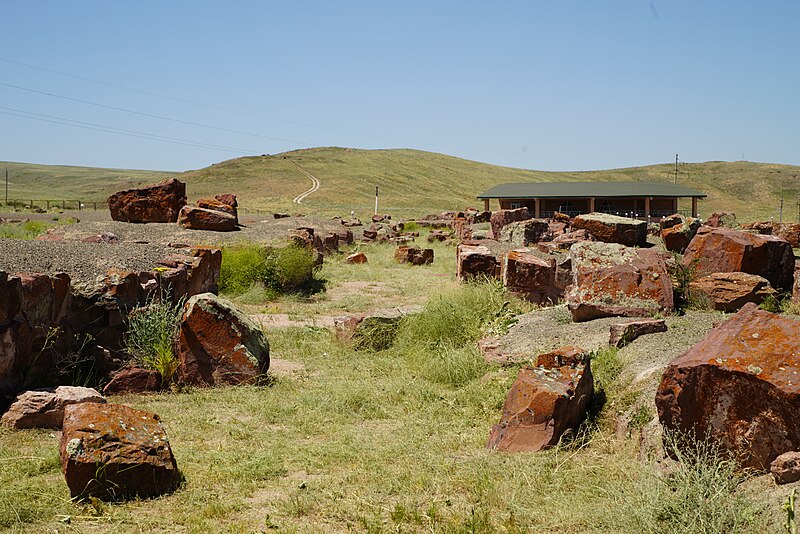
The extensive and astonishing architectural remains stretching directly beneath your feet form the foundational floor of a legendary early medieval red sandstone palace complex that covers an unprecedented footprint measuring two hundred five meters by one hundred eighty-five meters, resting upon cyclopean foundations buried three and a half to four meters deep into the solid earth. …
03 Remains of the Early Islamic Mosque
The low stone foundations visible directly before you represent the precious structural remains of what archaeologists have officially confirmed to be one of the very earliest documented Islamic mosques discovered anywhere within the vast modern territory of Kazakhstan. Please direct your eyes toward the open rectangular foundation layout stretching out gracefully to your left, following the clean line of neatly aligned stone base slabs with your gaze. …
04 The Red Sandstone Quarry
The sheer volume of physical human labor and the immense concentration of state wealth required to carve thousands of tons of cyclopean red sandstone blocks directly out of the hard earth in the middle of these dry desert steppes remain utterly staggering for modern visitors to comprehend. Please direct your gaze toward the exposed natural rock face standing directly ahead of you, where rough chisel cuts and partially carved block outlines still remain physically embedded within the natural…
05 The Mountain Water Supply System
Despite being situated in the middle of a dry desert landscape where water was an extraordinarily precious and scarce commodity, Akyrtas engineered a remarkably sophisticated long-distance water supply pipeline that drew fresh mountain spring water from natural sources located twelve kilometers away deep within the Kyrgyz Alatau Mountains. …
06 The Thirteenth-Century Roadside Caravanserai
Centuries after the monumental eighth-century red sandstone palace had been left unfinished and abandoned in quiet isolation, a vibrant new community emerged upon these very grounds during the thirteenth century in the form of a bustling roadside caravanserai settlement. Please direct your eyes across the low stone wall foundations stretching outside the main palace perimeter, observing the organized clusters of rectangular rooms that mark the living quarters of this medieval trade stop. …
07 Closing
Our journey through the mysterious and monumental realm of the Akyrtas Architectural and Archaeological Complex now comes to a memorable close. Together, we have traversed a unique historical landscape filled with incredible stone masonry, ambitious engineering, and unsolved historical enigmas. We stood before the massive foundations of the grand red sandstone palace, whose microchip-like geometry and Egyptian-level stone polishing recall the ambitious vision of eighth-century rulers. …