 Photo Wikimedia Commons
Contents
History & cultureBY TELLBY7 sections · numbered as on the map01 Orientation
Welcome to the Buddhistic Cloister of Ajina-Tepa, an extraordinary archaeological sanctuary nestled within the fertile and sunlit Vakhsh Valley of southern Tajikistan. Situated approximately twelve kilometers east of the modern city of Bokhtar, this landmark occupies a prominent natural elevation that once overlooked the bustling trade networks and caravan routes of the ancient Silk Road. As an integral part of the Cultural Heritage Sites of Ancient Khuttal, Ajina-Tepa has been recognized for its outstanding universal value and inscribed as a prestigious UNESCO World Heritage site. During the seventh and eighth centuries, Tokharistan experienced a monumental cultural and religious renaissance under the political protection and generous patronage of the Western Turks. Across this vibrant region, Buddhist monasteries flourished as vital centers of spiritual sanctuary, intellectual scholarship, and artistic creation. Monasteries like Ajina-Tepa were not merely secluded retreats for resident monastics, but dynamic crossroads where monks, international merchants, traveling scholars, and diplomatic envoys gathered to rest, share knowledge, and engage in sacred rituals. When you examine the overall architectural footprint of this sanctuary, you are looking at a masterwork of ancient Central Asian earth building engineering. The entire complex is planned as a grand rectangle measuring exactly one hundred meters in length by fifty meters in width. This expansive layout is systematically divided into two nearly identical square quadrangles linked together by a broad connecting corridor. The western quadrangle functioned as the monastic living quarters, featuring a peaceful inner courtyard surrounded by vaulted individual living cells, communal meeting spaces, and administrative chambers. The northern quadrangle was dedicated exclusively to the sacred temple precinct, centered upon a colossal terraced stupa and bordered by long gallery halls lined with painted clay sculptures and vivid frescoes. The massive perimeter walls, constructed from compacted mud known as pakhsa and dried adobe bricks, range between two point two and two point two meters to two point four meters in thickness. These heavy clay walls provided remarkable structural durability and natural thermal insulation, allowing the sanctuary to endure for over thirteen centuries against the harsh weather and shifting sands of time. Today, these ancient mud ruins offer an unparalleled window into the spiritual life and artistic brilliance of Silk Road civilization. As we begin our audio guide tour, we will enter through the historic eastern gateway, explore the tranquil residential cells, walk through the grand assembly hall, circumambulate the terraced base of the Great Stupa, and stand in awe before the legendary pedestal of the monumental reclining Buddha in Parinirvana. Please take a moment to absorb the profound atmosphere of this sacred landscape, and let us begin our journey together into the golden age of Central Asian Buddhism.
02 Section 1
You are standing at the eastern gateway of the Buddhistic Cloister of Ajina-Tepa, the primary historic entrance where ancient pilgrims first crossed the threshold into this sacred sanctuary. To begin our detailed exploration of this spot, consider the surprising origin of the site name itself, which translates directly as Demon Mound or the Hill of Evil Spirits. For many centuries, the ancient Buddhist name of this complex was entirely lost to history. …
03 Section 2
Stepping out of the protective crank corridor, you now stand inside the expansive western quadrangle, which functioned as the primary residential and administrative heart for the monastics of Ajina-Tepa. Begin your interpretation here by reflecting on a remarkable architectural fact: monks residing in this remote Central Asian valley dwelt within a perfectly symmetrical four-iwan courtyard layout built entirely of raw earth and sun-dried mud bricks. …
04 Section 3
Welcome into the Monastic Assembly Hall, the expansive rectangular chamber where the resident Buddhist monastics gathered for communal governance, formal religious lectures, and administrative council meetings. Consider first a surprising truth about this chamber: despite its current muted earth tones, hundreds of vibrant wall painting fragments and exquisitely sculpted clay statues once lined the walls, depicting secular donors dressed in luxurious caftans. …
05 Section 4
Passing through the wide passage, you have entered the northern temple quadrangle, the sacred spiritual heart of the Ajina-Tepa complex. Begin your focus here by contemplating an astonishing architectural fact: the Central Great Stupa positioned in the middle of this courtyard spanned twenty-eight meters at its maximum base foundation and was built in a complex terraced cross-star plan. …
06 Section 5
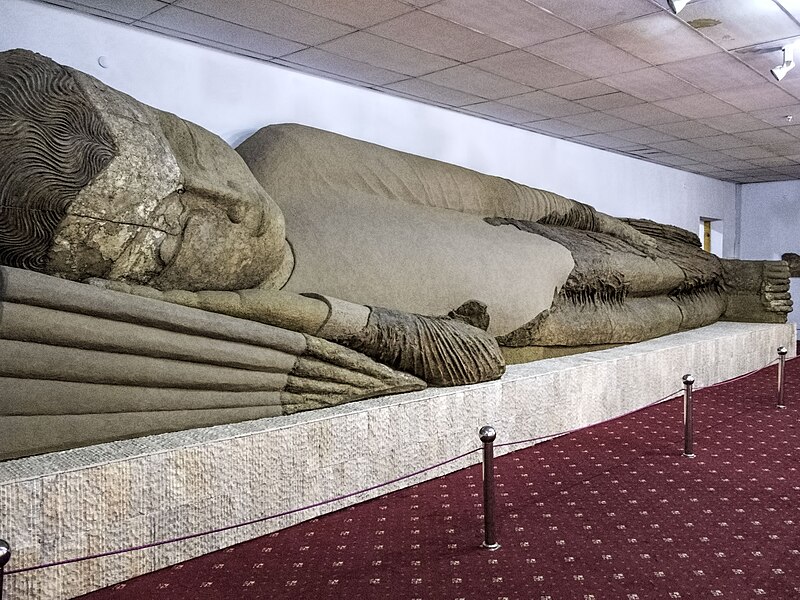
You have entered the eastern temple corridor, the setting of the most astounding artistic treasure ever unearthed at Ajina-Tepa. Open your interpretation here by reflecting on an extraordinary archaeological fact: this narrow hallway contained a monumental thirteen-meter-long clay sculpture of the Buddha entering Parinirvana, the largest Parinirvana Buddha statue ever discovered in Central Asia. …
07 Closing
As we complete our comprehensive tour of the Buddhistic Cloister of Ajina-Tepa, please step up to the elevated overview viewpoint to take in a final sweeping view of this historic sanctuary. Today, as you have witnessed throughout our journey, Ajina-Tepa stands as far more than a collection of ancient mud brick walls. …