 Photo Wikimedia Commons
Contents
History & cultureBY TELLBY7 sections · numbered as on the map01 Orientation
Welcome to the Fort Jesus Museum, positioned dramatically on a prominent rocky knoll on the northeastern shore of Mombasa Island in Kenya. As your dedicated audio guide, I am honored to lead you through this extraordinary World Heritage site overlooking the scenic Tudor Channel. As you step beyond the massive coral rag walls into the central grounds, you will experience an authentic atmosphere shaped by centuries of intense interaction between Swahili African, European, Arab, and Asian civilizations.
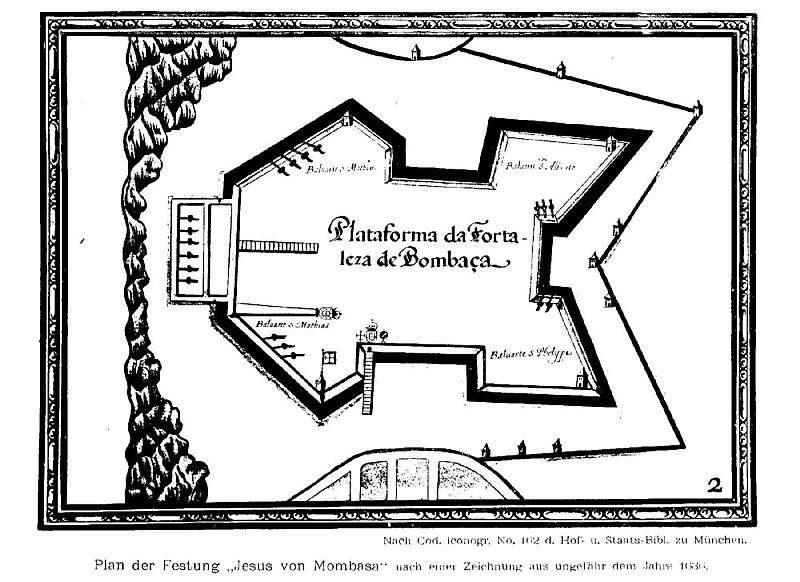
Constructed during the late sixteenth century by the Portuguese Crown, Fort Jesus was designed as a formidable bastion to enforce a strategic monopoly over lucrative Indian Ocean trade routes. Beyond its obvious strength as a defensive garrison, the fort stands as an unsurpassed masterpiece of Renaissance military theory, engineered according to the harmonious proportions of the human body. High Renaissance architects believed that human anatomical symmetry reflected cosmic order and functional perfection, a philosophical concept brilliantly translated into stone by Italian master designer Giovanni Battista Cairati. The pioneering star-shaped bastion geometry and coordinated crossfire layout established here subsequently served as an architectural blueprint for major fortresses across the globe, including Elmina Castle in Ghana and the Fortress of Saint Sebastian in Mozambique.
Because of its unparalleled command over East African maritime trade, Fort Jesus became the central prize in a succession of fierce geopolitical conflicts spanning four centuries. Portuguese garrisons, Ottoman Turkish forces, Omani Arab sultans, British colonial administrators, and indigenous Swahili rulers all fought relentlessly for control of this citadel. The physical scars remaining on these bulwarks bear silent witness to how disparate empires clashed, negotiated, and ultimately coexisted on this coast.
Our comprehensive audio itinerary will guide you through the fortress. We will examine the rock-cut dry moat and main gatehouse, investigate the underground rainwater cistern that sustained defenders during prolonged sieges, explore the seaward gun platform facing the ocean, admire the Omani House built above ancient foundations, and inspect the shaded arched passages preserved with historic soldier graffiti. Please take your time to immerse yourself in this timeless monument of global history.
02 The Dry Moat and the Main Gate
The extraordinary dry moat stretching before you at the landward entrance is not a natural ravine nor a water filled trench, but a monumental defense channel carved directly into solid fossilized coral bedrock by human hands. Reaching a uniform depth of five meters and a width of five meters, this artificial vertical chasm created an almost insurmountable obstacle for any invading army attempting a landward assault against the fortress walls. …
03 Central Courtyard and Portuguese Cistern
Standing in the broad open expanse of this central courtyard, you are positioned directly above the hidden engineering marvel that enabled defenders to endure the devastating thirty-three month siege maintained by Omani Arab forces between 1696 and 1698. When all external maritime supply routes and freshwater access were severed, the ultimate lifeline that preserved human life within these walls was the subterranean rainwater cistern dug deep into the bedrock beneath this courtyard. …
04 Seaward Projection and Historical Cannons
Among the historic artillery pieces lined up along this seaward platform overlooking the Indian Ocean, there is a legendary class of naval weapons. These are the short-barreled Scottish cannons known as carronades, invented in 1759 by the Carron Works foundry and widely nicknamed smashers due to their devastating short-range firepower. …
05 Omani House and Remains of Captain's House
The Omani House presents a fascinating architectural synthesis, constructed directly atop the northwest corner foundations of the destroyed Portuguese Captain's House by Omani governors who introduced their own courtly living style. It stands as a striking physical record of cultural overlay, where refined Arab artistic traditions were seamlessly grafted onto the rugged coral masonry of a European fortress. …
06 Passage of the Arches and Soldier Graffiti
Stepping into the shaded quiet of the Passage of the Arches, you come face to face with personal expressions of loneliness, faith, and identity left behind by anonymous Portuguese garrison soldiers over four centuries ago. Stationed far from home amidst unfamiliar tropical diseases and constant military threats, these forgotten guards etched drawings into the lime plaster walls, creating a poignant historic diary preserved in stone. …
07 Closing
Thank you very much for joining us on this audio journey through the historic precincts of the Fort Jesus Museum. The impressive coral fortress you experienced today is far more than a monument to past conflicts and military conquest. It stands as a profound symbol of shared human heritage, reflecting centuries of interaction, trade, and cultural exchange between Swahili African, Arab, European, and Asian civilizations. …