 Photo Wikimedia Commons
Contents
History & cultureBY TELLBY8 sections · numbered as on the map01 Orientation
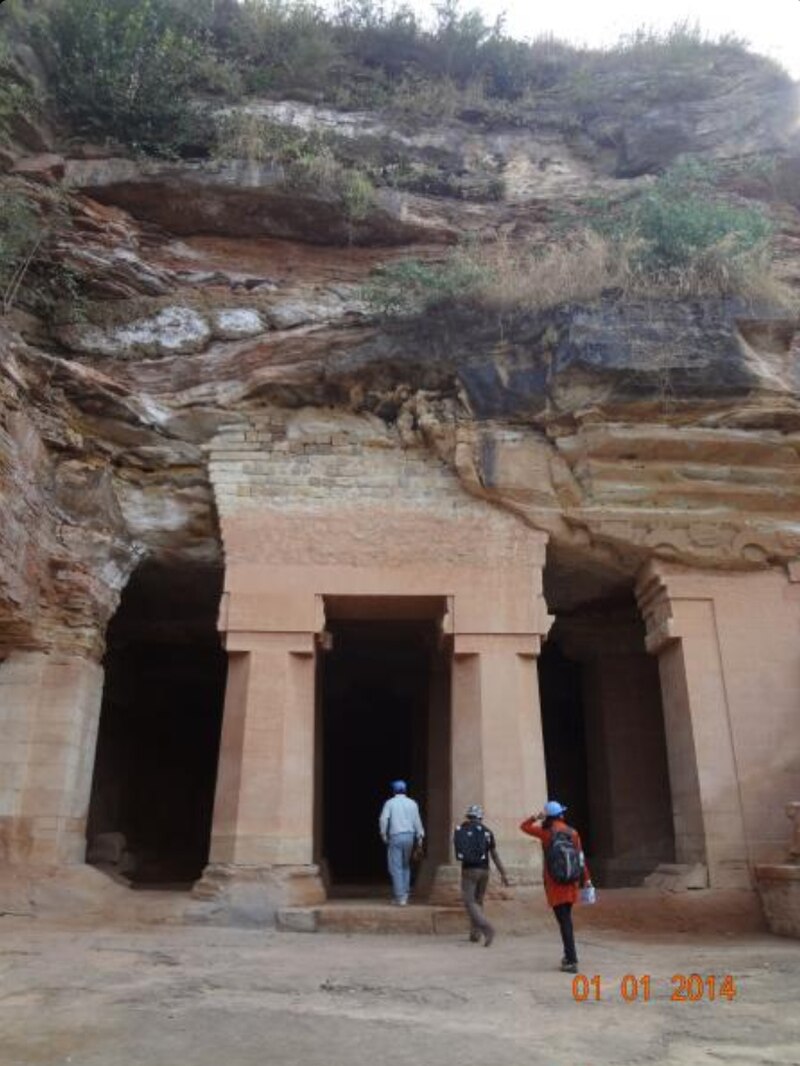
Welcome to the historic Bagh Caves, located in the Dhar district of Madhya Pradesh in central India. Situated at a distance of ninety-seven kilometers from Dhar town, this remarkable rock-cut complex is geographically positioned along the strategic trade and cultural corridors between the major cities of Indore and Vadodara. The complex is set dramatically among the southern slopes of the majestic Vindhya Range, standing directly above the seasonal stream known as the Baghani River. The natural landscape provided an ideal, tranquil, and secluded environment for the Buddhist monks who once resided, meditated, and engaged in deep intellectual discourse here during the golden era of Indian history. The entire site consists of a group of nine rock-cut monuments excavated directly into the perpendicular sandstone cliff faces of the hill. Today, these caves stand as an exceptional testament to the artistic brilliance, structural engineering, and spiritual devotion of ancient India. The name by which we recognize these caves today carries a fascinating historical origin. Following the gradual decline of Buddhism across central India around the tenth century AD, human memory of this grand monastic complex slowly faded away. As the resident monks eventually abandoned the sanctuary, the hollowed-stone chambers fell into complete silence and were reclaimed by the surrounding wilderness. Wild tigers inhabiting the dense forests of the Vindhya Range moved into the deserted stone halls to establish their dens. Consequently, local villagers began referring to these rock-cut caverns as the Bagh Caves, deriving the title directly from the Hindi word for tiger. Over time, the nearby rural settlement was named Bagh village, and the seasonal stream flowing gently beneath the sandstone cliffs was designated as the Baghani River. After centuries of quiet obscurity and wildlife habitation, this immense heritage site was brought back to global awareness in eighteen eighteen by an observer named Dangerfield. His published reports initiated modern historical recognition of the complex, prompting detailed investigations by archaeologists and scholars of Indian heritage. Scientific studies confirmed that these rock-cut structures were quarried between the late fourth century and the sixth to seventh centuries AD. This timeframe corresponds directly to the rule of the illustrious Gupta dynasty, an era universally recognized as the golden age of Indian art, architecture, literature, and philosophy. Under the imperial stability and cultural encouragement of the Gupta period, master masons carved these extensive monuments out of raw sandstone rock faces, transforming rugged wilderness cliffs into highly functional monastic retreats. As you begin your exploration today, take a moment to absorb the profound historical atmosphere of this ancient sanctuary set against the Vindhya Range and the Baghani Riverbank.
02 Section 1
As you stroll along the tranquil banks of the seasonal Baghani River, take a moment to observe the dramatic rock-cut cliff face rising across the water. Here, along the southern slopes of the Vindhya Range, master craftsmen of ancient India quarried a series of nine rock-cut monuments directly out of the perpendicular sandstone hill. When approaching these monuments, it is essential to understand the defining structural nature of Indian rock-cut architecture. …
03 Section 2
Step inside Cave 2, widely recognized as the best-preserved monastery among all surviving structures at the Bagh site. Known locally as the Pandava Cave, this monastery provides an extraordinary opportunity to inspect the complete architectural layout of a classical Indian Buddhist vihara. As you cross the threshold into the main chamber, observe the sophisticated quadrangular courtyard plan. …
04 Section 3
Guide your steps into the interior of Cave 3, another remarkable monastic space that offers profound insight into the daily routine and living conditions of medieval Buddhist monks. Like the adjacent monasteries, Cave 3 was crafted following a quadrangular vihara layout, featuring a spacious central court enclosed by individual monk cells. …
05 Section 4
Direct your attention to Cave 4, undeniably the most magnificent and historically significant surviving structure in the entire Bagh Caves complex. Popularly known as Rang Mahal, which translates evocative to the Palace of Colors, this cave earned its title due to the spectacular array of multicolored murals that once fully adorned its grand outer portico and expansive interior chambers. …
06 Section 5
As we continue our exploration along the cliffside path, walk toward the area housing Cave 5 and Cave 7. When surveying the site today, it is important to remember that of the original nine rock-cut monuments quarried into this hill, only five have survived the relentless forces of time, erosion, and natural rock collapse. …
07 Section 6
Now, step out into the main courtyard area, which offers a dramatic panoramic view looking back across the entire cliffside complex of the Bagh Caves. From this elevated vantage point along the hill slope, you can admire the impressive row of monolithic cave facades lined with rock-cut pillars, open porticos, and intricately sculpted entryways stretching along the sandstone rock face. …
08 Closing
As you walk along the exit path following the gentle flow of the Baghani River, our audio tour of the Bagh Caves comes to a conclusion. Nestled quietly along the southern slopes of the Vindhya Range in Madhya Pradesh, this exceptional rock-cut monastery complex stands as a timeless testament to ancient Indian artistic brilliance, religious devotion, and architectural mastery. …