 Photo Wikimedia Commons
Contents
History & cultureBY TELLBY8 sections · numbered as on the map01 Orientation
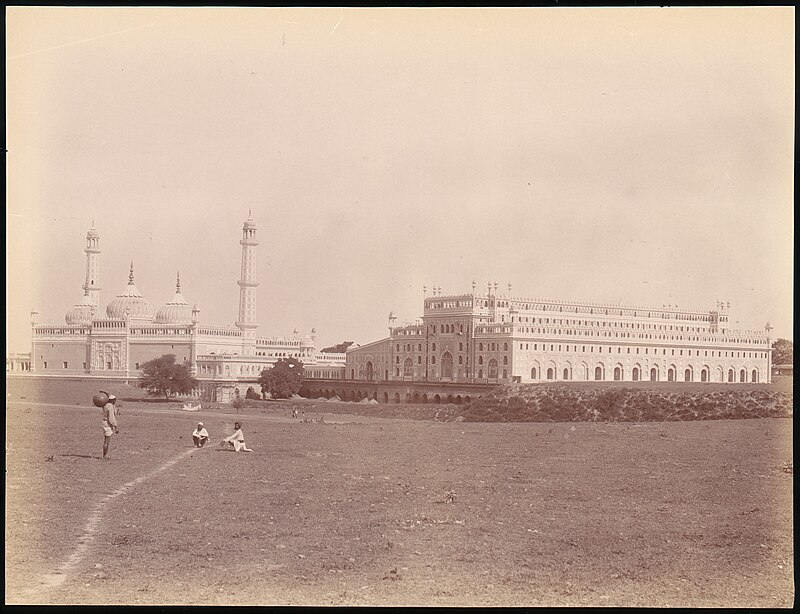
Welcome to the magnificent Bara Imambara, also widely known as the Asafi Imambara, located in Lucknow, Uttar Pradesh, India. As you stand near the entrance of this extraordinary complex, look around at the imposing masonry walls and high arched gateways that enclose this monumental sanctuary. You are stepping into one of the most remarkable Shia Islamic congregation halls and mosque complexes in the world. The birth of this monumental architectural ensemble is deeply intertwined with a period of severe regional crisis and an extraordinary act of royal compassion that redefined the identity of Awadh.
Let us travel back in time to the year seventeen eighty. During this period, a devastating drought and widespread famine swept across the region of Awadh. Crops failed completely, food supplies vanished, and thousands of ordinary families faced severe hardship and starvation. In response to this catastrophic crisis, Asaf-ud-Daula, the fourth Nawab of Awadh, made a historic and visionary decision. Rather than handing out short term handouts or temporary food relief, he initiated a massive public construction project designed to generate employment on an unprecedented scale. By commissioning the construction of the Bara Imambara, the Nawab provided honorable work and steady daily wages for thousands of laborers, artisans, stonemasons, and master architects. Historical records indicate that the construction costs ranged between half a million rupees and one million rupees, representing a massive financial undertaking that functioned as a early precursor to modern public works programs.
The generosity of the ruler during these tragic famine years touched the hearts of the population, inspiring a famous phrase that remains legendary across North India: He who does not receive from God, receives from Asaf-ud-Daula. Coupled with this history is a fascinating local belief. Popular legend tells that while ordinary laborers worked tirelessly during the day to raise the heavy brick structures, noblemen and members of the elite class would assemble under the cover of night to quietly dismantle sections of the rising walls. This intentional cycle was said to deliberately prolong the construction timeline, ensuring that public employment and steady income continued for as long as the famine persisted.
When the complex was finally completed in the year seventeen eighty-four, the Nawab continued to spend between four hundred thousand and five hundred thousand rupees annually on its decoration. The site served as an active Imambara, a sacred congregation hall where Shia Muslims gather for solemn ceremonies during Muharram to commemorate the martyrdom of Hussein-ibn-Ali, the grandson of the Prophet Muhammad. Administered today as a Monument of National Importance by the Archaeological Survey of India, the Bara Imambara stands as a living testament to human compassion and architectural grandeur. Please take a deep breath, adjust your audio device, and let us walk forward through the entrance gates to begin our exploration.
02 Rumi Darwaza: The Grand Gateway
As you look toward the western outer boundary of the complex or take a few steps along the western avenue, your eyes will immediately meet one of the most magnificent visual spectacles in all of Northern India: the legendary Rumi Darwaza. Standing dramatically at an astonishing height of eighteen meters, equivalent to fifty-nine feet, this soaring portal was commissioned under the vision of Nawab Asaf-ud-Daula during the monumental construction period of seventeen eighty-four. …
03 The Outer Gateways and Courtyard
Stepping through the first monumental fortification portal, you now find yourself inside the expansive outer courtyard of the Bara Imambara, connected by two sequential stone gateways that lead toward the primary hall. As you walk forward into this vast open courtyard, notice how the intense urban energy, bustling traffic, and loud street noises of modern Lucknow city gradually fade away behind the heavy masonry walls. …
04 Shahi Baoli: The Royal Stepwell
Let us now guide your steps toward the eastern wing of the inner courtyard, where we encounter one of the most intriguing subterranean structures in the entire complex: the Shahi Baoli, or Royal Stepwell. This extraordinary multi-tiered stepwell features a deep, steeply descending masonry architecture that was historically linked through underground hydrological channels to the nearby Gomti River, functioning as the vital freshwater reservoir for the entire Imambara complex. …
05 The Great Hall and Sacred Tombs
Leaving the stepwell, please step through the grand entrance doorway into the solemn interior of the primary building. You are now standing inside the greatest architectural highlight of the Bara Imambara and one of the most astonishing structures in world heritage: the Central Vaulted Hall. Measuring an impressive fifty meters in length, sixteen meters in width, and soaring over fifteen meters in height, this colossal chamber represents one of the largest arched vaulted halls in the world…
06 Bhool Bhulaiya: The Labyrinth
Ascending the narrow stone stairways leading from the main hall, you now step into the most famous, mysterious, and celebrated feature of the complex: the legendary Bhool Bhulaiya. The Hindi phrase Bhool Bhulaiya translates to a disorienting place where one forgets paths and loses all sense of direction. …
07 Asfi Mosque: The Spiritual Anchor
Emerging from the narrow passages of the Bhool Bhulaiya out onto the elevated upper courtyard, you are greeted by the luminous and serene presence of the Asfi Mosque. Situated upon the high terrace of the Bara Imambara complex, this sacred place of worship was constructed by Nawab Asaf-ud-Daula simultaneously with the main Imambara hall. …
08 Closing
Having navigated the monumental gateways, the awe-inspiring pillarless central hall, and the disorienting passages of the Bhool Bhulaiya, you have now arrived at the breathtaking upper terrace lookout. Stepping out onto the stone edge of this high terrace, you are rewarded with a magnificent panoramic vista of Lucknow. …
