 Photo Wikimedia Commons
Contents
History & cultureBY TELLBY8 sections · numbered as on the map01 Orientation
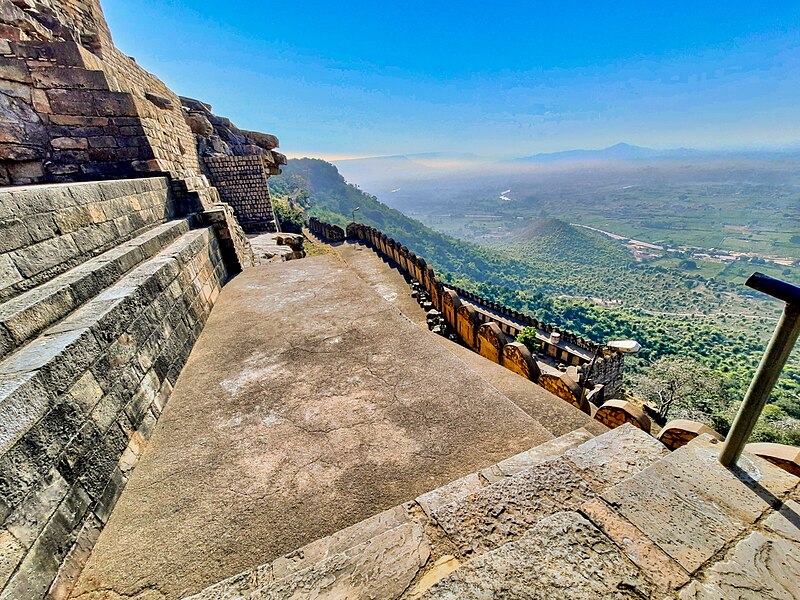
Welcome to Kalinjar Fort, one of the most magnificent and historically significant hill fortresses in India, located in the Banda district of Uttar Pradesh. As you stand at this extraordinary destination, you are observing a brilliant architectural marvel perched high upon an isolated flat topped hill within the famous Vindhya range. Rising approximately two hundred and forty four meters above the surrounding plain, this natural fortress is situated near the village of Tarahti under the Naraini Tahsil, roughly fifty six kilometers south of the city of Banda. Positioned precisely at the geographic interface between the states of Uttar Pradesh and Madhya Pradesh, Kalinjar Fort has historically served as a formidable barrier against ambitious conquerors seeking to expand their dominions toward the southern territories of the Indian subcontinent.
This sacred and historic hill is situated in the ancient land of Jejakbhukti, which forms an integral core of Bundelkhand. Long before its massive stone ramparts were erected, this plateau was revered as a holy sanctuary for spiritual meditation and austere penance. Indeed, ancient Sanskrit texts including the sacred Vedas, the immortal epics of Mahabharata and Ramayana, as well as early Buddhist and Jain scriptures, explicitly mention Kalinjar as one of the most exalted sites of ascetic devotion, known as Tapasya Sthals. Scholars, sages, and pilgrims alike have recognized the deep spiritual resonance of this elevated plateau for thousands of years.
During the medieval era, Kalinjar developed into a masterwork of military fortification and strategic architecture, standing as a true gem of archaeology. Between the ninth and fifteenth centuries, the fort functioned as a vital stronghold for the rulers of the Chandela dynasty. It stands as one of the eight famous forts constructed by the Chandela kings during the end of the first millennium and the beginning of the second millennium. Throughout centuries of military conflict, the fort maintained a legendary reputation for ultimate invincibility. It was not until the year fifteen sixty nine that the Mughal Emperor Akbar successfully secured control of Kalinjar. Following his victory, Emperor Akbar bestowed this strategic fort upon Birbal, one of the celebrated nine jewels of his imperial court.
In the early eighteenth century, the heroic Bundela leader Chhatra Sah reasserted local authority over Kalinjar, earning official recognition from the Mughal Emperor Bahadur Shah between seventeen zero seven and seventeen twelve. Today, Kalinjar Fort stands as an irreplaceable gift of India to world heritage, perfectly combining ancient religious sanctity with unparalleled medieval military engineering. As you prepare to explore this massive complex, let us walk together through its timeless stone gates, royal palaces, sacred reservoirs, and rock cut shrines.
02 Northern Principal Entrance & Seven Gates
You are now standing near the northern principal entrance of Kalinjar Fort, which serves as the primary gateway leading into the fortress from the direction of the historic town of Tarahti below. The entire fortification features two main entry points, and this northern passage was engineered as the chief defensive approach for anyone ascending from the urban settlement. …
03 Raja Mahal: The Royal Palace
We have now reached the central administrative and royal district of Kalinjar Fort, where the magnificent Raja Mahal, or the King's Palace, is located. Situated prominently within the interior plateau of the fortress, this palace served as the primary seat of governance and official residence for the Chandela monarchs and subsequent rulers who commanded this strategic stronghold. …
04 Rani Mahal: The Queen's Palace
Located in close proximity to Raja Mahal within the inner citadel is Rani Mahal, or the Queen's Palace. This magnificent structure was designed specifically as the private residential quarters for the royal women, including the queens, princesses, and female attendants of the Chandela court. While Raja Mahal functioned as the public, administrative, and strategic hub of the fortress, Rani Mahal was dedicated to privacy, domestic tranquility, and refined artistic elegance, offering a fascinating…
05 Sacred Water Bodies and Heritage Sites: Sita Sej, Patal Ganga, and Budha-Budhi Taal
As we move across the inner plateau of Kalinjar Fort, we encounter a cluster of fascinating historical and sacred water sites: Sita Sej, Patal Ganga, Pandu Kund, and Budha-Budhi Taal. In any hill fortress elevated hundreds of meters above the surrounding plains, securing a reliable and plentiful water supply was essential for long term survival during military warfare and prolonged sieges. …
06 Neelkanth Mahadev Temple
Situated dramatically on the western edge of Kalinjar Fort, overlooking the sheer vertical drops of the cliff, stands the world-famous Neelkanth Mahadev Temple. This extraordinary rock-cut temple is widely regarded as the spiritual heart of Kalinjar and one of the most magnificent artistic and architectural achievements of medieval India. …
07 South-East Panna Entrance & Vindhya Viewpoint
We have now moved to the south-east corner of Kalinjar Fort, home to the second major gateway of the complex, which leads directly toward the region of Panna in Madhya Pradesh. While the northern entrance served as the primary connection to the town of Tarahti below, this south-eastern passage provided a crucial strategic conduit toward the southern territories, emerald-rich hills, and forested interior routes of central India. …
08 Closing
As our audio guide tour comes to a conclusion, we return to our starting orientation point, carrying with us the profound memories and historical weight of Kalinjar Fort. We have journeyed together through millennia of extraordinary history, traversing a landscape where ancient spiritual devotion, royal splendor, and masterly military architecture converge in complete harmony. …